



Editor’s Note: This story is part of Beneath the Blue Ridge: The Virginia Olson Case, a special series from 828newsNOW revisiting the unsolved killing of Virginia Olson in Asheville. Through records, reporting and interviews, the series examines what happened and why the case remains unresolved. Read the full series here.
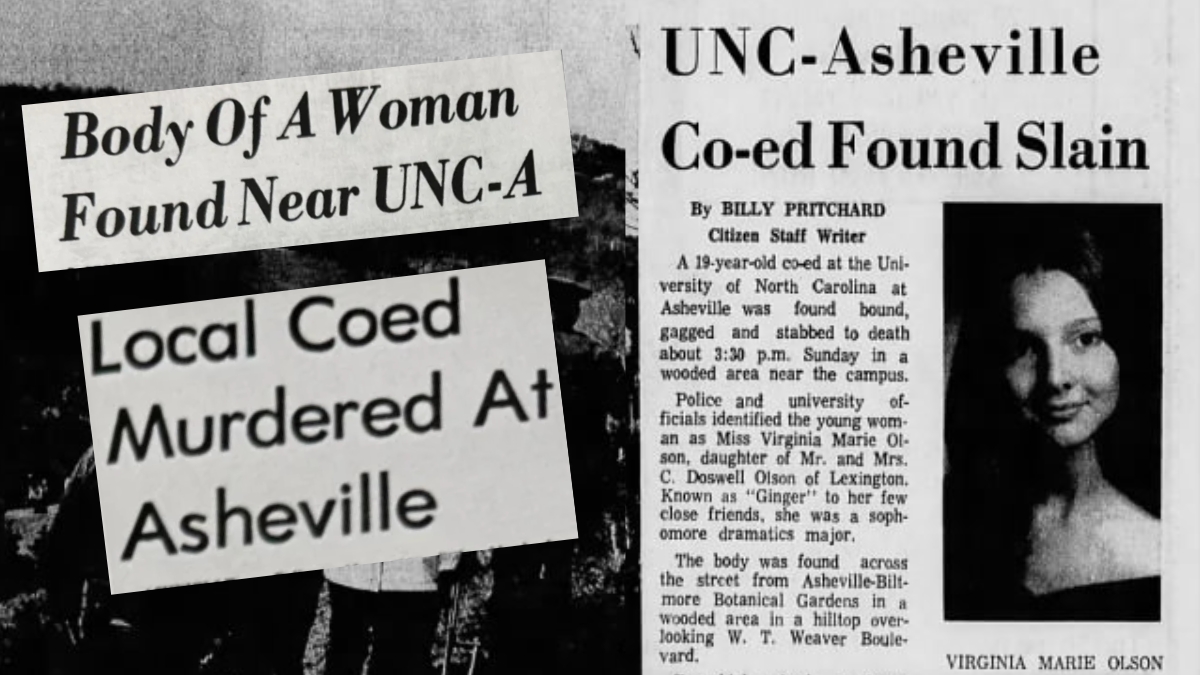
ASHEVILLE, N.C. (828newsNOW) — It was a clear and promising spring Sunday in Asheville on April 15, 1973 — the kind of day that invites students outdoors with their books and a blanket. For 19-year-old Virginia “Ginger” Olson, a drama major at the University of North Carolina Asheville, it seemed like the perfect time to study among the budding trees of the Botanical Gardens at Asheville. Little did she know it would be her last — her last spring day, her last study session, her last everything.
The Virginia Olson Case: Timeline
- April 15, 1973 — Olson leaves her dorm, her body is found just over two hours later.
Around 1 p.m., 19-year-old Virginia “Ginger” Olson leaves Craig Hall at UNC Asheville to study near the Botanical Gardens. Around 3:30 p.m., two teenagers discover Olson’s body and alert authorities. - April 1973 — Investigation begins
Asheville police collect evidence, interview witnesses and canvas the area. The case quickly becomes a priority. - 1974–1984 — Follow-up investigations
Detectives pursue multiple leads and question several suspects, but no charges are filed. - 2000s — Case revisited
The case is entered into the Buncombe County Cold Case Unit. Investigators reexamine evidence and interview new potential witnesses.
A promising student, a peaceful afternoon — and a brutal crime
Olson, described by classmates as quiet and introspective, left her dorm, Craig Hall, about 1 p.m. that afternoon. The morning had been chilly, but by midday, the sun had warmed the air to the 50s. Wearing jeans, a green T-shirt and a red-and-blue flannel shirt, Olson carried her homework to a hilltop spot overlooking the gardens and UNCA campus.
She set out her books and glasses — a familiar ritual for the shy, studious teenager. But sometime between then and midafternoon, someone else climbed that hill.
About 3:30 p.m., two local teenagers — Thomas Guthrie, 14, and Larry O’Kelly, 17 — stumbled across a horrific scene. Olson’s body lay partially concealed beneath her flannel shirt. Her T-shirt had been torn and used to bind her hands and feet. Stabbed in the chest, with her throat cut, she was also sexually assaulted.
A campus haunted by loss
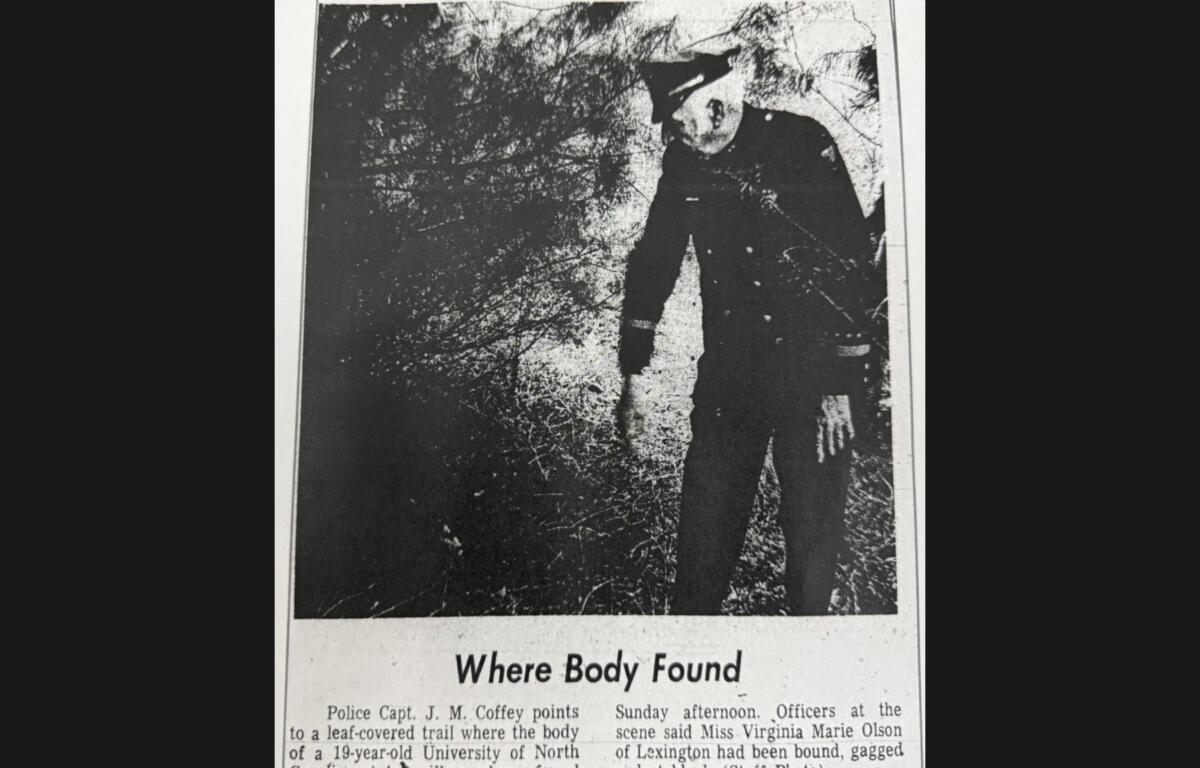
The news shocked the Asheville community and the UNCA campus, which had never experienced a killing before. Students and faculty mourned the young woman who had seemed more destined for a life on stage than for a page in a police report.
More than five decades later, memories of Olson still surface among people who were on campus that spring. In comments shared on 828newsNOW social media posts about the case, former students recalled the shock that spread across UNCA when news of her death broke. One woman said she knew Ginger through drama and remembered the entire school as traumatized. Another, who said Olson was in her Spanish class, recalled students crying after a professor stopped class to share the news.
Despite hundreds of interviews and multiple suspects, no one was ever charged. Early reports mentioned a 19-year-old man questioned by police and later a middle-aged suspect who lived nearby. Both were investigated, but neither case produced enough evidence to bring charges.
By that fall, Assistant Police Chief Joe Trulove told The Asheville Times, “That case won’t ever be closed.”
A scholarship, then silence
Students raised money for a memorial scholarship in Olson’s name — an effort to turn grief into legacy. The Ginger Olson Memorial Scholarship was awarded for the first time in 1976 but quietly disappeared from UNCA’s records decades later.
For years, the story surfaced sporadically in the local press — sometimes tied to advances in forensic technology, sometimes as one name on a growing list of unsolved killings.
In 1984, investigators tracked a suspect to Santa Fe, New Mexico, but again, no charges were filed. Ten years later, Olson’s name reappeared in a Citizen-Times story about Buncombe County’s cold cases. By 2009, hers was one of about two dozen unsolved homicides assigned to a pair of Asheville detectives.
As the decades have passed, investigators and cold case advocates have noted a growing challenge common to long-unsolved crimes: time. Potential witnesses age, memories fade and some individuals who may have held even small pieces of information are no longer alive to share them.
53 years later, the mystery endures
Half a century after the murder, Olson’s story continues to resonate in Asheville — especially among those who still walk the wooded paths of the botanical gardens.
The anniversary of her death approaches once again, marking not only another year without answers but also another reminder of how much time has slipped away. Each passing year narrows the circle of those who might recall something from that day in 1973, leaving investigators with fewer living voices to draw from as they continue to search for clarity in a case that has never been closed.
The story of Ginger Olson is one of loss, of questions left unanswered and of a campus that still remembers.
The campus where she studied is still shadowed by a tragedy that time has not erased.
This story is part of Beneath the Blue Ridge, an ongoing series revisiting the Virginia Olson case. Six parts, released over three weeks. Follow along as the story unfolds with new installments each Monday and Wednesday.
Do you have information about the Virginia Olson case?
We are actively reporting this story. If you have information we want to hear from you.
Tips on the 1973 killing of Virginia Olson can be submitted to the Asheville Police Department at 828-252-1110, by texting “TIP2APD” to 847411, or through Asheville-Buncombe Crime Stoppers at 828-255-5050. The N.C. State Bureau of Investigation Cold Case Team can be reached at 919-662-4500 or contactus@ncsbi.gov.
828newsNOW is an independent news organization and is not affiliated with law enforcement.