


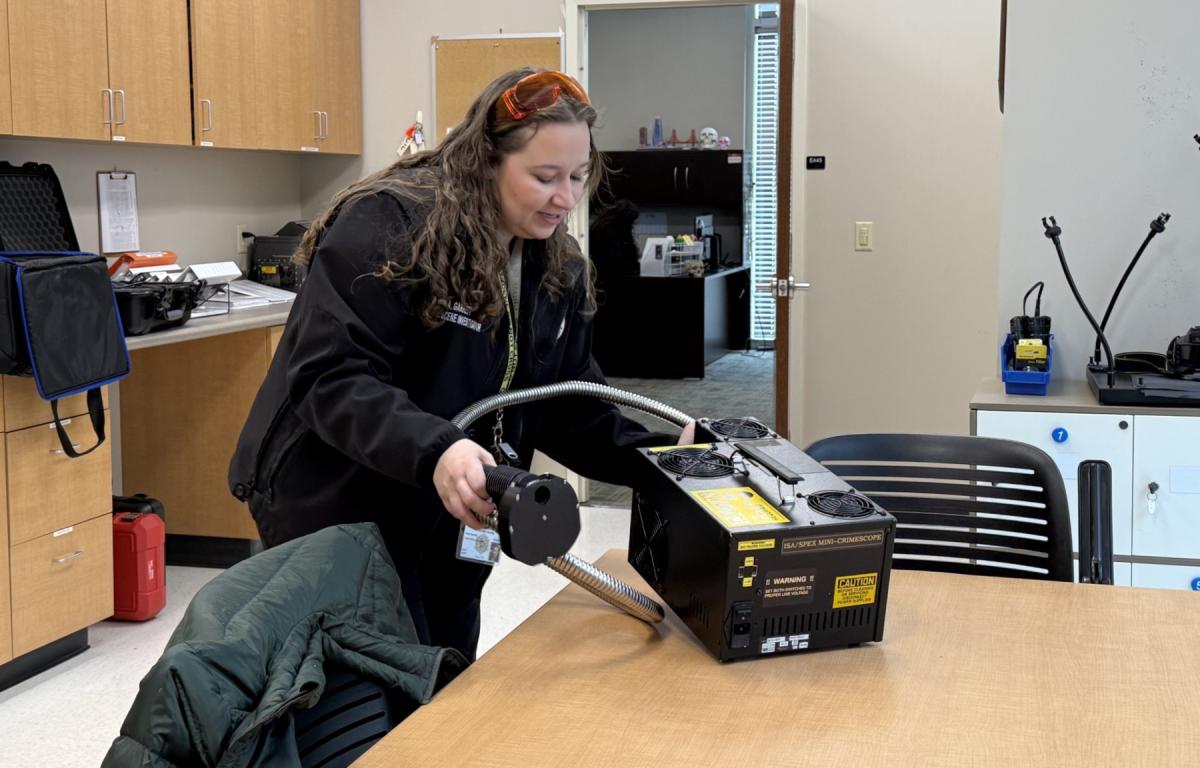

ASHEVILLE, N.C. (828newsNOW) — Behind a locked doorway inside the Buncombe County courthouse, crime scene investigator Anna Garrett walks through a lab where every item brought in from a death scene or major investigation is carefully preserved, dried, shielded from digital tampering or sealed for court.
“Anything we collect goes back here first,” Garrett said, gesturing toward the sheriff’s office crime scene lab and evidence room. “Before it ever goes to the property and evidence unit, it’s secured and processed.”
Wet or blood-stained items are placed inside a drying chamber to prevent mold. Cell phones are stored in a Faraday box to block outside signals and prevent remote access. Arson-related evidence, often soil soaked with accelerants, is refrigerated to slow biological breakdown.
Garrett, 29, has spent nearly four years as a crime scene investigator with the Buncombe County Sheriff’s Office. She said the job sits at the intersection of two lifelong interests.
“I’ve always been fascinated with forensic science, and I really love criminal justice,” she said. “This is where those two meet, and I feel very lucky to have this job.”


Garrett described the job as the place where expectations shaped by television quickly give way to reality.
“The ‘CSI effect’ is real,” she said. “TV makes it look like miracles happen in an hour. In real life, lab results take months, and evidence isn’t always recoverable.”
Garrett’s path to the job began at Asheville-Buncombe Technical Community College, followed by a bachelor’s degree in forensic biology from Western Carolina University and a master’s degree in forensic psychology from Walden University.
At Western Carolina, she was introduced to forensic anthropology research conducted at the university’s decomposition site, known informally as “the forest,” where scientists study how human remains break down under different conditions.
“That kind of research helps us in real cases,” Garrett said. “It tells us what evidence might still exist if a body is found outdoors or after a fire.”
But no amount of coursework, she said, fully prepares investigators for their first death scene.
“You don’t really know how you’re going to react,” Garrett said. “You know you’re going to see things, but you don’t know how it will affect you until you’re there. But after you’ve done it a few times, it becomes another day at the office.”
She now helps prepare interns for that reality, reminding them they can step away if a scene becomes overwhelming.
“For me, the hardest scenes are people my age,” Garrett said. “And anytime the family is present, that’s difficult.”


Crime scene investigators are not sworn law enforcement officers. They do not make arrests or carry firearms. Their role is documentation — photographing, collecting and preserving evidence that may later be scrutinized in court.
“Everything we do from the moment we arrive can be introduced in court,” Garrett said. “We’re not giving opinions. We’re testifying to what we did and what we collected.”
The Buncombe County CSI unit consists of four investigators and a supervisor. The team is entirely female — a reflection, Garrett said, of a field that tends to attract people more interested in analysis than enforcement.
“This field is very female-dominated,” she said. “A lot of men who want to go into investigations want to be sworn officers. We’re very much a behind-the-scenes unit. We don’t seek the spotlight.”
Technology has become an increasingly important part of that work. Investigators use high-resolution cameras, alternate light sources to detect biological evidence and 3D scanning equipment that allows jurors to virtually walk through crime scenes long after they’ve been cleared.
“Photos don’t always tell the whole story,” Garrett said, setting up a Matterport 360-degree camera. “This helps people visualize spaces.”
But not every scene labeled a “crime scene” involves a crime. Many calls turn out to be accidental deaths or medical emergencies, Garrett said.
“Sometimes it’s an accident, or nothing criminal happened at all,” Garrett said. “Our job is to document what’s there — not what we think happened.”
That objectivity, she said, is one of her favorite parts of the work.
“I like going in without bias and just documenting what I see,” she said. “Every scene is different. It’s never the same twice.”
For students interested in forensic work, she encourages experience over credentials.
“There’s no single path,” she said. “Different backgrounds make teams stronger. Get as much experience as you can — ride-alongs, internships, anything.”
Despite the emotional weight of the job, Garrett says she remains certain she chose the right career.
“I love that nothing is the same,” she said. “As difficult as it can be, it’s meaningful work.”
Outside the lab, Garrett spends most of her time reading and caring for her toddler at home in Madison County.
People at Work is a series that highlights individuals by exploring their stories, perspectives and experiences beyond their professional roles. If you know someone who would be a great fit for People at Work, please submit your recommendation by emailing us at news@828newsNOW.com.