




ASHEVILLE, N.C. (828newsNOW) — Mission Hospital’s planned expansion in Buncombe County is facing new scrutiny after competing health systems appealed a state decision to award the facility 95 additional acute care beds.
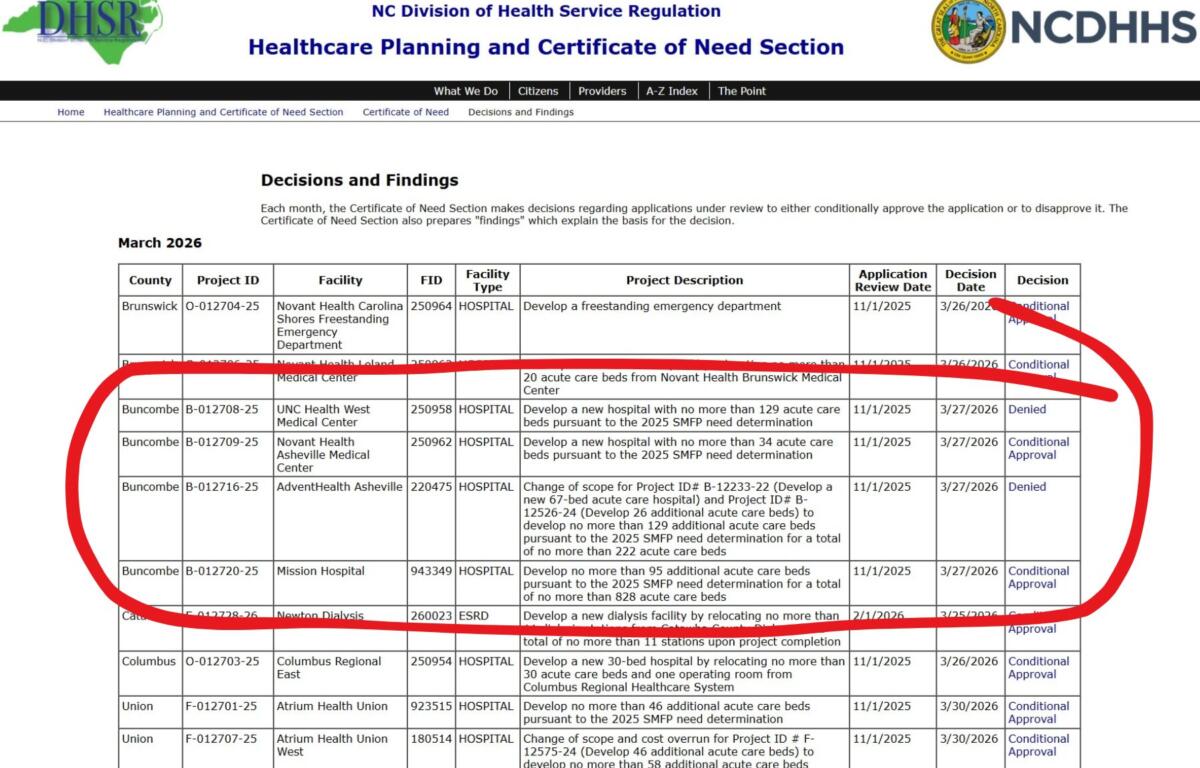
The North Carolina Department of Health and Human Services earlier this month approved a total of 129 new acute care beds through its 2025 Certificate of Need (CON) process. Mission Hospital, operated by HCA Healthcare, received 95 of those beds, while Novant Health was awarded 34 beds for a proposed community hospital in Arden serving southern Buncombe County.
Other applicants, including AdventHealth and UNC Health, were not awarded beds in this cycle.
AdventHealth had planned to incorporate additional beds into its new hospital project in Weaverville and has previously prevailed over HCA in two earlier CON applications. Now, the system says it is formally challenging the state’s decision.
“AdventHealth’s commitment to serving Western North Carolina remains unchanged, and we are grateful for the continued support of the communities we serve across Buncombe, Graham, Madison and Yancey counties,” spokesperson Victoria Dunkle said in a statement.
“Based on the recent health care access and quality concerns in our region, we do not believe the recent decision regarding the 129-bed application is in the best interest of our community and will have profound impacts,” Dunkle said. “After careful consideration, we have decided to appeal the State’s determination to ensure the region’s health care needs are fully considered.”
Dunkle added that construction on the first phase of AdventHealth’s Weaverville hospital is already underway and that expanding inpatient capacity remains a priority.
“Additional inpatient capacity remains critical to bringing advanced trauma and tertiary care closer to home,” she said. “We will continue to pursue additional beds to meet the needs of our communities.”
She also pointed to future opportunities, noting the 2026 State Medical Facilities Plan identifies a need for 92 additional acute care beds across the region, including Clay County. AdventHealth intends to apply for those beds as part of its long-term expansion strategy.
Mission Health spokesperson Nancy Lindell said the approval affirms the hospital’s role in the region.
“We are pleased that the North Carolina Department of Health and Human Services Division of Health Service Regulation approved Mission Hospital to add 95 inpatient beds to its Asheville campus, affirming the essential and critical care we continue to provide to Western North Carolina,” Lindell said. “We look forward to alleviating bed capacity constraints so that patients can get the high-quality, advanced care services only Mission can provide.”
The decision has also drawn criticism from Reclaim Healthcare WNC, a coalition of physicians, nurses, elected officials, clergy, attorneys, business leaders and community members advocating for Mission staff and increased accountability from HCA Healthcare.
In a message to supporters, Campaign Director Aaron Sarver said the group was “genuinely floored” by the decision, pointing to Mission Hospital’s recent regulatory history, including multiple Immediate Jeopardy citations and ongoing enforcement actions.
“Like many of you, we assumed that given the Immediate Jeopardy sanctions and the ongoing patient care problems at Mission, that they had zero chance of being awarded more beds,” Sarver wrote.
Appeals filed, state declines comment
At least one competing system, AdventHealth, has filed an appeal of the decision. The North Carolina DHHS declined to comment on the matter, citing ongoing litigation.
“The Agency is unable to comment on this matter as it has been appealed to the Office of Administrative Hearings and is actively in litigation,” the department said in a statement to 828newsNOW.
Why the state approved Mission’s expansion
In its competitive review findings, DHHS indicated that Mission’s proposal best met CON criteria compared to competing applications, emphasizing capacity, efficiency and regional need.
Mission’s existing infrastructure was a key factor. As the largest hospital in Western North Carolina, the facility can add beds more quickly and with less new construction than competitors proposing new hospitals.
The state also pointed to Mission’s role as the region’s primary tertiary care center, handling complex cases and receiving patient transfers from smaller hospitals. Expanding capacity there was viewed as strengthening the broader regional system.
Cost and efficiency also weighed in the decision. Regulators found Mission’s proposal to be more cost-effective per bed and better positioned to scale quickly.
Additionally, utilization data showed high occupancy rates at Mission, suggesting current capacity is strained and supporting the need for expansion.
Safety concerns raised but not disqualifying
The decision has sparked debate over how patient care concerns factor into the CON process.
Mission Hospital has faced federal scrutiny in recent years, including Immediate Jeopardy citations tied to patient care. In its CON application, HCA acknowledged at least one such citation that had not yet been formally resolved at the time, though corrective actions had been taken.
DHHS addressed those concerns in its findings, stating that HCA provided “sufficient evidence” of quality care across its six North Carolina facilities. The review did not further emphasize Mission’s past regulatory issues.
The state’s approach reflects a broader distinction in how decisions are made: the CON process focuses primarily on capacity and access to care, while quality and safety oversight are handled through separate regulatory channels.
Conditions and next steps
The approval includes conditions, such as timelines for completing the expansion and ongoing compliance requirements. However, no major restrictions tied directly to past safety violations were cited as determining factors in the decision.
Reclaim Healthcare WNC is urging community members to contact state officials and push for changes to the CON process, including placing greater weight on quality-of-care history and enforcement actions.
Additional acute care beds are expected to be made available through another CON cycle later this year, setting the stage for continued competition — and continued debate — over how best to meet the region’s growing health care needs.