



ASHEVILLE, N.C. (828newsNOW) — Two years after Tropical Storm Helene tore through Western North Carolina, the numbers still struggle to convey the scale of what happened.
Nearly $60 billion in estimated damage and recovery needs. Thousands of damaged roads, bridges and homes. Nearly 19,000 jobs lost in a single month. Billions of dollars committed to rebuilding.
And the work is far from finished.
Here is a look at Helene’s devastation — and Western North Carolina’s recovery — by the numbers.
$59.6 billion
North Carolina’s estimated total damage and recovery needs from Helene.
The state’s assessment included about $44.4 billion in direct damage, $9.4 billion in indirect and induced losses and another $5.8 billion for strengthening infrastructure and making communities more resilient to future disasters.
13.98 inches
Rain recorded at Asheville Regional Airport during the roughly three-day period surrounding Helene.
About 10 inches fell Sept. 25-26, 2024, ahead of Helene, saturating the ground and swelling rivers. Helene’s bands dumped roughly another 4 inches Sept. 27.
Some mountain locations received far more. Rainfall totals reached 14 to 20 inches along parts of the Blue Ridge escarpment, with isolated totals topping 24 inches.
More than 100
Lives lost in North Carolina during Helene.
The storm’s flooding, landslides and other impacts made it one of the deadliest natural disasters in state history.
13,090
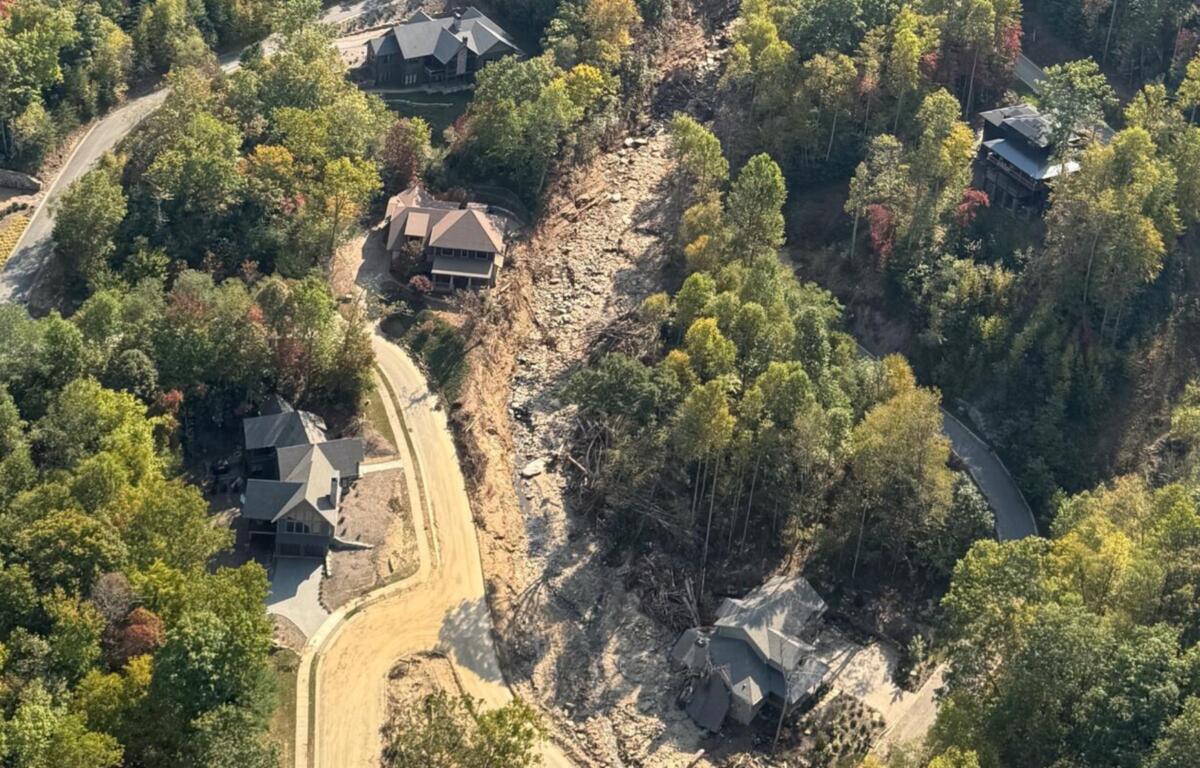
Landslides mapped by the N.C. Geological Survey.
The state plans to use the mapping to help develop a landslide early-warning system. The General Assembly also allocated another $1 million this year to continue mapping landslides that threaten critical infrastructure.
Nearly 9,500
Helene-damaged sites identified along North Carolina’s state-maintained transportation system.
The damage affected thousands of miles of roads and 869 bridges across Western North Carolina.
By March 2026, NCDOT said 87% of those damaged sites had been repaired.
About 99%
State-maintained roads damaged by Helene that have reopened.
But open does not necessarily mean permanently repaired.
Some roads continue to operate with temporary repairs or traffic configurations while permanent reconstruction moves forward. Some of the region’s largest transportation projects are expected to take years to finish.
About $10 billion
Estimated damage and recovery needs for public and private transportation infrastructure.
The state’s assessment puts the total at about $10.3 billion when damage, losses and strengthening and mitigation needs are included.
The N.C. State Auditor’s Helene recovery dashboard shows about $2.2 billion spent on transportation out of a roughly $7.9 billion budget.
About 7,000
Private roads, bridges and culverts severely damaged by Helene, according to a state recovery assessment.
Repairs to private infrastructure have moved more slowly than those on the state-maintained highway system.
As of June 2026, about 3,000 approved projects remained in the queue for North Carolina’s Private Road and Bridge Program. About 120 sites had been completed and another 143 were in progress, according to the Governor’s Recovery Office for Western North Carolina.
About $380 million
Estimated cost of projects in the state’s private road and bridge recovery program, according to GROW NC.
That’s considerably more than the program’s authorized budget of $175 million, which includes $25 million for partial reimbursements.
The program is no longer accepting applications. GROW NC Director Matt Calabria has said the state will try to connect people who were unable to apply with other resources.
379
Homes destroyed in Buncombe County.
County figures released in February 2026 showed 94 of those homes were in Asheville and 285 were elsewhere in Buncombe County.
The figure represents destroyed homes, not the much larger number of homes that sustained varying degrees of damage.
About 2,200
Active applications in the Renew NC Single-Family Housing Program as the second anniversary approached.
The federally funded program helps eligible homeowners repair, reconstruct or replace Helene-damaged homes.
As of September, the program’s dashboard showed 159 projects in construction and 153 completed.
$1.4 billion
Federal Community Development Block Grant Disaster Recovery funding awarded to North Carolina for Helene recovery.
The money supports housing and other long-term recovery programs across the affected region.
Asheville separately received $225 million in CDBG-DR funding for its recovery.
Nearly 19,000
Jobs lost across Western North Carolina in the month immediately following Helene, according to the N.C. Department of Commerce.
Nearly 13,000 of those losses were in Buncombe County, where employment fell 9.3% from September to October 2024.
Leisure and hospitality suffered the biggest blow, losing about 14,000 jobs, or 15.6%, as visitors disappeared and hotels, restaurants and attractions closed.
$1.76 billion
Estimated economic output lost in Western North Carolina during the final three months of 2024 because of Helene.
A state analysis found that 92% of that loss was concentrated in the counties hit hardest by the storm.
Two years later, the employment picture remains mixed. Some counties have surpassed earlier employment levels, while Buncombe County had about 3,100 fewer jobs in March 2026 than it did in March 2024.
822,000 acres
Estimated forestland affected by Helene, according to the N.C. Forest Service.
The agency estimated timber losses at about $214 million.
The storm also left enormous amounts of fallen and damaged trees across the mountains, creating years of forest recovery work and concerns about wildfire risk.
More than $1 billion
Grants and loans awarded by the N.C. Department of Environmental Quality during the two years since Helene to repair infrastructure and make communities more resilient to future disasters.
That includes $906 million in state and federal funding awarded through July to repair and upgrade drinking water, wastewater and septic systems in 28 counties. Projects receiving the money are required to strengthen those systems against future flooding.
More than 1,320 tons
Debris removed from streams in 16 counties as of September through DEQ-funded programs.
The agency awarded $12 million through two grants for stream debris removal and streambank restoration.
385
Homes repaired or weatherized through DEQ’s $10 million Home Repair Weatherization Readiness Program.
19
Flood-resilience projects receiving more than $10 million through the state’s Flood Resiliency Blueprint in the French Broad River Basin.
Projects include creating additional floodwater storage, restoring and reconnecting floodplains and moving vulnerable facilities and infrastructure out of harm’s way.
Up to 24
Permanent solar and battery-powered microgrids planned across six counties to provide backup electricity following future disasters.
The $5 million initiative also includes two mobile microgrid hubs designed to serve communities elsewhere in North Carolina when needed.
$10 million + $20 million
Money awarded or allocated to address high-hazard dams.
DEQ has awarded $10 million to address problems with nine high-hazard dams, where failure could threaten people and property downstream.
The General Assembly has allocated another $20 million for repairs at 12 dams.
45
Businesses in Chimney Rock affected by Helene.
Fifteen were destroyed.
Nearly two years later, the village’s tourism economy was still struggling. Officials said this summer that tourism revenue remained about 50% below previous levels and visitation was down roughly 60%.
$88 million
Cost of Madison County’s new Public Service Complex.
The county broke ground in August on the project, which eventually will house county government offices, social services and court functions after Helene heavily damaged the Madison County Courthouse.
Completion is expected in 2029.
Sept. 30, 2026
The scheduled end of FEMA’s extended temporary housing and rental assistance for eligible Helene survivors.
FEMA extended the programs for six months in March to give survivors additional time to repair damaged homes or find permanent housing.
As the second anniversary approached, another extension had not been announced.
Years to go
There isn’t a number that neatly measures how long Western North Carolina’s recovery will take.
Interstate 40 reconstruction through the Pigeon River Gorge is expected to continue into 2028. Madison County’s new government complex is expected to be finished in 2029. Other road, bridge, housing, water, sewer and flood-resilience projects will stretch farther into the future.
Two years after Helene, most roads have reopened, businesses have returned and thousands of homes and pieces of infrastructure have been repaired.
But the numbers also show why the second anniversary isn’t the end of Western North Carolina’s recovery.
In many places, rebuilding will continue for years.