


Western North Carolina is home to a remarkable collection of frescoes painted by artist Ben Long. Spread across mountain churches and small towns, these works combine centuries-old technique with stories from the communities where they were created. This guide gives you everything you need to visit all eleven frescoes, learn their history, and plan your own “fresco trail” through the region.
Who Ben Long Is and Why His Work Matters
Ben Long was born and raised in Statesville, North Carolina, and became one of the few modern artists recognized as a master of true fresco, the demanding technique of painting pigments onto wet plaster. This is the same process used by Michelangelo in the Sistine Chapel.
After studying at the University of North Carolina–Chapel Hill and the Art Students League in New York, Long traveled to Florence to apprentice under Maestro Pietro Annigoni. He spent nearly eight years in Annigoni’s studio learning the classical Italian approach to fresco before returning to North Carolina, where he later lived and worked in Asheville.
Long has completed more than a dozen frescoes across the state, along with commissions in France and Italy. He has lived and worked in Europe for more than thirty years and now divides his time between studios in Europe and the United States. His work blends centuries-old technique with local settings and real people who served as models, creating pieces that feel both timeless and rooted in the communities where they were made.
What is a frescoe?
A fresco is painted directly onto wet plaster, allowing the pigments to bond with the wall as it dries. Because the surface can’t be corrected once the plaster sets, the artist works quickly and precisely. Few artists still practice the technique today.
How to Visit the Frescoes
Before you set out, a few helpful visiting basics
- Many frescoes are inside active churches
- Check hours ahead of time
- Photography is allowed
- Parking differs by location
- Plan your route ahead of time as many of the frescoes are in churches in rural areas.
11 Frescoes Along the Blue Ridge Heritage Trail
The frescoes featured in this guide are part of the Benjamin F. Long IV Fresco Trail, a collection of artistic sites spread across the Blue Ridge National Heritage Area. There are eleven frescoes at seven locations in Western North Carolina, each tied to a church, school, or community space that helped bring the artwork to life. Additional frescoes created by Ben Long can also be found on the trail in Statesville and Charlotte.
St. Mary’s Episcopal Church | West Jefferson
Address:
St. Mary’s Episcopal Church
400 Beaver Creek School Road
West Jefferson, NC
(336) 982-3076
Frescoes at this location:
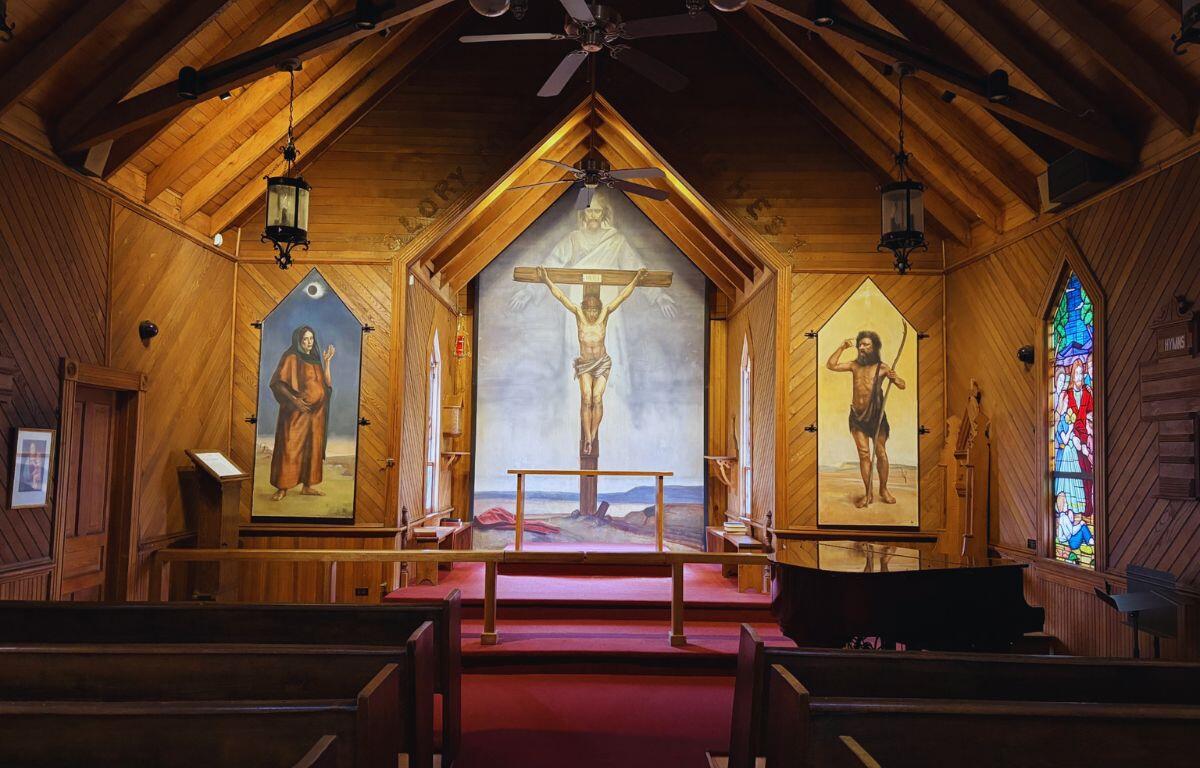
Mary Great with Child, Mystery of Faith and John the Baptist
Visitor Information:
St. Mary’s is open all day, every day for visitors. Groups may request a guide with advance notice.
The Story Behind the Frescoes
St. Mary’s is home to three of Ben Long’s earliest and most talked-about frescoes: Mary Great with Child, John the Baptist, and Mystery of Faith. Painted in the mid-1970s, these works introduced many people in Ashe County to the traditional fresco technique Long learned in Italy.
The most controversial of Long’s frescoes is Mary Great with Child. He chose to paint Mary visibly pregnant, a choice rarely seen in Western religious art. Long chose to use his then pregnant wife as the model for this fresco. When it was unveiled in 1974, some parishioners were surprised by how direct and human the image felt. The painting’s realism sparked conversations that have followed it for decades.
Together, the three frescoes at St. Mary’s show Long’s early style. They remain some of the most visited works on the fresco trail, drawing people who want to see where his North Carolina story began.
Holy Trinity Episcopal Church | Glendale Springs
Fresco at this location:
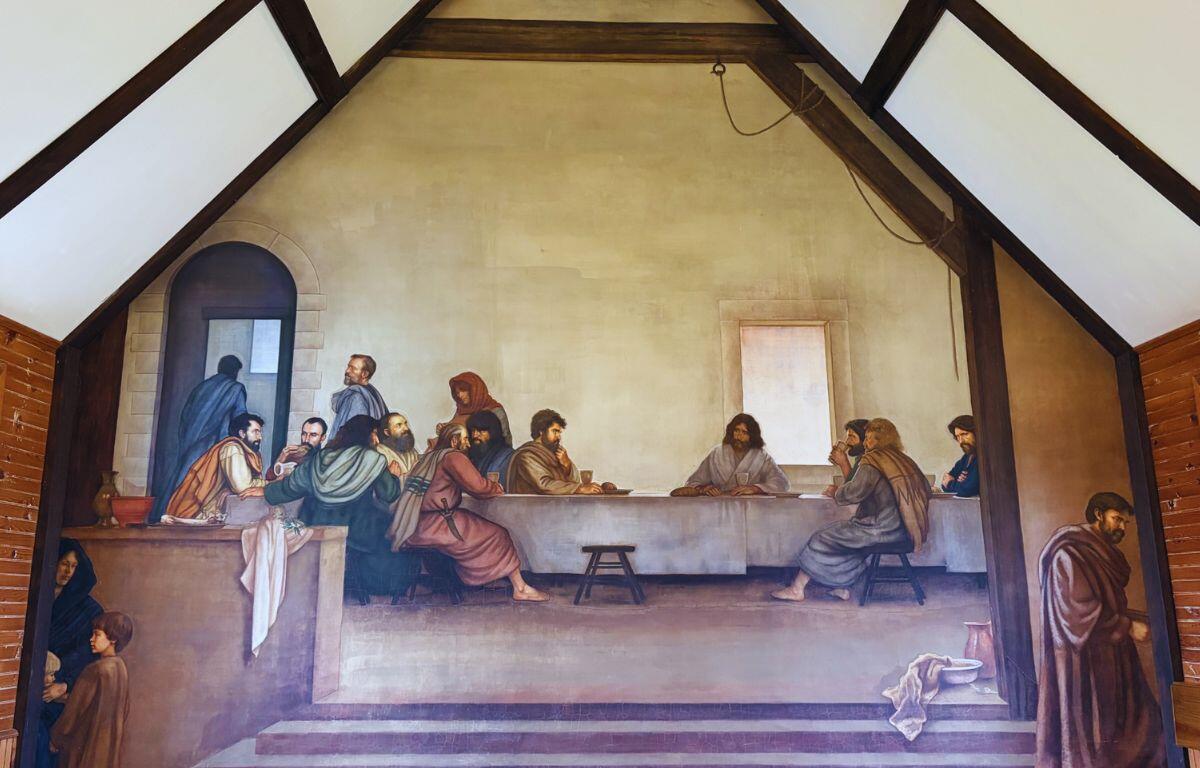
The Last Supper
Address:
Holy Trinity Episcopal Church
120 Glendale School Road
Glendale Springs, NC
(336) 982-3076
Visitor Information:
Holy Trinity is open all day, every day for visitors. Groups may request a guide with advance notice.
The Story Behind the Frescoes
Holy Trinity is home to The Last Supper, one of Ben Long’s most recognized frescoes. The mural follows the traditional layout of the biblical scene but brings a distinctly local touch. Long used community members as models, giving the familiar moment a grounded feel that reflects the church and region where it lives.
The setting at Holy Trinity makes the fresco even more striking. Light from the sanctuary windows softens the scene, drawing visitors into the details of each figure. This fresco continues the story of how Long blended sacred subjects with familiar faces from the mountains.
St. Paul’s Episcopal Church | Wilkesboro
Frescoes at this location:
Paul’s Conversion and Paul’s Imprisonment
Address:
St. Paul’s Episcopal Church
200 W. Cowles St.
Wilkesboro, NC
(336) 667-4231
Visitor Information:
The frescoes are free to visit, Monday – Saturday 8:30 A.M. to 3:30 P.M.
The Story Behind the Frescoes
St. Paul’s houses two frescoes that bookend the life and calling of the Apostle Paul: St. Paul’s Conversion and St. Paul in Prison. Long created these murals more than a decade apart, which gives visitors a chance to see the evolution of his technique.
Rumple Memorial Presbyterian Church | Blowing Rock
Frescoes at this location:
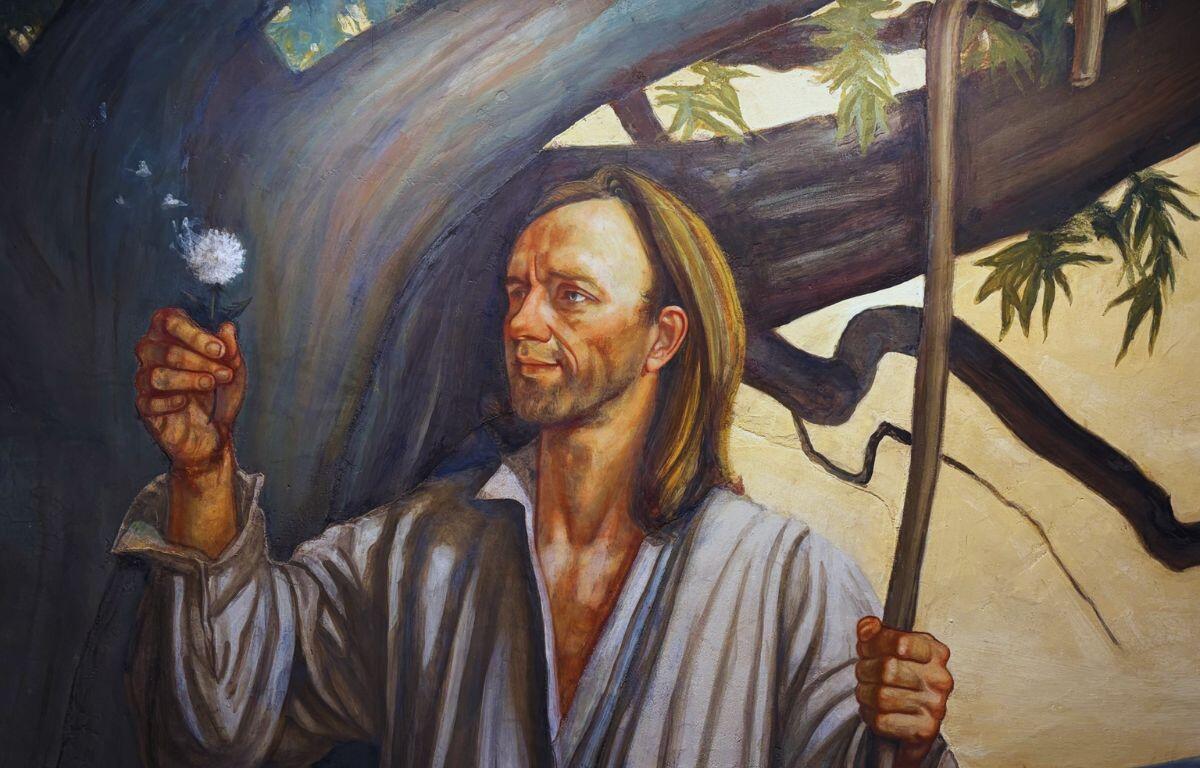
The Good Shepherd and Psalm 23
Address:
Rumple Memorial Presbyterian Church
1218 Main St
Blowing Rock, NC
(828)-295-7675
Visitor Information:
The frescoes are available for public viewing Friday and Saturday from 11:00 a.m. to 5:00 p.m. and Sunday from 1:00 p.m. to 4:00 p.m. This schedule is subject to change for special events. It is recommended that visitors call ahead to confirm access to church and fresco viewing.
The Story Behind the Fresco
Rumple Memorial features two of Ben Long’s gentle and pastoral frescoes: The Good Shepherd and Psalm 23. These pieces highlight Long’s ability to blend Biblical imagery with the natural world, drawing on the quiet, mountain setting around Blowing Rock. The figures are warm and approachable and both frescoes feel rooted in the themes of comfort and care.
Crossnore School, E. H. Sloop Chapel | Crossnore
Fresco at this location:
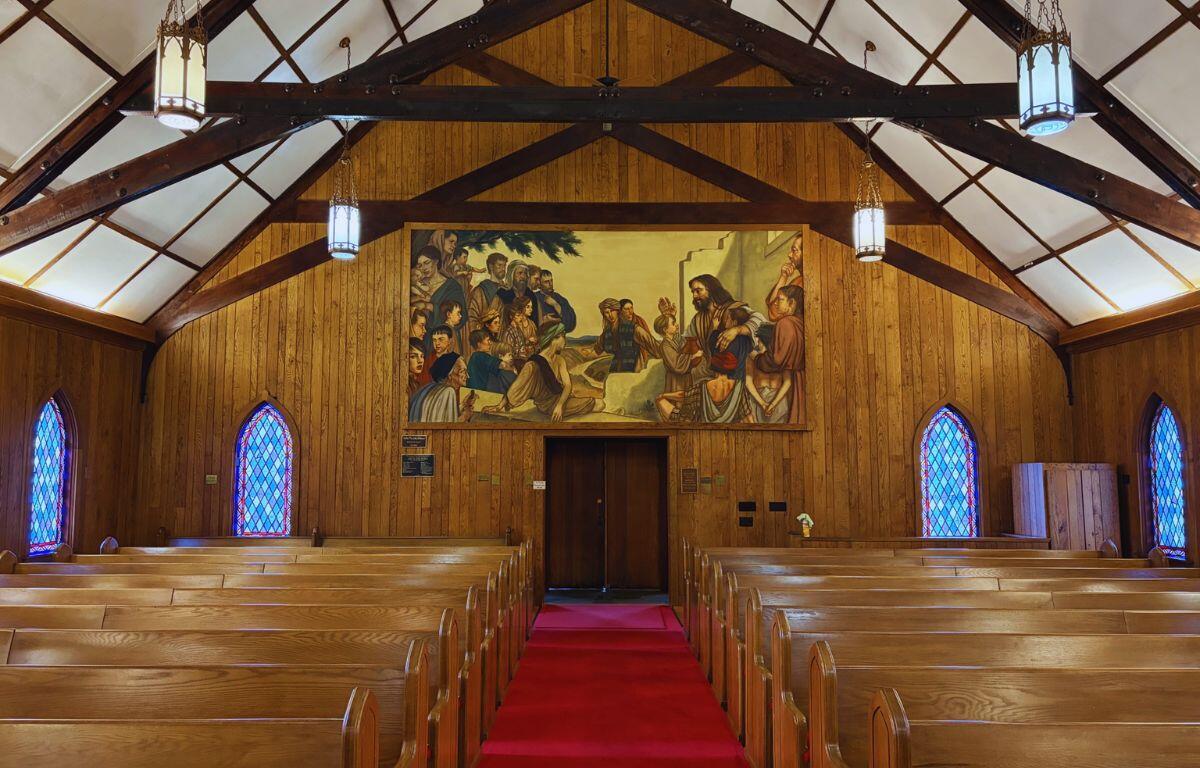
Suffer the Little Children
Address:
Crossnore School, E. H. Sloop Chapel
100 DAR Dr.
Crossnore, NC
(828) 733-4305
Visitor Information:
The fresco is located in the E.H. Sloop Chapel and is open for viewings daily from 8:30 am–5:00 pm.
The Story Behind the Fresco
At the historic Crossnore School, Long painted Suffer the Little Children, a moving fresco that honors the school’s mission of caring for children and families in need. The mural shows Christ welcoming children with open arms. Many of the faces were inspired by real students connected to the school.
City of Morganton Municipal Auditorium | Morganton
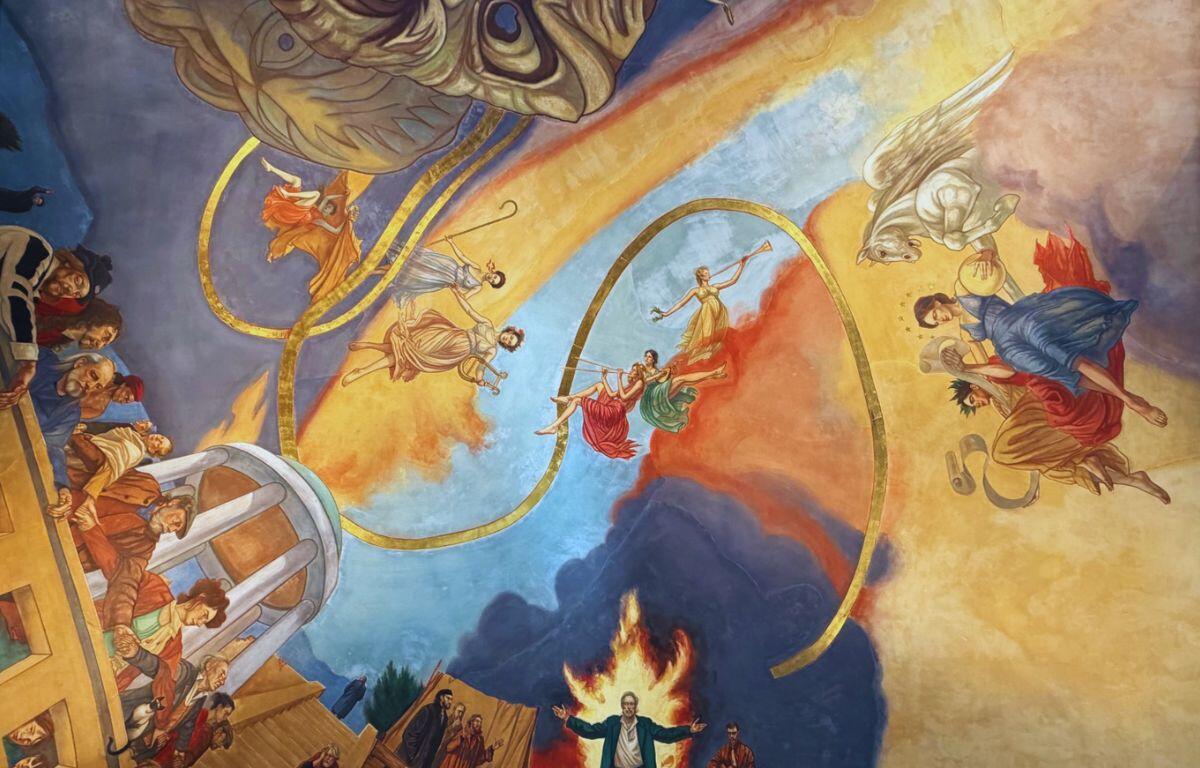
Fresco at this location:
The Muses and the Sacred Dance
Address:
COMMA (City of Morganton Municipal Auditorium)
401 S. College St.
Morganton, NC
(828) 438-5294
Visitor Information:
The fresco can be viewed Monday -through Friday from 12:00 pm – 5:00 pm, and during all public performances at COMMA.
The Story Behind the Fresco
At the City of Morganton Municipal Auditorium, Ben Long took on one of his most ambitious projects: a ceiling fresco measuring roughly 24 by 33 feet. Completed between January and April 2004, the mural commonly known as “The Muses” features the nine classical Muses of Greek mythology, figures tied to the arts and sciences. They appear among a gathering of mortals, animals, and architectural elements, with two masks representing comedy and tragedy hovering above the scene. Long even included himself in the composition, seated on the steps with his brushes, along with friends, family, and even his dogs as models.
Placing a fresco of this scale in a civic auditorium rather than a church marked a shift in Long’s vision. Here, the work wasn’t created for a single congregation but for the wider community, offering a public celebration of creativity, imagination, and everyday inspiration.
Chapel of the Prodigal, Montreat College | Montreat
Fresco at this location:
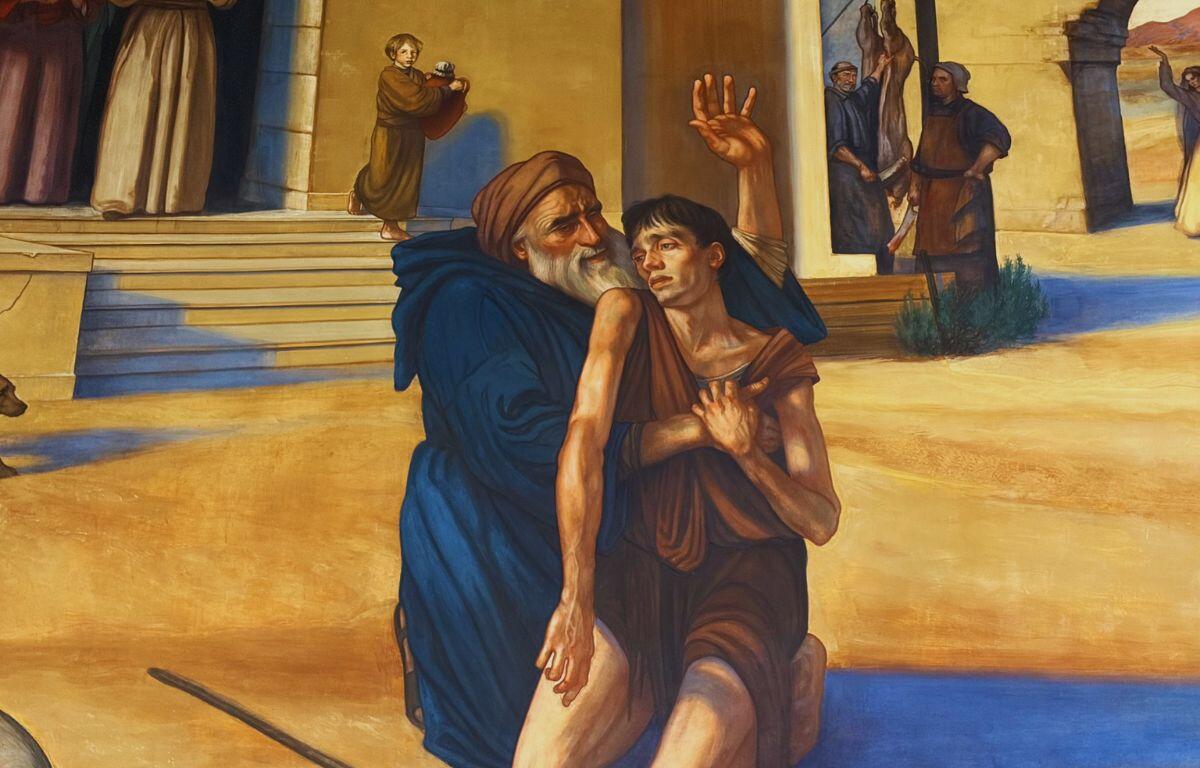
Return of the Prodigal
Address:
Chapel of the Prodigal – Montreat College
358 Texas Rd.
Montreat, NC
(828) 669-8012, ext. 3820
Visitor Information:
The Chapel of the Prodigal is open to the public Monday-Friday 9:00 a.m.-5 p.m. and Saturdays 10:00 a.m.-12 p.m. Guests are welcome to visit the Chapel at any time unless a college class is in session.
The Story Behind the Fresco
Montreat College houses Return of the Prodigal, one of Long’s most emotionally rich frescoes. Based on the parable of forgiveness and homecoming, the mural captures the moment the father embraces his son. The faces are expressive and deeply human, reflecting the themes of grace and reconciliation at the heart of the story.
The chapel setting amplifies the impact. Surrounded by stone walls and mountain quiet, the fresco is often described as one of the most powerful on the trail.
How the Frescoes Continue to Shape the Region
What makes these frescoes endure is the way they root art in everyday life. A parishioner, a neighbor, a farmer, a child sitting still long enough to become a model. All of them are now part of stories told across plaster walls. Long brought an ancient process to the mountains and showed how timeless it could feel when paired with familiar places and familiar people.
The frescoes aren’t museum pieces protected behind glass. They live in small mountain churches and community spaces, where morning light falls across pigments he mixed by hand.
Today, visitors travel to see these works, sometimes discovering them by accident on a quiet mountain road. Locals return to them again and again, finding something new each time. The frescoes have become part of the region’s shared memory. They’re reminders that meaningful art doesn’t always hang in big cities. Sometimes it’s waiting in a rural chapel, painted by someone who believed the mountains deserved work of lasting worth.
That legacy lives on through the communities that care for these churches and open their doors to travelers. And it lives on in the way these frescoes continue to connect people to place, to story and to the idea that art rooted in home can become part of history.
FAQs About the Ben Long Frescoes
Are the frescoes free to visit?
All of the Ben Long frescoes along the Blue Ridge National Heritage Area are available to view at no cost, though some sites accept donations.
Which fresco is closest to Asheville?
Chapel of the Prodigal, Montreat College | Montreat
Can visitors take photos?
Yes, photos are allowed at all of the frescoes along the Blue Ridge National Heritage Area.
How long does a visit take?
Most visits run 20-30 minutes unless you want more time to explore.