


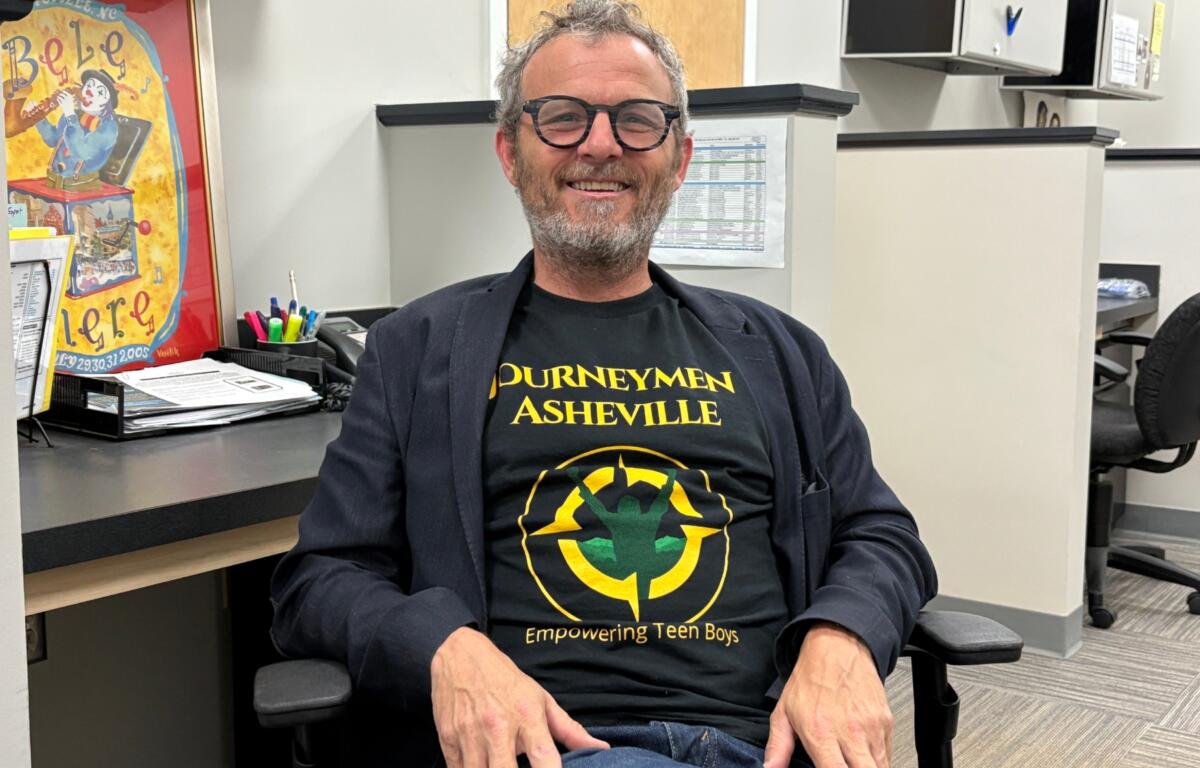

ASHEVILLE, N.C. (828newsNOW) — In a world of nonstop social media, online influencers and growing mental health struggles among teenagers, one Asheville nonprofit is working to give boys something many say they’re missing: connection, guidance and a safe place to grow.
For nearly two decades, Journeymen Asheville has focused on helping teenage boys become healthy, resilient young men through mentoring, community activities and rites-of-passage programs designed to build confidence and emotional awareness.
“We don’t tell the boys what kind of man to be,” Executive Director Joel Besemer said. “We give them a process where they get to discover that themselves.”
The Asheville-based nonprofit serves boys ages 13 to 19 across Buncombe County through school-based programs, community gatherings and outdoor retreats. Besemer said the organization works with about 40 to 50 volunteer mentors each year and consistently serves around 100 boys annually.
Journeymen Asheville was founded 18 years ago by men involved in the Mankind Project, an organization focused on personal growth and mentorship for adult men. After participating in similar programs themselves, founders realized many of the lessons would have been valuable much earlier in life.
“They realized, ‘Man, if somebody had told me some of this when I was 13, 14 or 15, maybe I wouldn’t have carried all this baggage into my 30s and 40s,’” Besemer said.
Rites-of-passage experiences
The organization draws inspiration from traditional rites-of-passage experiences found in many cultures, where older men guided boys into adulthood.
“In a lot of cultures, men would take boys out of the village at a certain age and teach them what it meant to be a man in the tribe,” Besemer said. “We don’t really do that anymore.”
Instead of prescribing masculinity, Journeymen Asheville encourages boys to identify their own strengths, values and purpose.
Programs range from twice-monthly gatherings where boys share meals, talk and play games, to larger outdoor events and camping trips. The nonprofit also runs mentoring circles inside nearly every public middle school in Buncombe County.
Besemer said boys typically find the organization through school referrals, recommendations from mentors or parents searching for support online.
The teens who benefit most from the program often fall into three categories, he said: boys overly connected to devices and social media, boys struggling socially or emotionally after the isolation of the COVID-19 pandemic, and boys lacking strong male role models at home.
“There’s some social stuff going on with these COVID kids,” Besemer said. “It’s harder to be social, and they’re struggling to find community. We provide that community.”
Focusing on emotions and belonging
A major focus of the program is helping boys identify and process emotions in healthy ways.
“We deal in five emotions — mad, sad, glad, scared and guilty,” Besemer said. “A lot of boys stuff their emotions down and then they burst out at inappropriate times. We give them ways to move through those emotions without it causing problems for them.”
The organization also emphasizes authenticity and belonging.
“We want them to have a community where they can take their masks off and be their true selves without being judged,” Besemer said.
Some participants remain involved long after completing the program. Besemer pointed to Jordan Bowman, now executive director of Journeymen Triangle, as one of the organization’s biggest success stories.
Bowman participated in the group’s very first rites-of-passage weekend 18 years ago and now helps lead similar programs for other boys.
“That’s the full-circle moment for us,” Besemer said.
Over the years, Besemer estimates about 2,000 boys have participated in Journeymen Asheville programming, with roughly 200 still involved in some capacity as mentors, volunteers, board members or supporters.
Learning accountability
As concerns grow nationally about the influence of toxic online content targeting boys and young men, Besemer said the organization sees its role as more important than ever.
“What we’re focused on more than ever is being the opposite of what these boys are being fed online,” he said.
Besemer referenced the rise of online personalities promoting aggressive or unhealthy versions of masculinity and said social media algorithms can quickly expose vulnerable teens to harmful messaging.
“A boy can start with something as innocent as wanting to build bigger muscles, and within 24 hours, the messages being fed to him by the algorithm are staggering,” Besemer said. “It is harder now to be a boy than when I was that age.”
He said Journeymen Asheville aims to intervene early by teaching accountability, emotional intelligence and healthy relationships.
“We’re trying to intercede with these boys before they become men who don’t take accountability for anything,” he said.
The nonprofit operates on a sliding scale, so no family is turned away because of finances. Besemer said community donations help fund scholarships for participants.
People interested in supporting the organization can volunteer, mentor or donate through the group’s website.