


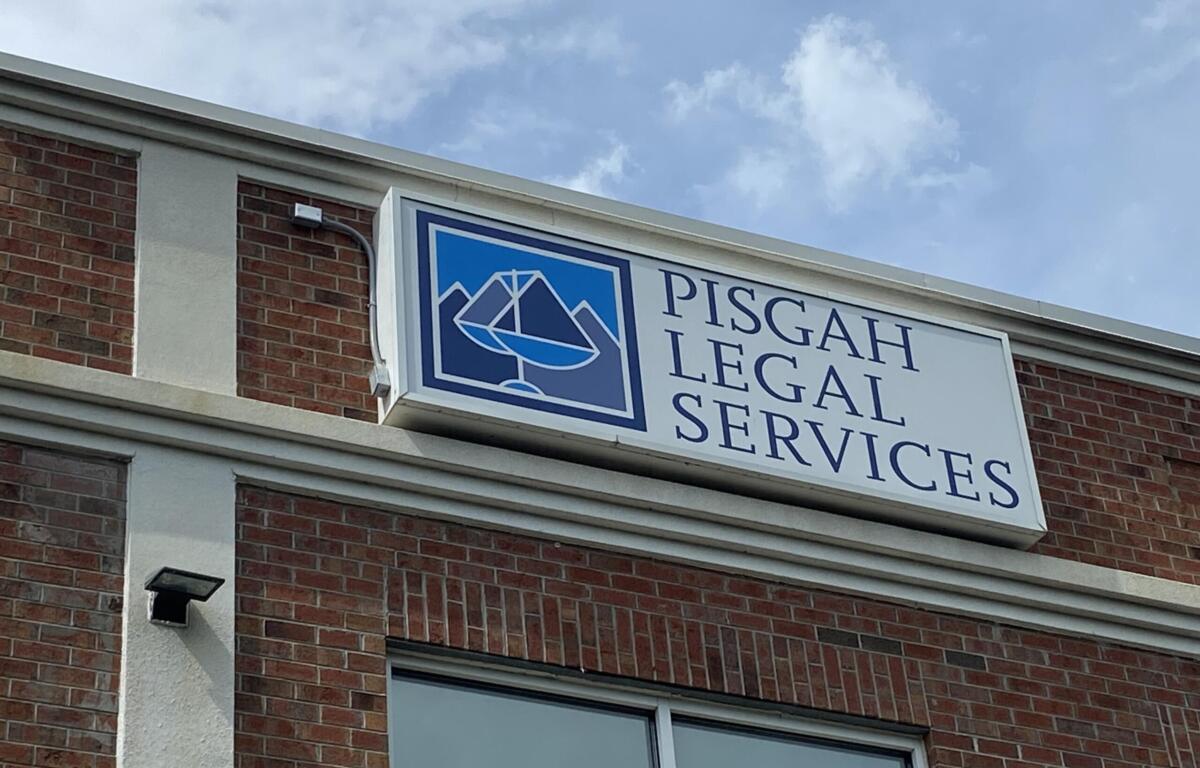

ASHEVILLE, N.C. (828newsNOW) — Pisgah Legal Services is a regional nonprofit providing free civil legal consultation to low-income residents of 18 Western North Carolina counties. However, the recent redirection of millions in state funding could have a major impact on the assistance they are able to provide.
Unlike in criminal law, civil cases do not guarantee the right to an attorney. Pisgah Legal seeks to fill that gap for WNC residents.
“Having an attorney and access to an attorney is often what makes the difference,” said Jaclyn Kiger, executive director of Pisgah Legal. “The work that we do, it’s of great significance and consequence to a person’s life.”
Kiger said that the nonprofit served nearly 28,000 people across WNC in 2025. The organization handles everything from domestic violence cases to health insurance and disability income. Since September 2024, Pisgah Legal has also aided lower-income WNC residents in navigating Tropical Storm Helene recovery.
“My heart is just broken over how many people that have called us, particularly since Hurricane Helene. Some that never thought they’d need help before didn’t realize you would need a lawyer for the things that we’re doing. I mean, you shouldn’t. But the reality is, you do, and it can make a huge difference,” Kiger said. “We’ve seen our clients get the FEMA case approved and a new mobile home. We’ve seen repairs come through, where people could move back and their home is their one asset. For some, they lost everything, and even just getting back to stability is important.”
Understanding NC IOLTA
As a nonprofit organization, Pisgah Legal relies heavily on outside funding to serve its client base.
For several decades, one of its largest funding sources has been an annual grant awarded through the North Carolina Interest on Lawyers’ Trust Accounts, or NC IOLTA, a program of the North Carolina State Bar.
NC IOLTA funds come from interest generated by lawyers’ trust accounts, or sums of money belonging to clients, such as a settlement check, temporarily held by their legal counsel in a special, interest-bearing account. Since the implementation of the program, generated interest has funded $134 million in grants for civil legal services across the state.
Pisgah Legal is one of the organizations that receives those grants. The nonprofit stakes a large portion of its funding on receiving the NC IOLTA grants. In 2025, for instance, Pisgah Legal received a $1.9 million grant from NC IOLTA, which made up around 15% of the nonprofit’s annual budget.
Shifting funds
However, over the past year, NC IOLTA underwent a major restructuring. In May 2025, the North Carolina House proposed a state budget provision that would redirect NC IOLTA interest to the North Carolina Office of Indigent Defense Services’ Private Assigned Counsel Fund. On July 7, 2026, Gov. Josh Stein signed the budget into law. Up to $15 million a year from NC IOLTA will now fund the use of court-appointed private attorneys to defend indigent clients in criminal cases.
Up to $2 million a year may go to other NC IOLTA initiatives, but only from funding earned by the program before July 1, 2025.
The state may enlist private attorneys for indigent clients in criminal cases where a public defense attorney is not immediately available. However, following a rate cut for PAC attorneys in 2011, “good attorneys who have long felt an obligation to serve justice and protect the Constitution have been forced to walk away from public defense. They simply cannot afford to do this work any longer,” Margaret A. Gressens, IDS Research Director, wrote in a 2019 report.
“IDS is grateful that the General Assembly has recognized the need for additional PAC funding,” the office said in a statement after the budget was signed. “We will act as quickly as possible after budget certification and we look forward to raising rates as early as this fall.”
The IDS Commission announced in a meeting on Saturday, Aug. 7, that rates for PAC attorneys were increased to $85 an hour for misdemeanor cases, $90 an hour for low-level felonies, $110 an hour for high-level felonies and $120 an hour for potentially capital cases. The new rates will go into effect on Oct. 1, 2026.
The loss of NC IOLTA funding for indigent civil defense, however, “makes North Carolina the only state in the nation to use IOLTA program funds to meet its constitutional obligation to provide for indigent criminal defense instead of grantmaking for civil legal aid,” NC IOLTA said in a July 1 release.
Consequences and concerns
Kiger said that the loss of NC IOLTA funding for Pisgah Legal will have a massive impact on the nonprofit’s ability to administer aid, especially to WNC residents still hurting after Helene.
“We are almost 50 years old, and we have a good track record of getting through hard times. But, I guess what I’ll say is that this is a man-made hard time for us that doesn’t, didn’t, need to exist,” Kiger said. “It’s hurting the entire state, but from my perspective, the west is getting the worst of this, because we are already hurting and we have already been through a huge natural disaster. There are too many low-income people, and people of all income ranges, who are still struggling to recover, and we just… this is a blow that we really don’t need.”
In the absence of NC IOLTA funding for civil legal aid, Kiger said she would urge lawmakers not to forget about the North Carolinians who rely on indigent civil services.
“I would direct to them: Please, please help the people of our state who need civil legal aid services, and please do not forget about Western North Carolina and what we have been through, and people in the East have been through, and across the state,” Kiger said. “There are so many low-income people who will not have a roof over their head, or feel safe, or have custody of their children or have food on their table, and we could have helped. So please help.”
For more information about NC IOLTA, visit www.nciolta.org.
For more about Pisgah Legal Services, visit www.pisgahlegal.org.
For more about North Carolina state law, visit www.ncleg.gov.