


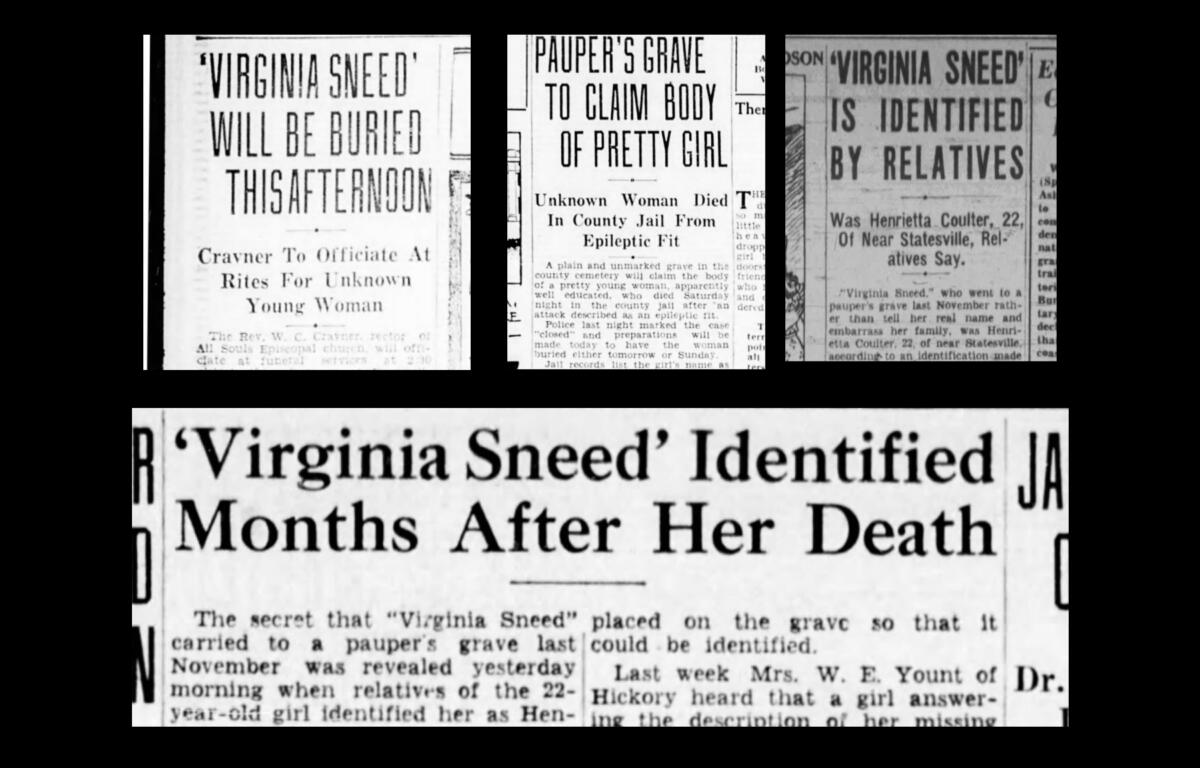

ASHEVILLE, N.C. (828newsNOW) — She told Asheville police her name was Virginia Sneed.
It wasn’t.
And when officers asked for her real name, the young woman refused.
“I will stay in jail the rest of my life before I will cause any embarrassment to my family,” she told a police desk sergeant, according to a July 13, 1940, account in the Asheville Citizen-Times.
Three days after her arrest in November 1939, she was dead.
More than 700 people viewed her body, hoping to identify her. Strangers arranged her funeral. And for nearly eight months, she lay in a grave without her real name while her family searched for Henrietta Coulter.
Even after her family found her, some questions remained unanswered.
An arrest on Biltmore Avenue
On Nov. 15, 1939, Asheville police took a young woman into custody on Biltmore Avenue while investigating whether she was a vagrant, according to newspaper accounts from the time.
She identified herself as Virginia Sneed but later admitted the name was made up.
A Nov. 24, 1939, Asheville Citizen-Times article reported that she was picked up on an investigation charge and ordered held for examination at a venereal disease clinic. The newspaper did not report that she had been diagnosed with a disease.
The young woman offered little information about herself.
She reportedly told officers she had family connections in Asheville, Salisbury and Winston-Salem and had received some nursing training. She also said she had been separated from her husband for nearly a year.
But she wouldn’t tell them who she really was.
Newspapers described her as well-dressed, articulate and seemingly educated. Lelia Bowles, the matron at the Buncombe County Jail, told the Citizen-Times that the woman was not a habitual jail inmate.
“She was a very nice person and seemed to be well educated,” Bowles said.
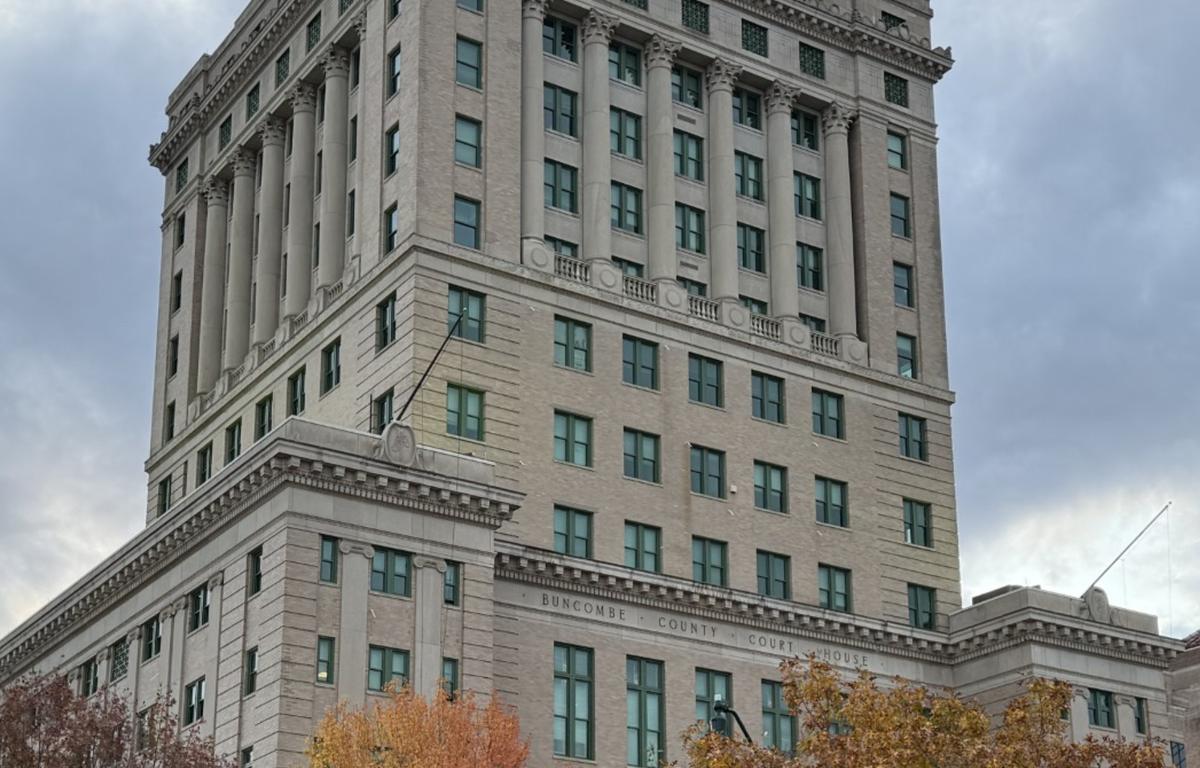
The woman remained in the Buncombe County Jail, which at the time occupied the upper floors of the courthouse in downtown Asheville. The jail remained there until 1978, when officials moved it to a separate detention facility.
On Nov. 18, three days after her arrest, she died.
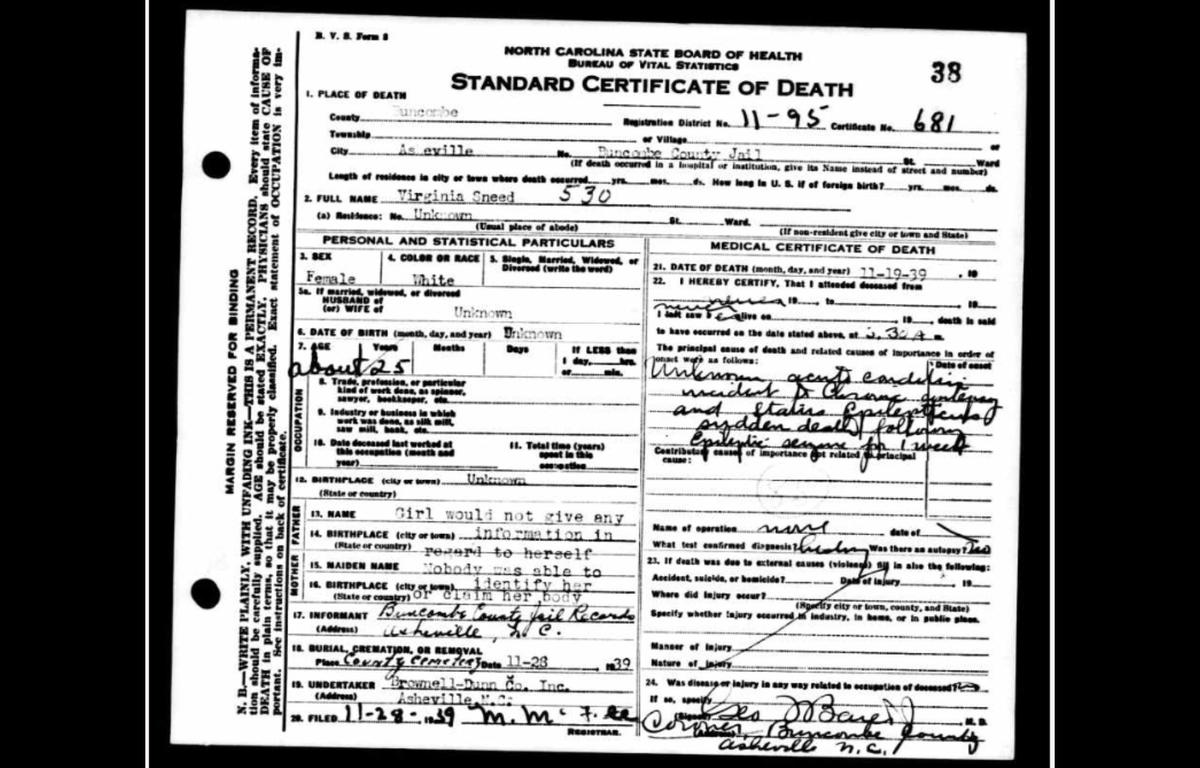
Her death certificate, issued under the name Virginia Sneed, lists the jail as her place of death and records the time as approximately 5:30 a.m.
The coroner attributed her death to an epileptic seizure, according to contemporary newspaper accounts.
The certificate also offers a glimpse of the problem authorities faced in trying to identify her.
“Girl would not give any information in regard to herself,” someone wrote in the section where her parents’ names should have appeared.
The notation continued, explaining that no one had been able to identify her.
Her birthplace was listed as unknown, and even her age was an estimate.
The certificate recorded her age as “about 25.” Newspapers later identified her as 22, although the May 18, 1918, birth date on her family gravestone would make her 21 when she died.
With no way to notify her family, authorities turned to the public for help.
Hundreds came looking for answers
Asheville newspapers published descriptions of the unidentified woman, hoping someone would recognize her.
A Nov. 21, 1939, article in The Asheville Times described her as 5 feet, 6 inches tall, weighing between 125 and 128 pounds, with blue eyes and dark hair.
She had been wearing a dark blue dress with a red velvet ruffle across the front and a red necklace.
Police hoped those details might jog someone’s memory.
People began arriving at Brownell-Dunn Funeral Home to see whether she might be a missing relative, friend or acquaintance.
More than 700 people viewed her body, according to newspaper reports.
None could identify her.
Police followed up on leads, but they went nowhere. A Nov. 24 newspaper account said her fingerprints were not on file in Washington, where fingerprints submitted by law enforcement agencies were kept.
With no family to claim her body, arrangements were made for a funeral.
A stranger brings flowers
The service was held Nov. 28, 1939, at Brownell-Dunn Funeral Home.
The Rev. W.C. Cravner, rector of All Souls Episcopal Church, officiated. Mrs. Frank McShane sang, and Mrs. Lucile McInturff played the organ. Asheville florists donated flowers, and funeral home employees served as pallbearers.
Shortly before the service, an unidentified woman arrived carrying a corsage.
According to a Nov. 29 Asheville Citizen-Times account, she asked that the flowers be pinned to the dead woman’s dress.
As funeral home employees opened the casket and placed the corsage on the body, the visitor stood nearby and wept.
Then she left.
She was gone before the funeral began.
The newspaper did not identify her or explain why she had come.
After the service, the woman known as Virginia Sneed was buried at the Buncombe County Home Cemetery, a burial ground associated with the county’s former poor farm northwest of Asheville.
A July 1940 newspaper account said several large stones had been placed around her grave.
Her real name remained unknown.
A cemetery near Erwin High School
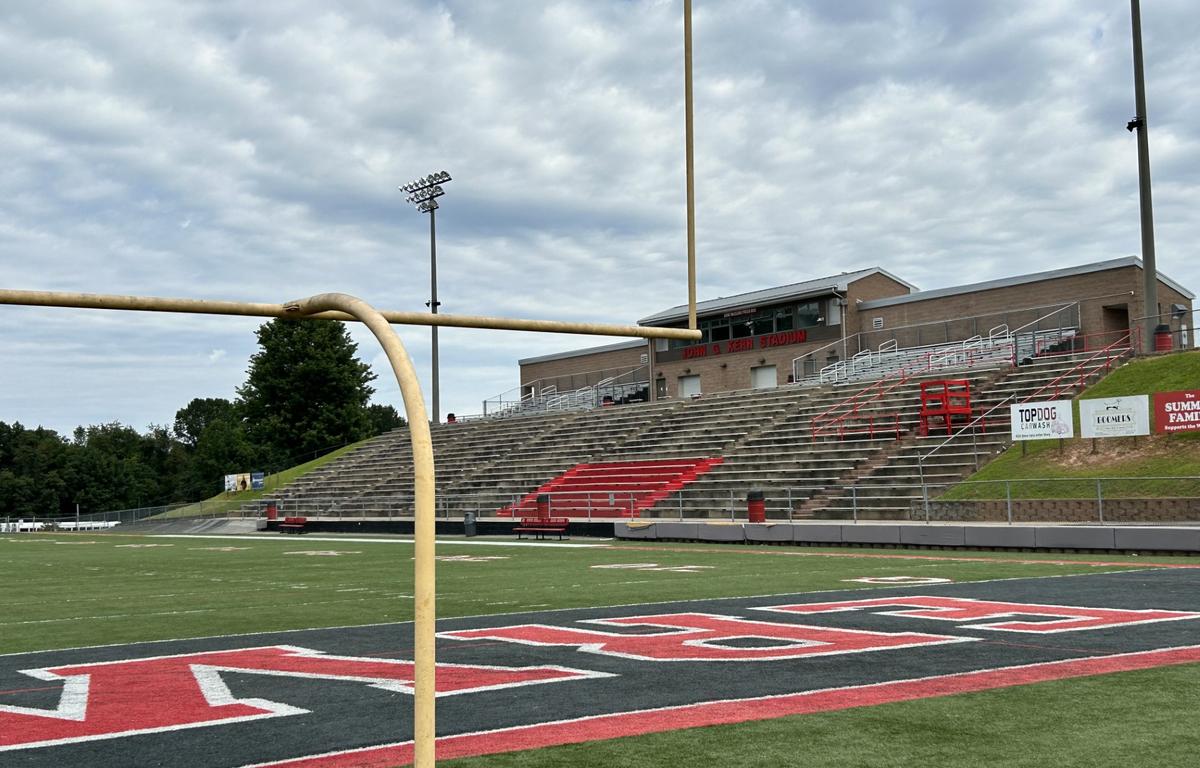
The cemetery where Henrietta was first buried was on property that later became part of the Clyde A. Erwin High School campus off Lees Creek Road.
Historical reporting by the Asheville Citizen-Times and Mountain Xpress describes the former burial ground as occupying a slope near what is now the school’s football field.
Hundreds of graves were relocated in 1973. Later reports raised questions about whether all the remains had been removed.
By then, Henrietta’s remains had long since been moved to Iredell County.
A family searching for its youngest daughter
Henrietta Franklin Coulter was born May 18, 1918, in the Statesville area, the youngest of 10 children born to Robert and Mary Coulter.
Her mother, also known as Mollie, died in 1929, when Henrietta was 11.
Henrietta grew up in a large family whose members eventually settled in different communities. She frequently visited her brothers and sisters, sometimes staying with one and then another.
That made it difficult for the family to realize she was missing.
Each sibling apparently assumed she was visiting someone else.
It wasn’t until Nov. 11, 1939, that they realized no one knew where she was, according to a July 13, 1940, Asheville Citizen-Times article.
Four days later, Henrietta was arrested in Asheville.
Three days after that, she died.
Her family had no idea.
Research by Shellie Taylor, a local history program specialist at the Iredell County Public Library, provides additional details about Henrietta’s life before her disappearance.
Henrietta married Gordon Ball in 1936, when she was 18.
The marriage ran into difficulties. In 1937, Ball faced abandonment and nonsupport proceedings, and a court ordered him to pay Henrietta $8 a month.
By the time she was arrested in Asheville, Henrietta reportedly had been separated from her husband for nearly a year.
Whether her marriage had anything to do with her travels or her decision to conceal her identity is unknown.
Taylor’s research, published by Iredell Free News in 2023, found no explanation for why Henrietta came to Asheville, how she got there or whom she might have been visiting.
Her family finally finds her
The breakthrough came in July 1940.
Henrietta’s sister, Mrs. W.E. Yount of Hickory, heard about the unidentified woman who had died in Asheville the previous November.
The description sounded familiar.
She contacted Brownell-Dunn Funeral Home, which sent her a photograph of the woman.
Mrs. Yount and her brothers and sisters recognized the face.
They believed they had found Henrietta.
The relatives traveled to Asheville, where they met with Elizabeth Fragge, an embalmer at the funeral home.
Fragge described scars on the woman’s body that family members recognized.
That was enough to convince them.
On July 13, 1940, the Asheville Citizen-Times reported that the mystery had finally been solved.
Virginia Sneed was Henrietta Coulter.
Her brother, J.C. Coulter of Winston-Salem, also provided a detail about her medical history.
He told the newspaper Henrietta had experienced epilepsy since she was 8 years old.
That was consistent with the coroner’s reported conclusion that she had died from an epileptic seizure, although the surviving newspaper accounts do not fully explain what happened during her three days in jail or what medical treatment she received.
Her family had been searching for her for months, unaware that she had been buried in Asheville shortly after disappearing.
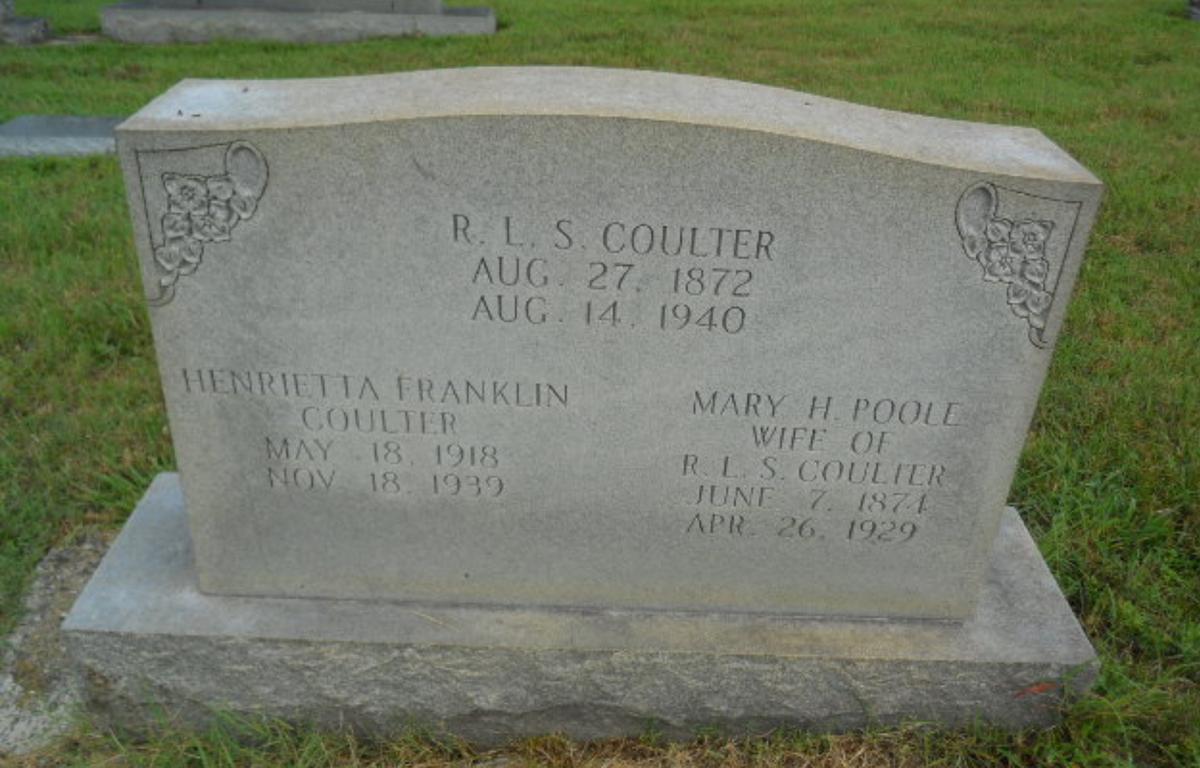
They arranged to have her remains moved to New Bethany Baptist Church Cemetery in Iredell County, where her mother was buried.
Henrietta’s father, Robert Coulter, died Aug. 14, 1940, about a month after the family learned what had happened to his youngest daughter.
Some questions remain
More than 85 years later, questions remain about why Henrietta came to Asheville and why she refused to tell police her real name.
The historical records document her arrest, death, funeral and eventual identification. But they offer little explanation for what brought her to Asheville or her determination to remain anonymous.
There is also the unidentified woman who arrived at her funeral with a corsage, wept when she saw the body and left without explaining who she was.
The newspapers never answered that question.
Henrietta is buried at New Bethany Baptist Church Cemetery in Iredell County. Her gravestone bears the name Asheville authorities never learned while she was alive.
Her family eventually found her, and the mystery of her identity was solved.
But why she came to Asheville, why she refused to reveal her name and who brought flowers to her funeral remain unanswered.
EDITOR’S NOTE: Historical sources include the 1939 North Carolina death certificate issued under the name Virginia Sneed; November 1939 and July 1940 editions of the Asheville Citizen-Times and The Asheville Times; cemetery records; research by Shellie Taylor of the Iredell County Public Library, published in Iredell Free News in 2023; and historical reporting on the former Buncombe County Home Cemetery.