EDITOR’S NOTE: Strangeville explores the curious and unexplained stories that have long defined Asheville and Western North Carolina. The region is full of unanswered questions, from old folklore and local legends to eerie encounters, unsolved moments in history, and the true-crime mysteries that still leave people wondering. Each week, we look back with an open mind and a sense of curiosity, trying to understand why some stories take hold and why some can never be explained.
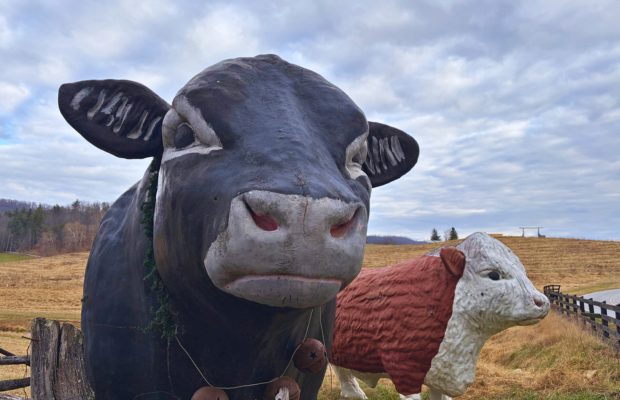
EDNEYVILLE, N.C. (828newsNOW.com) — In the open farmland of rural Henderson County, two oversized fiberglass steers stand watch along Old Clear Creek Road. Beyond them, past rolling pastureland and toward the base of Bald Top Mountain, a ghost town rises from the Clear Creek Valley.
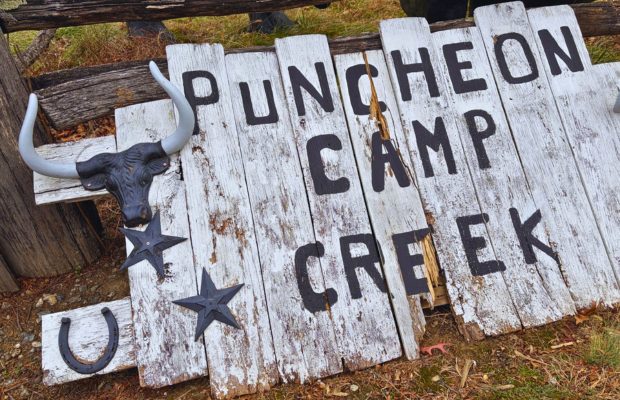
Puncheon Camp Creek Ranch is a privately built Western-style village created by Boyd Leon “Bub” Hyder on land his family has farmed for generations. Though it was never a functioning town, it is known as a ghost town due to its deserted streets and the way it seems to appear out of nowhere as you drive along Old Clear Creek.
The village sits near Puncheon Camp Creek, a small stream that winds through the property. A white chapel with a five-point star on its steeple overlooks the site. Nearby stand a red schoolhouse, a post office, a jail, a courthouse, and a general store outfitted with vintage Pure Oil gas pumps. A hotel and saloon face the gravel drive. The structures create the illusion of a long-abandoned frontier town near the working ranch.
Closer inspection reveals that nothing here was left to decay by accident. The buildings are maintained. The signs, including no trespassing signs, are deliberate and add to the scene. The courthouse features a domed roof and classical details, possibly inspired by designs from architect Richard Sharp Smith, who shaped much of Western North Carolina’s historic architecture in the late 19th and early 20th centuries.
The word “puncheon” carries several meanings, but in this region, it generally refers to split logs that were smoothed on one side and used as flooring in early Appalachian cabins.
Hyder began assembling the village after purchasing part of the Puncheon Camp Creek farm in a 1988 bankruptcy sale. He later expanded the property to nearly 600 acres, operating it as the Puncheon Camp Creek Land and Cattle Company. After restoring existing farm buildings, he repurposed them and constructed additional structures to form the village.
Hyder comes from a long line of Henderson County families who worked as farmers, carpenters, school board members and law enforcement officers in Edneyville. That legacy carries into the present. Hyder holds monthly services at the small church he built on the property, named Marie’s Chapel in honor of his mother, and he continues to host fundraisers for the Boy Scouts.
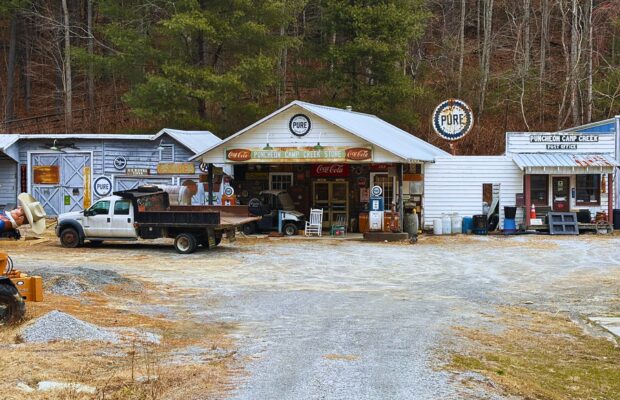
Puncheon Camp Creek Ranch is not open to the public. A gate and posted signs make that clear. Visitors who find the site generally do so intentionally and by invitation, following back roads into the countryside. What they encounter is a place that looks abandoned but never was, a town that feels forgotten even though it was carefully imagined.
Puncheon Camp Creek Ranch stands as one of Western North Carolina’s most unusual landmarks. A ghost town rooted in family history and a personal vision that turned farmland into folklore.
The buildings and displays at Puncheon Camp Creek Ranch are located on private property and are not open to the public. The site can be seen from the road, but visitors should observe all no trespassing signs and respect the landowner’s privacy.
-
Haunted Asheville and WNC: Ghost stories, eerie legends and mysterious places

From Asheville’s historic landmarks to mountain trails, old cemeteries and Appalachian folklore, explore the ghost stories and mysterious places that have become part of Western North Carolina’s history.
-
Strangeville: Elvis, Asheville and a tiny Cherokee museum

Just off of Highway 19 on the way down to Cherokee, N.C., eagle-eyed drivers might spot the silhouette of Elvis Presley on the side of a small brown building. Inside, visitors will find the Elvis Museum, owned and curated by Dorothy “Dee” Smith.
-
Strangeville: Revolutionary War Ghosts of the Carolina Backcountry

Ahead of America 250, Revolutionary War folklore links Western North Carolina’s Overmountain Men to ghostly legends from the Battle of Kings Mountain.
-
Strangeville: Harry Gardiner, the ‘Human Fly’ Who Climbed Asheville’s Flat Iron Building
A century before viral stunts, Harry Gardiner drew crowds to downtown Asheville by scaling the Flat Iron Building without ropes — part spectacle, part fundraiser and part civic promotion.
-
Strangeville: Devil’s Den and the outlaw legends of Iron Mountain

On the North Carolina-Tennessee line, Devil’s Den became part of a darker mountain history shaped by moonshiners and outlaws.