Editor’s Note: Western North Carolina is rich with untold stories—many resting quietly in local cemeteries. In this Tombstone Tales series, we explore the lives of people from our region’s past whose legacies, whether widely known or nearly forgotten, helped shape the place we call home.
CANTON, N.C. (828newsNOW.com) — At Locust Field Cemetery, a rough stone symbolizes the quiet persistence of family and dedication.
Thomas Abel was a Revolutionary War soldier who died in Haywood County on Aug. 30, 1822. Today, his burial place is marked not by a single headstone, but by a collection of stones added across generations, each telling part of the same story.
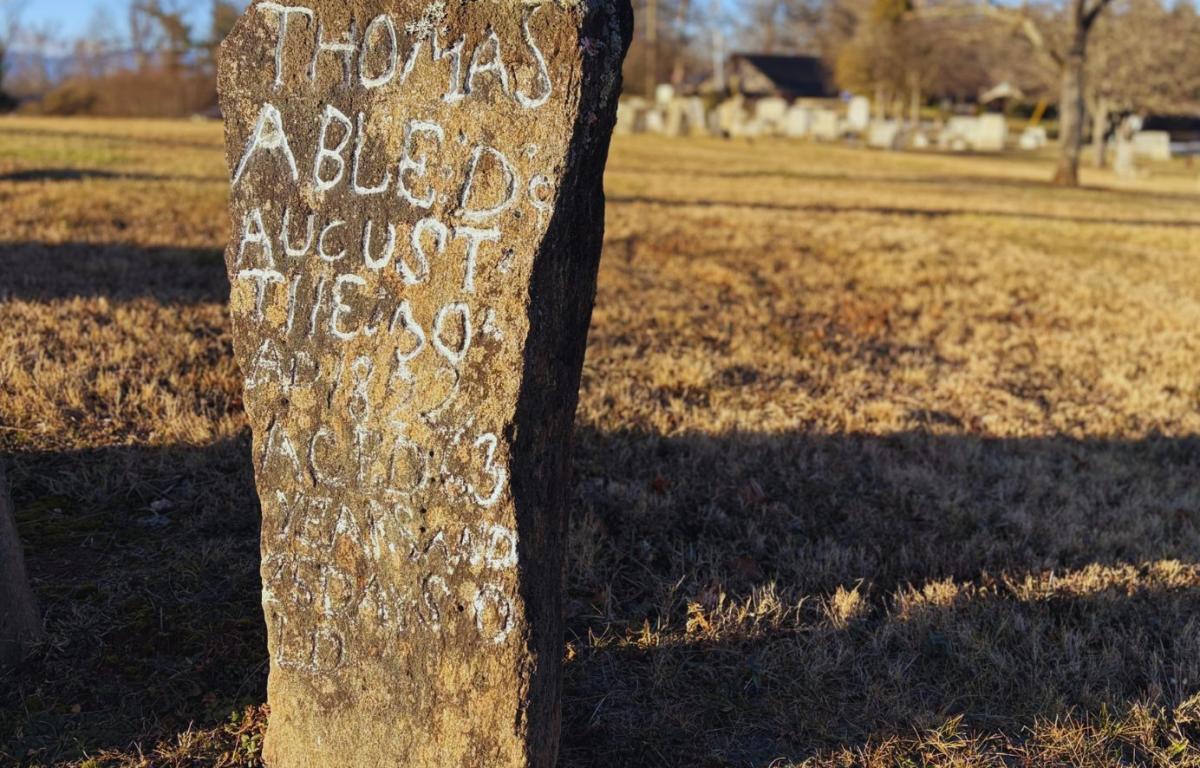
The earliest marker is easy to miss. A narrow, roughly shaped stone bears a hand-carved inscription that reads, in part, “Thomas Able D … August the 30 … A.D. 1822.” The lettering is shallow, but the meaning is clear. This is the original grave marker, likely placed shortly after Abel’s death, reflecting the simple burial practices of early 19th-century frontier families.
Nearby stands a larger fieldstone monument, installed long after Abel was buried. It reads “Thomas Henry Abel, Aug. 1759 – Aug. 1822,” and names his wife, Elizabeth Kathrine Woodfin Abel, who died March 30, 1855. At the base, the stone bears the inscription “First settler of Haywood County,” a phrase that reflects family and community tradition.
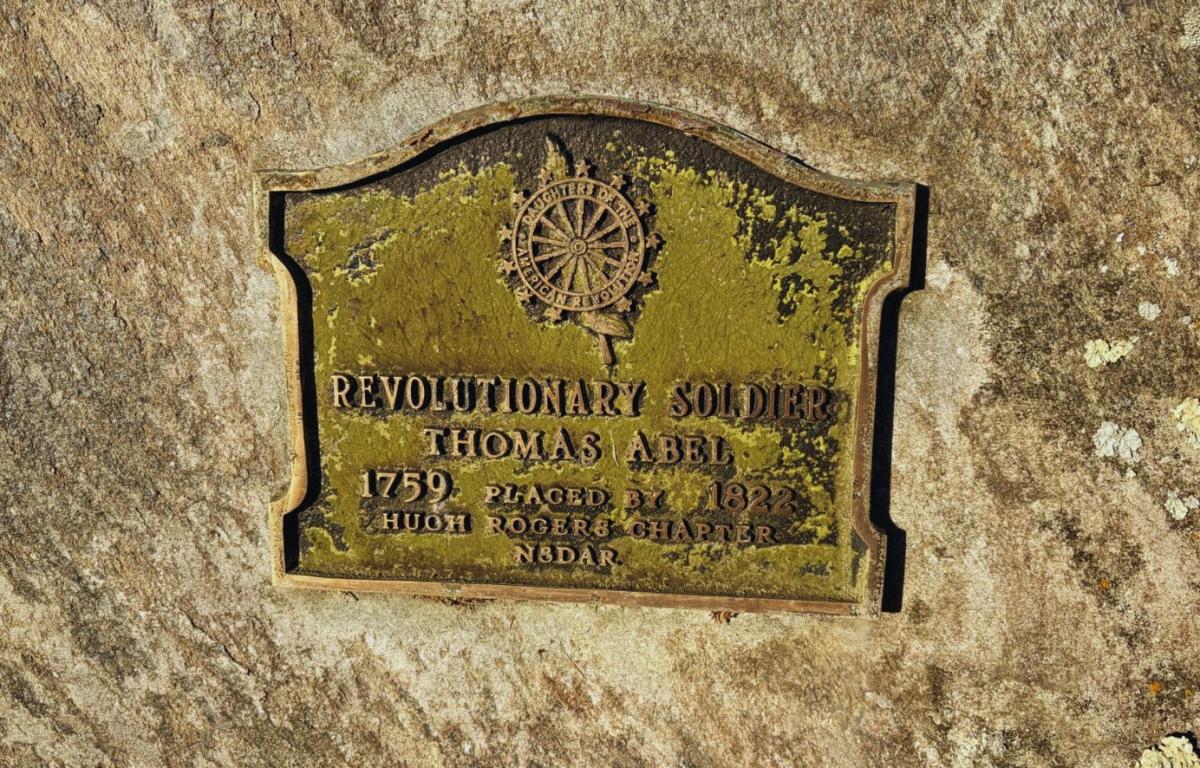
Affixed to the stone is a bronze plaque placed by the Hugh Rogers Chapter of the Daughters of the American Revolution. It identifies Abel as a “Revolutionary Soldier” and formally recognizes his service in the war for independence.
That service is documented through a federal pension file created after the war, when Congress expanded benefits to widows of Revolutionary War soldiers.
In June 1839, Elizabeth Abel appeared in Haywood County court to apply for a widow’s pension. She testified that she and Thomas were married in September of 1782, on a place along the Pigeon River. She said they lived together as husband and wife until his death in 1822.
Elizabeth traced their long residence in Western North Carolina and told the court she had often heard her husband describe his Revolutionary War service.
According to her account, Thomas entered service in Shenandoah County, Virginia. Her statements were supported by an affidavit from fellow Revolutionary War pensioner, Daniel Henson, who swore he served alongside Thomas Able in Virginia in 1781 and 1782.
Notes attached to the pension file reference a size roll listing “Thos. Able,” age 22, described as 5 feet 8 inches tall with brown hair, gray eyes and a fair complexion. The roll identifies him as a planter, born and residing in Shenandoah County, and states he enlisted March 19, 1781.
Elizabeth testified that her husband frequently spoke of seeing Gen. George Washington and said he was present at the Siege of Yorktown, where he witnessed the surrender of British Gen. Charles Cornwallis.
In stone and bronze, Thomas Abel’s memorials stand as a lasting tribute to a Revolutionary War patriot who helped shape a new nation.
-
Haunted Asheville and WNC: Ghost stories, eerie legends and mysterious places

From Asheville’s historic landmarks to mountain trails, old cemeteries and Appalachian folklore, explore the ghost stories and mysterious places that have become part of Western North Carolina’s history.
-
Tombstone Tales: Bascom Lamar Lunsford’s remarkable life

The Asheville lawyer, folklorist and festival organizer spent decades preserving Western North Carolina’s songs, dances and mountain traditions.
-
Tombstone Tales: A Fairview grave says James Brevard ‘became a seraph.’ Who was he?
Buried at Cane Creek Cemetery in 1847, the farmer, postmaster and state legislator left a public record that helps explain an extraordinary epitaph.
-
Tombstone Tales: The Reems Creek pitcher who played one game in the Major Leagues
Richard “Rome” Chambers became the first known Western North Carolina native to play Major League Baseball before returning home to Buncombe County, where he died just one day before his 27th birthday.
-
Tombstone Tales: A Revolutionary War veteran’s grave in Mitchell County tells a WNC story for July Fourth
At Kona Baptist Church Cemetery, a memorial to George Silver carries the story of American independence into the Toe River Valley and a family legacy deeply rooted in Western North Carolina.