


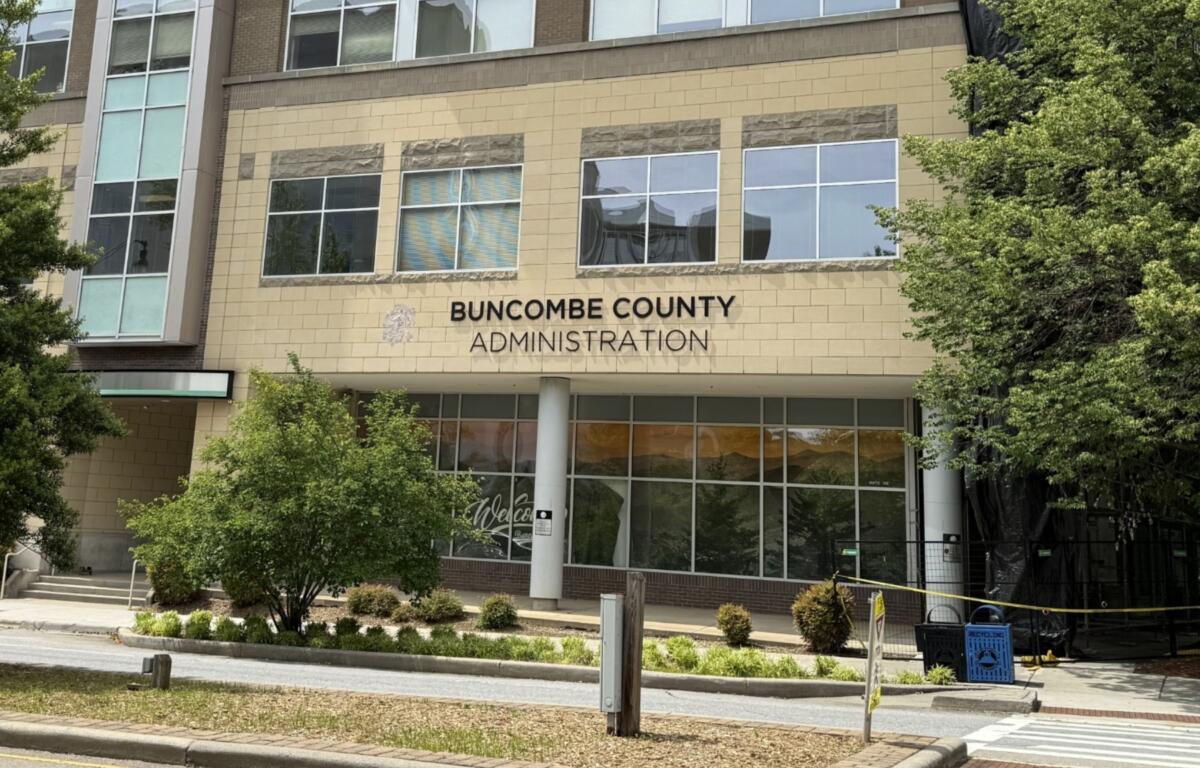

ASHEVILLE, N.C. (828newsNOW) — Property tax rates and the impact of the county’s 2026 revaluation became a central focus Tuesday night as Buncombe County officials laid out their budget outlook and residents and commissioners weighed the financial pressure of increasinging property values.
Property taxes and the impact of Buncombe County’s 2026 revaluation dominated public comment and the county’s budget presentation Tuesday night, as residents urged commissioners to hold the line on rates while officials laid out a multi-million-dollar spending plan.
During a meeting of the Buncombe County Government Board of Commissioners, County Manager Avril Pinder presented a proposed $485.1 million fiscal year 2027 budget that reflects a post-revaluation reset in the county’s tax structure.
Following a 43 percent increase in the county’s tax base from the 2026 property reappraisal, the revenue-neutral tax rate, the rate designed to generate the same amount of revenue as the previous year, is set at $39.22 per $100 of assessed value.
Pinder is recommending a rate of $43.52, about 4.3 cents above revenue neutral, which she said would help fund a 12 percent increase in expenditures, including education, public safety, housing and infrastructure.
That proposal immediately became part of a broader debate that had already played out during public comment earlier in the evening.
Residents warn of tax burden, rent increases
Speakers repeatedly urged commissioners to avoid any increase above the revenue-neutral rate, arguing that higher property values alone are already driving up costs for residents.
One CPA speaking on behalf of a business group said the county is “at a financial crossroads.”
“Property re-evaluations have delivered a significant financial hit to homeowners and businesses across the county,” he said. “At the same time, county spending continues to grow.”
He warned that rising government costs would eventually land on taxpayers.
“You cannot continue expanding government and expect taxpayers to absorb the impact without pushback,” he said. “Delaying tough decisions only makes the problem worse.”
Another speaker focused on how tax increases ripple through renters.
A West Asheville resident described a man he called “George,” a 78-year-old Ingles employee still working full time.
“George owns his own mobile home … and he was complaining to me about some of the fees he’s having to pay,” the speaker said. “When the landlord gets his tax bill, which would obviously or probably is going to be higher, he’s going to pass that bill on to George.”
“There’s thousands of Georges in Buncombe County,” he added. “They have no say-so whatsoever in what happens here.”
A financial planner urged commissioners to make cuts instead of raising rates.
“When clients and individuals or even businesses come to me and the budget is more than their income, we need to sharpen our pencils,” she said. “Every business unit … should be looking at how to reduce their budget by 10 percent.”
She added, “The people of the county need each of you to determine where that 10 percent can be cut from the budget instead of growing it.”
Calls for ‘revenue-neutral’ rate
Several speakers directly referenced the county’s revenue-neutral tax rate as a baseline.
A real estate and business advocate said, “We are already feeling an intense affordability squeeze.”
“Rising costs, higher insurance premiums and everyday inflation are making it harder for residents to stay in their homes,” he said. “Balancing the county budget is of utmost importance, but relying too heavily on homeowners is unfair and unsustainable.”
Another speaker warned of broader housing impacts.
“In regard to housing, well-known trickle down for a property owner … means that to cover additional property tax that rent has to go up,” the speaker said. “Taxpayers deserve explanations of itemized increases.”
Budget discussion centers on property tax rate
During the budget presentation, Pinder said property taxes account for roughly 70 percent of general fund revenue, making rate decisions critical to funding county services.
The proposed budget includes 32 new positions, a 2.71 percent cost-of-living adjustment for employees and increased spending on education, public safety and housing.
But she also flagged uncertainty at the state level, citing proposed legislation that could alter how reappraisals are implemented. One bill under consideration could require counties to delay use of updated property values, a change Pinder said would significantly increase the required tax rate.
“If that legislation were to pass, it would require a much higher tax rate to balance the budget,” she said.
Commissioners did not vote Tuesday night. A public hearing on the budget is scheduled for May 19, with final adoption expected in June.
For now, residents and officials are focused on the same question: whether Buncombe County will stick to the revenue-neutral rate or move above it to fund its spending plan.