



ASHEVILLE, N.C. (828newsNOW) — Asheville’s push to rebuild and strengthen its water system after Tropical Storm Helene is gaining momentum, with key projects advancing and federal funding beginning to fall into place, city officials said Tuesday.
At a May 5 meeting of the city’s Infrastructure Recovery Board, Water Resources Director Bill Hart outlined a series of upgrades aimed at making Asheville’s water system more resilient to extreme weather, especially storms that muddy reservoirs and disrupt treatment.
Hart said the city is moving away from a long-standing reliance on direct filtration, a process that worked for decades because of historically clean reservoir water. That changed during Helene, when turbidity — a measure of water cloudiness — spiked to levels the system couldn’t handle.
At one point, Hart said, turbidity in the Bee Tree Reservoir reached about 500 units, far beyond what the system could treat.
“We got to a point where it was not treatable by that process,” Hart told board members.
To address that, the city plans to install new treatment structures that use chemical coagulation and flocculation — a process that binds particles together so they can be removed more easily. The upgrades are designed to handle much higher turbidity levels, potentially well beyond what was seen during the storm.
“If you take very muddy water and run it through this system, what comes out on the other side is clear,” Hart said. “It is an amazing process.”
The improvements will be added to existing facilities, allowing water to be pre-treated before moving through current filtration systems.
Federal funding progress
One of the biggest developments, Hart said, is that the Federal Emergency Management Agency has accepted a key project for public assistance funding, a first for a project of its kind.
The project, with an estimated cost of $25 million, could receive up to 75 percent reimbursement through FEMA, though final approval will depend on additional review.
“This was a positive movement in that process,” Hart said. “We’re very excited.”
Other projects are also moving forward. Design work is underway at multiple sites, including the North Fork and William DeBruhl facilities, with major milestones expected by early 2027.
Expanding capacity and redundancy
In addition to improving treatment capabilities, the city is working to strengthen how water moves through the system.
A new transmission line, estimated at $135 million, is planned to route water away from flood-prone areas, reducing the risk of damage during future storms. The system will ultimately include multiple lines operating at once, creating redundancy.
“You’ve got three ways to get the water out,” Hart said. “The new one is more resilient.”
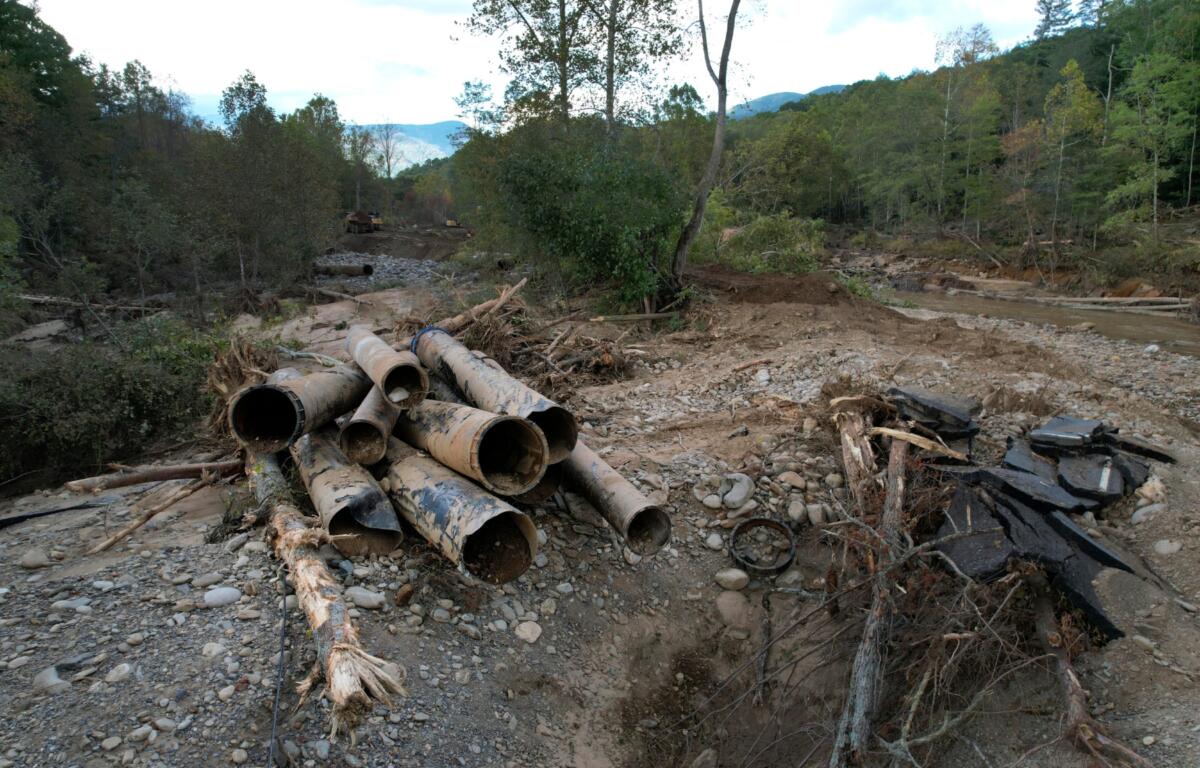
The city is also working to restore a damaged fuse gate at Bee Tree Reservoir, a repair expected to be completed by fall 2026. Once finished, it will allow the reservoir to return to full capacity, adding an estimated 58 days of water storage.
At the same time, officials are pursuing longer-term solutions, including doubling the capacity of the Mills River Water Treatment Plant and exploring a potential fourth water source.
Debris removal and watershed work
Crews are continuing debris removal in watershed areas, including clearing storm-related wood and sediment from reservoirs, access roads and nearby land.
Hart said the work is focused on preventing problems, such as debris washing back into reservoirs during heavy rain.
“We’re really looking at maintaining our structures and protecting the community,” he said.
The city is also considering future stream stabilization efforts, including planting vegetation to reduce erosion in areas impacted by landslides.
No guarantees — but greater resilience
Board members asked whether the upgrades would prevent another system failure if a storm like Helene were to hit again.
Hart stopped short of making guarantees but said the improvements significantly raise the system’s capacity and flexibility.
“I would not ever make a guarantee,” he said. “But we are putting systems in place that can treat water well beyond what we experienced.”
He added that while some infrastructure, like pipes near roads and rivers, will always be vulnerable, the goal is to ensure water can still be delivered and repairs can happen more quickly.
What residents may notice
Questions about potential water rate increases remain open. Hart said the city routinely reviews rates and will continue to do so as recovery projects move forward, though no major changes have been announced.
For now, officials say the focus is on rebuilding stronger.
“I don’t ever want to be in that position again where we can’t provide water,” Hart said. “We’re going to do everything we can to make sure we have the right structures in the right places.”
The Infrastructure Recovery Board is one of four advisory groups created to guide Asheville’s post-Helene recovery, alongside boards focused on housing, the economy, and the environment and public well-being.