



EDITOR’S NOTE: Strangeville explores the curious and unexplained stories that have long defined Asheville and Western North Carolina. The region is full of unanswered questions, from old folklore and local legends to eerie encounters, unsolved moments in history, and the true-crime mysteries that still leave people wondering. Each week, we look back with an open mind and a sense of curiosity, trying to understand why some stories take hold and why some can never be explained.
ASHEVILLE, N.C. (828newsNOW) — In the mountains along the North Carolina-Tennessee line, a name like Devil’s Den offers a not-so-subtle hint that strangers should stay away.
Devil’s Den is on Iron Mountain, where northern Mitchell County rises toward the Tennessee border and the ridges fold into one another. The area was ideal for outlaws who needed to hide out. This was not easy country to enter, and it was even harder country for law enforcement who had to pursue criminals through rough terrain.
In the late 1800s and early 1900s, this stretch of the Appalachians was remote border country. A man who knew the coves and ridges had an advantage over officers who came looking for him.
The origin of the name Devil’s Den is unknown, but by 1900, newspaper accounts show its dark reputation matched the name. One report described Devil’s Den as “the scene of many crimes”, including a deadly encounter between a Tennessee lawman and two men accused of operating an illegal liquor business.
A deputy sheriff from Unicoi County had gone to Devil’s Den to arrest William Harrell, who was accused of running a “blind tiger,” an old term for a place where illegal liquor was sold.
According to the report, Harrell opened fire. The deputy returned fire and killed him. Then Harrell’s brother attacked the deputy with a knife, leaving the officer with fatal wounds.
It was the kind of story that made Devil’s Den sound like a warning. In that border country, moonshine could turn neighbors into suspects and lawmen into targets.
That same borderland shaped the legend of Bill Honeycutt.
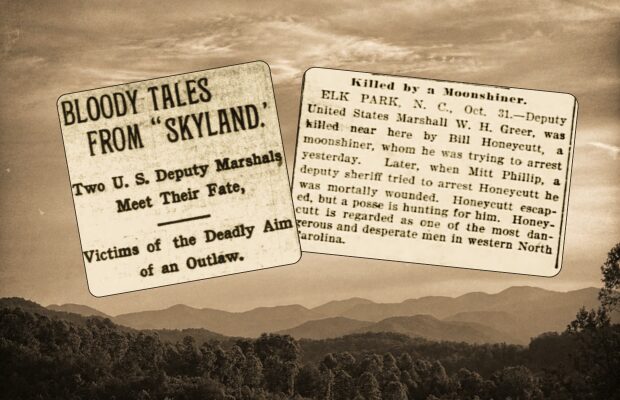
Honeycutt was from Mitchell County, and newspapers in 1899 described him as a notorious outlaw. According to Allen Cook’s account in “Moonshine, Murder and Mountaineers,” Honeycutt operated a blind tiger from a store near the North Carolina-Tennessee border. When North Carolina lawmen came for him, the story goes, he could slip into Tennessee. When Tennessee officers arrived, he could move back into North Carolina.
Cook’s account says Honeycutt eventually had several warrants issued against him in Mitchell County. When Deputy Marshal Greer and another deputy tried to surprise him, Honeycutt’s animals gave warning and the outlaw sensed trouble before they reached him. He captured one deputy at gunpoint and locked him in a hog pen.
Greer confronted Honeycutt near the Tennessee line. Honeycutt, carrying a rifle, turned toward the border. The marshal rushed him before he could get away. Both men fired. Greer was shot in the leg, and Honeycutt was wounded in the side but made it into Tennessee. Greer later died after infection set in, making Honeycutt a wanted man.
Honeycutt fled into Tennessee and was eventually captured in a mountain cabin near Johnson City. One report said officers found him with several rifles leaning against a wall. When the men rushed inside and cut off his access to the weapons, Honeycutt reportedly said, “Well, boys, you’ve got me”.
Honeycutt’s capture ended his run from the law, but it did not end the story of the mountains that helped build his legend.
Devil’s Den became more than a point on Iron Mountain. It became a reminder of a time when the mountains could shelter outlaws, the state line could offer a way out and a man could disappear into the ridges for only so long.