


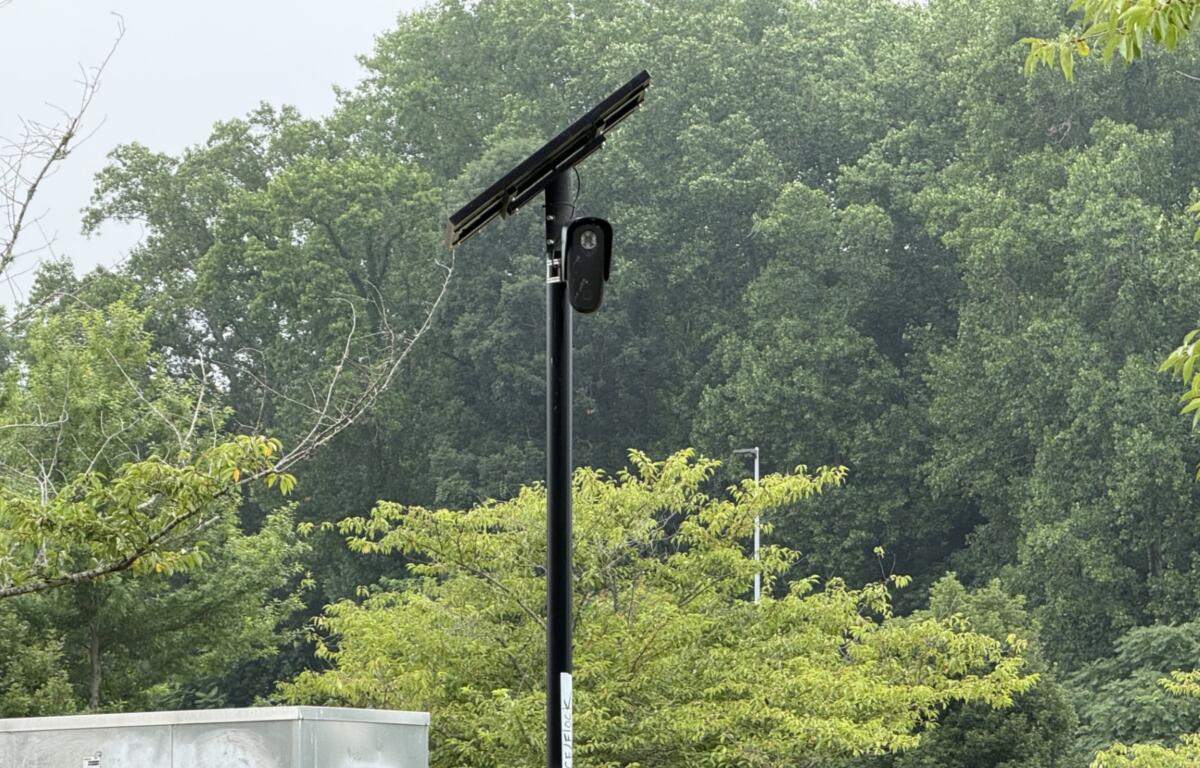

ASHEVILLE, N.C. (828newsNOW) — The Asheville Police Department has 11 Flock cameras scattered around the city. Among the public, the cameras have been a controversial installation, but APD says that there are serious safeguards around their use.
In an Asheville City Council meeting on Tuesday, May 12, city officials approved a $1.14 million federal grant for the development of a Real-Time Intelligence Center at APD. The RITC is intended to operate as a centralized hub of cameras across the city that can capture crime as it occurs. The Flock cameras will be part of that network.
During the public comment portion of the meeting, Asheville residents expressed concerns over privacy and the security of collected camera data.
However, APD Technology Supervisor Jimmy Wingo said that there are major restrictions around when APD can access photos taken by Flock cameras.
What do Flock cameras capture?
Wingo said that the model of Flock camera used by APD is a license plate reader that captures still images of passing vehicles.
“It is a still snippet of a car. Now, most of the time, you do get a picture of the full car. Most of the time, not all the time. Sometimes, it is literally the back of the car, if you will,” Wingo said.
When can APD access Flock photos?
Wingo said that APD can only sift through camera data if there is reasonable suspicion that a vehicle in the area has been involved in a crime. Otherwise, any photographs taken by Flock cameras are inaccessible.
Furthermore, Wingo said that out of 200 APD officers, only a select handful have the ability to access Flock photos.
“We have 18 people who have the ability to search, and only 18 people,” Wingo said. “Those searches, you have to put the reason. You have to put a case number if you have it.”
In some instances, like if a shooting had just occurred and an officer was searching for a car involved in the crime, there may not be a case number, Wingo said. However, there must always be a documented reason why the camera was accessed, without exception.
“Our lieutenant does quarterly audits,” Wingo said. “He just did an audit, and 100% of the time, we have reasons. All the reasons that we’re supposed to have. That’s what we’re looking for. We’re looking to make sure that everybody’s doing what you’re supposed to do.”
There are limits to how long Flock photos can be kept, too.
According to North Carolina General Statute 20-183.32, “captured plate data obtained by an automatic license plate reader system, operated by or on behalf of a law enforcement agency for law enforcement purposes, shall not be preserved for more than 90 days after the date the data is captured.”
Wingo said that the length of time APD keeps the data is even shorter.
“In North Carolina law, they can be stored up to 90 days. Flock, by their own company, has set 30 days as their limit. Now, we could probably ask Flock to make it longer, but we haven’t,” Wingo said. “Honestly, we’ve had many cases where a detective would come in and say, hey, 31 days ago, this car, we know this car went by there. No. Sorry. It’s gone. You can’t get it back.”
There are instances where Flock data might be kept longer than 90 days.
N.C. law 20-183.32 says that plate data can be preserved under a state or federal search warrant, or if a preservation request is able to provide “specific and articulable facts showing that there are reasonable grounds to believe that the captured plate data is relevant and material to an ongoing criminal or missing persons investigation or is needed to prove a violation of a motor carrier safety regulation.”
Even so, data must then be destroyed one year after the preservation request, unless another one is filed and approved under the same grounds. Data generated by Flock and other license plate readers is confidential and not available on public record.
What about illegal access?
Wingo said that there are consequences if officers access data without reasonable suspicion.
“If you don’t have a reason to tie that back into a crime, you cannot search it, and there’s disciplinary action for you if you do,” Wingo said. “We’ve seen this already in the media, where people are getting fired left and right.”
On Aug. 5, 2026, Elizabeth Anne Snowman, a police officer with the Mooresville Police Department, was arrested after an MPD audit indicated that she had accessed license plate reader data 31 times for illegal purposes.
She was using the data to “find information and track her boyfriend’s ex-wife,” explained MPD Chief Ron Campurciani in a press conference.
Wingo said he approved of disciplinary measures if officers are discovered to have misused a license plate reader system.
“I got asked about that the other day, and I think it’s great, honestly. I mean, I hate they’re being fired, but what is the system doing? The system’s doing what it’s designed to do, right?” Wingo said. “ It’s capturing the people who are doing things wrong, and therefore, they’re having to be held responsible.”
A promise of trust
Wingo said he wanted to assure the public they can trust APD to follow the rules.
“This is legit just trying to catch the bad guys and help the victims,” he said. “Honestly, our LPR cameras have helped us more. We’ve recovered so many stolen tags, stolen cars. But what it’s really helped us with is serious, serious crimes.”
Wingo said the speed Flock cameras can grant investigations will be able to help victims of crime faster.
“We’ve been able to assist that family in getting to court quicker and having a little bit, whatever you call it, closure,” Wingo said. “Finale.”
For more information
APD currently offers public information sessions and tours of the Real-Time Intelligence Center from 2-4 p.m. on Thursdays at APD headquarters, 100 Court Plaza, Asheville, N.C. Tour slots are limited to four to five people.
Read more. . .
-
Asheville man sentenced after gun linked to 4 shootings
Zyon Jacobs, 21, received 21 months in federal prison for illegally possessing firearms, including one tied to four Asheville shootings
-
$510,000 investment supports health care access in Western North Carolina
UnitedHealthcare funding will support Western Carolina Medical Society programs that connect uninsured patients with specialty care, provide medical interpreter services and support medical professionals across the region.
-
During Deal Days, you can get lifetime access to ChatGPT, Gemini, Claude, and more for $70
Asheville and WNC readers can explore multiple AI models and image, voice and video tools with 1min.AI’s lifetime plan. The $69.97 offer ends October 11; monthly credit limits apply.
-
Blue Ridge Parkway to clear Helene debris to reduce wildfire risk
Crews will remove fallen trees and storm debris along 11 miles near Asheville
-
This is not Helene: Why WNC’s rain threat is different
Asheville is more than 2 inches below normal rainfall as tropical moisture approaches, but flooding remains possible