


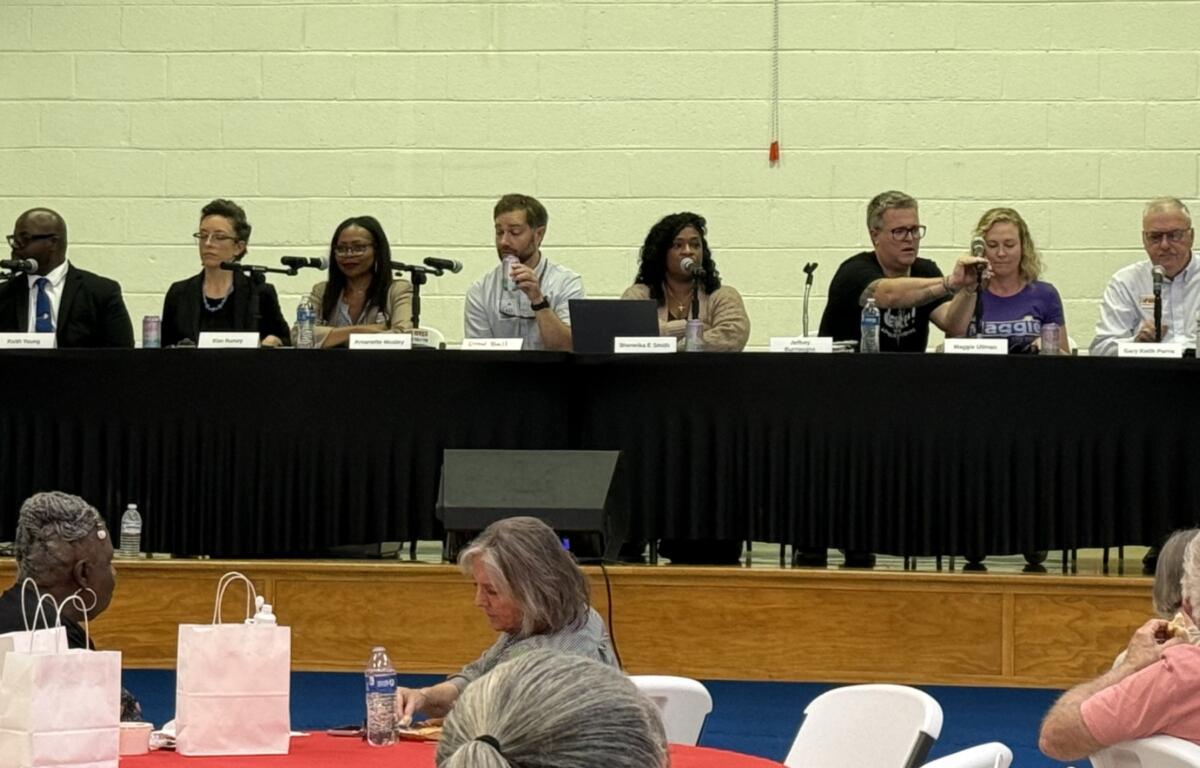

ASHEVILLE, N.C. (828newsNOW) — For the candidates gathered in Shiloh, the questions were less about campaign slogans and more about the basics.
Can longtime residents afford to stay in their homes?
Will the city fix sidewalks, drainage and roads before approving more development?
What happens when the next major storm hits?
And will the people who have lived in Shiloh for generations still be here to see the neighborhood’s future?
Those questions shaped a candidate forum held in the Shiloh Community Center, where candidates for Asheville City Council, mayor and Buncombe County sheriff spoke directly with residents about their priorities ahead of the Nov. 3 general election.
The forum followed a neighborhood walk in which candidates heard residents’ concerns firsthand.
The six candidates running for three Asheville City Council seats are Drew Ball, Maggie Ullman Berthiaume, Jeffrey Burroughs, S. Antanette Mosley, Sheneika Smith and Keith Young.
Mayor Esther Manheimer is seeking a fourth term against Council member Kim Roney.
Sheriff Quentin Miller, the Democratic incumbent, is facing Republican Gary Parris in November.
The candidates did not always agree on solutions, but many of the answers returned to the same basic idea: Shiloh residents want to see investment in the infrastructure and homes already here before the neighborhood takes on more growth.
Infrastructure before development
A question from residents focused on drainage, sidewalks, streetlights, road maintenance, public transportation and utility improvements.
Roney said the city needs to honor the Shiloh community plan and recognize the strain that development can put on a neighborhood that already lacks infrastructure.
She pointed to stormwater problems, limited sewer access and the need for safer streets and transit stops.
“It’s really important for me that we design our roads for everyone to get to their destination safely, no matter what mode of transportation they’re using,” Roney said.
She also pointed to the city’s recent inventory of Shiloh water service lines and a planned project using $4 million in federal funding to identify and replace lead pipes.
Young focused on what he described as a long-standing lack of investment in Asheville’s infrastructure.
When he first joined City Council in 2015, he said the city had gone decades without making sufficient investments in roads, drainage, sidewalks and other infrastructure.
He pointed to a $74 million bond approved during his time on council that funded infrastructure, affordable housing and parks.
“When you go around Asheville and you see that every park is brand new, that’s because I led,” Young said.
Young said the city needs to continue maintaining what it has rather than continually putting off infrastructure work.
For Smith, the answer is to look at infrastructure comprehensively rather than responding to individual complaints one at a time.
She said the city should identify what Shiloh residents have requested, what has already been funded and what remains in the queue.
“You cannot propose housing in a community that you have not invested sidewalks into,” Smith said, also citing drainage and stormwater controls.
That concern has become particularly important as residents face proposals for new development in the neighborhood.
Smith pointed to a recent proposal for more than 100 multifamily units in Shiloh, saying she listened to residents’ concerns about the scale of the project, infrastructure and whether it fit the neighborhood’s long-term vision.
Helene exposed gaps — and the strength of neighborhoods
The conversation also turned to Tropical Storm Helene and what candidates believe Asheville should learn from the disaster.
Burroughs, a River Arts District community leader and first-time candidate, said Helene showed what happens when systems fail — and how much communities can accomplish when residents organize themselves.
After the storm damaged his home, including his sewer and water lines, he said he encountered problems with insurance and assistance.
He said the experience reinforced the need for stronger community-based emergency infrastructure.
Burroughs pointed to the idea of resilience hubs, where neighborhoods could have places equipped with backup power, communications and other resources during emergencies.
“Don’t come into my community and tell me what you’re going to do,” Burroughs said. “You can have a seat at our table and let’s have a conversation.”
Ulman also emphasized the importance of what she called “human infrastructure” — the relationships among neighbors that become essential when conventional systems stop working.
During Helene, residents relied on churches, community centers, fire stations and neighbors for water, food, information and support.
“What if all those places had satellites so they could — you could have called all your children to let them know you were safe?” she asked. “What if all those places had refrigerators so that you could put your medicine when you didn’t have power?”
Ulman said Asheville is moving toward a grant program that could put money into resilience hubs throughout the city.
Mosley said Helene also demonstrated that disaster recovery isn’t equal for everyone.
“Recovery isn’t equal for everybody,” she said. “Some folks were struggling before the disaster and some folks will struggle after the disaster.”
She said Shiloh and other historically underserved neighborhoods have learned over generations how to take care of themselves when government systems fail.
Mosley said the neighborhood’s experience could help shape resilience hubs throughout Asheville.
Keeping people in their homes
Housing was another major theme, particularly for older residents who don’t want to leave the community they’ve spent decades building.
Ball said keeping people in their homes should be a central part of Asheville’s housing strategy.
The city has access to federal community development block grant money following Helene, he said, and those dollars should be directed toward helping homeowners make repairs and remain in place.
Ball also pointed to a proposed $30 million affordable housing bond on the November ballot.
“Fixing folks’ homes and keeping them in their home is one of the most effective affordable housing strategies that we have,” Ball said.
Smith said the issue goes beyond housing supply.
For longtime Black residents of Shiloh, she said, keeping homeowners in place is tied to preserving the neighborhood’s history and identity.
She described the debate over building more housing versus preserving existing homes as a question of neighborhood preservation.
“Keeping Black elders in their home is almost like the lynchpin to us remaining in the city,” Smith said.
She said the city should invest in infrastructure and home repairs while also making sure new development is appropriate for the neighborhood.
Roney described her approach as a combination of building new housing and protecting residents from displacement.
She said Asheville needs housing for workers and families while also investing in repairs, accessibility, down payment assistance and other tools that allow existing residents to remain in their homes.
“If you need to downsize, you shouldn’t have to leave town,” Roney said.
A future where longtime residents are still here
The forum’s final question asked candidates to envision Shiloh in 2030, when a larger share of the population will be 55 and older.
Parris, the Republican candidate for Buncombe County sheriff, said his focus would be on collaboration among local, state and federal agencies.
Parris, a 22-year Navy veteran, said the sheriff’s role extends beyond enforcing laws to building relationships that can improve public safety and emergency response.
“Being a sheriff is much more than enforcing the law,” Parris said. “That’s the critical partner.”
Berthiaume, who is caring for her 84-year-old father-in-law and 94-year-old mother-in-law, said aging in place requires more than a house.
Residents need affordable and adaptable homes, sidewalks, reliable transit and access to health care, groceries and churches, she said.
Burroughs said infrastructure investments should be designed to serve residents throughout their lives.
“It’s about building the infrastructure that’s going to sustain you for the rest of your lives and your children’s lives,” he said.
Mosley offered perhaps the simplest vision.
She said she wants the people who built Shiloh to still be living there in 2030 and enjoying the results of the investments made in the neighborhood.
“I want to be able to point to longtime residents who are still living here and that they can say that they benefited from the investment too,” Mosley said.
Young brought the discussion back to property taxes and the financial pressure facing older homeowners.
He said the easiest way to age in place is to be able to keep the home a person already owns.
“If we don’t manage our money right, you can’t manage your money right,” Young said, arguing that rising taxes can take an increasingly large bite out of the fixed incomes of older homeowners.
For Smith, the issue is ultimately about whether the city follows through on the promises it makes to neighborhoods.
Residents shouldn’t have to repeatedly attend meetings, send emails and petition elected officials for basic needs, she said.
“I take it personal when I see Ms. Sophie come before council after numerous emails and Ms. Norma Baines,” Smith said. “It’s a waste of your time, and it does impede on the life that you all have fought and struggled for.”
The forum ended without a single solution to the problems residents raised. But there was broad agreement about what was at stake.
Shiloh residents aren’t simply asking what Asheville will look like in the future. They’re asking who will still be here to see it.