


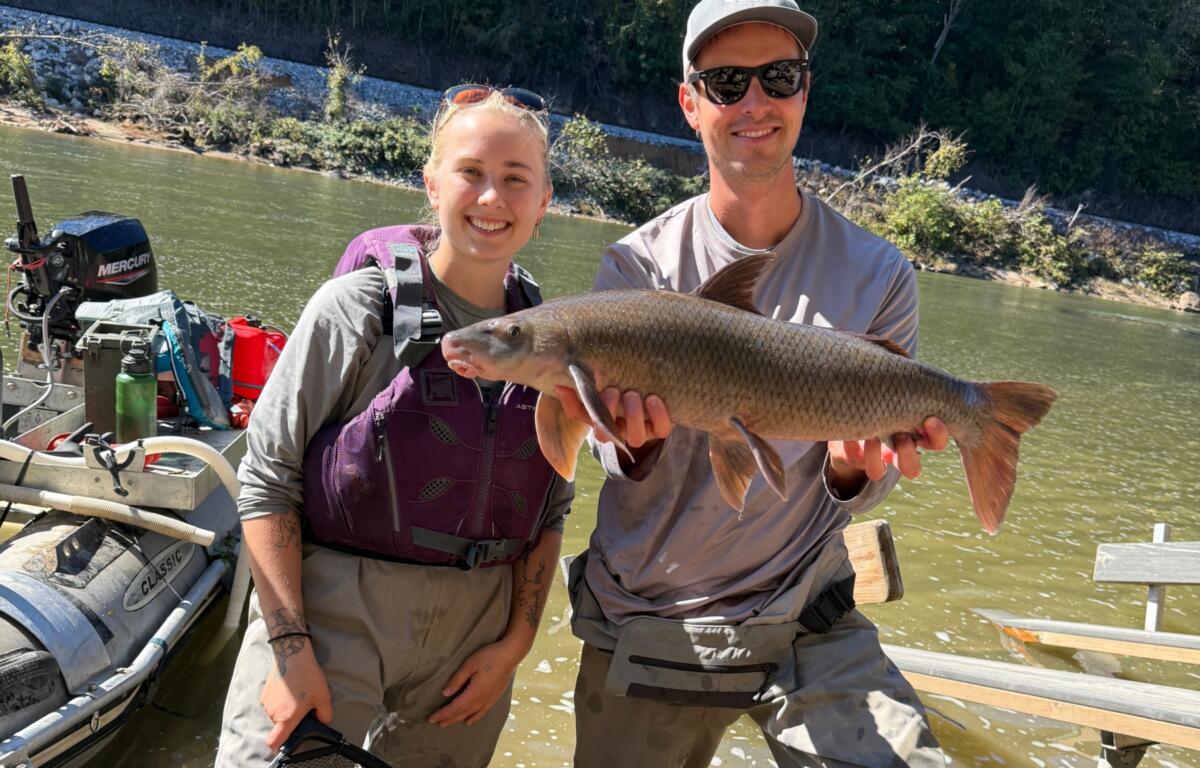

ASHEVILLE, N.C. (828newsNOW) — For years, two North Carolina wildlife biologists joked about the day they’d catch a blue sucker in the French Broad River. Neither really expected it to happen.
Then, on Oct. 21, it did.
While monitoring fish populations near Hot Springs, biologists with the N.C. Wildlife Resources Commission pulled a 29-inch male blue sucker from the river — a species never before documented in the French Broad River.
The unexpected catch was more than a pleasant surprise. Wildlife officials say it offers another encouraging sign for a river that has endured decades of industrial pollution, barriers to fish migration and, more recently, the devastation of Tropical Storm Helene.
Fisheries biologist Dylan Owensby was in the boat when the fish was caught.
“My first reaction was confusion for a second and then after realizing what it was, I was shocked and in a little bit of disbelief,” Owensby said. “I knew that there were no records of it in North Carolina, so it definitely felt special.”
He quickly snapped a few pictures of the fish in the boat’s live well, just in case it jumped out.
The discovery also meant Owensby owed fellow fisheries biologist Luke Etchison an apology.
For years, Etchison had jokingly predicted they’d catch a blue sucker every time they headed out to monitor the river. Just a couple of weeks before the discovery, Owensby had told him he didn’t think it would ever happen.
“So, as we were driving up to the bank, I yelled to Luke that I owed him an apology!” Owensby recalled.
A river making a comeback
The French Broad River hasn’t always been a welcoming place for fish.
Decades of industrial pollution took a heavy toll on the watershed. By the 1960s, a stretch of the river between Brevard and Hendersonville had so little dissolved oxygen that aquatic life could not survive there.
Conditions began improving after the federal Clean Water Act passed in 1972. The eventual closure of major industrial facilities along the river also helped reduce pollution.
But dams continued to pose another problem, preventing some fish from reaching upstream spawning grounds.
Since 2022, state biologists have been moving native fish from the lower French Broad River to upstream stretches where dams have prevented them from returning on their own.
Those efforts have included tangerine darters, gizzard shad, freshwater drum, black buffalo, smallmouth buffalo and smallmouth redhorse.
Now, the blue sucker has joined a growing list of fish discoveries in the watershed.
Biologists believe the species may be expanding into North Carolina from Tennessee as river conditions improve.
“Blue suckers are what we call an indicator species,” Etchison said. “When suckers are found, it suggests we have good water quality. It’s also a sign that the French Broad River is recovering from Hurricane Helene devastation.”
Blue suckers favor deep, fast-moving water, making portions of the French Broad suitable habitat.
The discovery is encouraging, although biologists are still studying how Helene affected fish populations and habitat throughout the watershed.
Wildlife officials say six other fish species previously unknown or considered lost to the watershed have also been documented: snubnose darter, white bass, brook silverside, stonecat madtom, mountain madtom and American brook lamprey.
Why these fish matter
Suckers might not get the attention that trout and bass do, but they play an important role in keeping rivers healthy.
Some species are nicknamed the “salmon of the South” because they migrate upstream in the spring to spawn.
Those migrations carry nutrients from larger rivers into smaller streams, benefiting aquatic insects, vegetation and other fish.
Dams can interrupt that process by blocking access to spawning areas.
Suckers also connect to one of Western North Carolina’s most endangered aquatic species: the Appalachian elktoe.
The federally endangered freshwater mussel historically lived in the French Broad and Swannanoa rivers but has disappeared from those waterways, according to the N.C. Wildlife Resources Commission.
Recent research by Appalachian State University and state wildlife biologists has identified several sucker species as hosts for Appalachian elktoe larvae.
The tiny larvae attach temporarily to fish, typically on their gills, before dropping off in another location to continue developing. The process generally doesn’t harm the fish.
Mussels also help keep rivers clean by filtering suspended particles from the water.
That means protecting fish populations and restoring their ability to move freely through rivers could benefit other aquatic species as well.
What’s next for the French Broad?
The N.C. Wildlife Resources Commission considers the French Broad a priority watershed for conservation. It also has more state-listed fish species than any other river basin in North Carolina.
Biologists regularly monitor the river to track changes in fish populations, evaluate reintroduction efforts and look for rare or threatened species.
State wildlife staff are also working with Clemson University and the U.S. Forest Service to study sucker movements and populations in the lower French Broad, including how the fish are recovering after Helene.
Looking ahead, Etchison hopes continued restoration work and the possible removal of additional dams will allow more fish to return to their historic spawning grounds.
“We are hopeful that our reintroduction efforts and future dam removals will restore these important sucker migrations to the upper French Broad River and uplift the entire French Broad ecosystem,” he said.
After years of joking about catching a blue sucker, the two biologists finally caught one.