


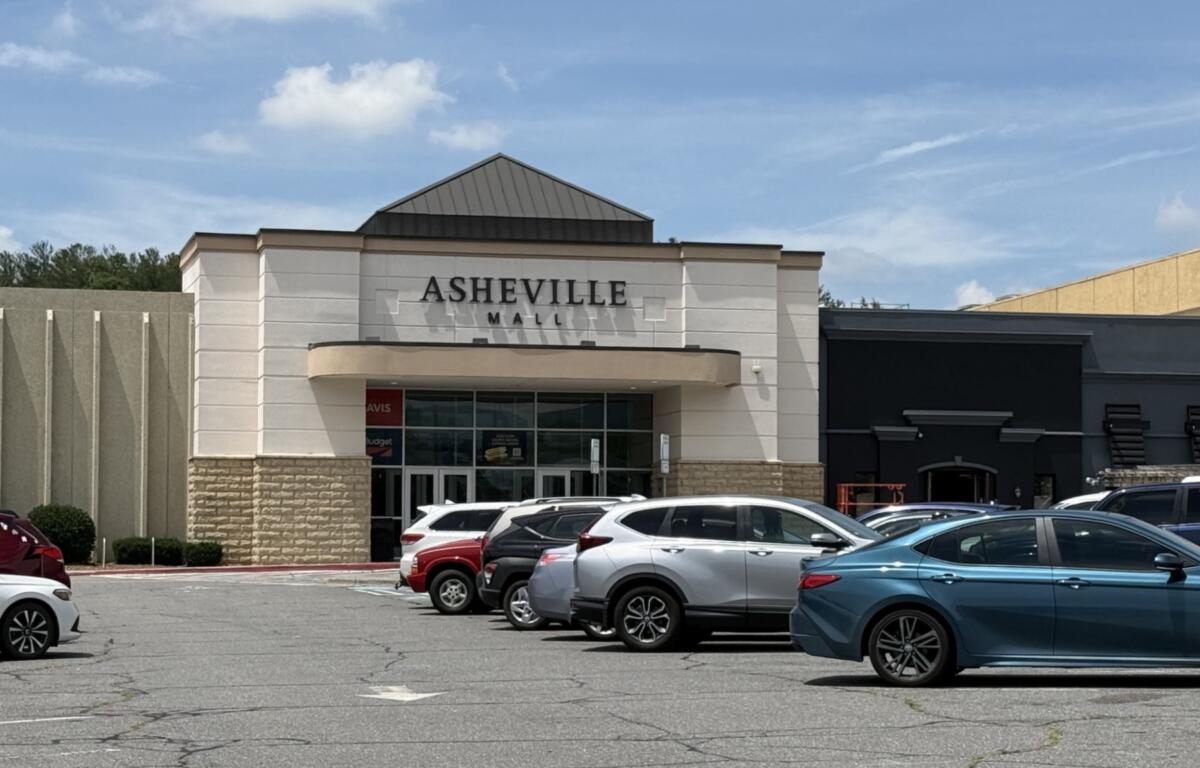

ASHEVILLE, N.C. (828newsNOW) — A proposal to rezone much of the Asheville Mall property back to regional business zoning sparked a lengthy debate Wednesday night over the future of Asheville’s urban place district, with the city’s Planning and Zoning Commission ultimately recommending denial of the request.
The commission voted 4-3 to recommend denying a rezoning request for approximately 40 acres at Asheville Mall, concluding that the change would be inconsistent with the city’s comprehensive plan and long-term vision for the Tunnel Road corridor.
While the vote focused on a single property, much of the nearly hour-long discussion centered on whether the urban place zoning district is working as intended.
Attorney Jesse Swords, representing the property owner, argued that urban place regulations have proven too restrictive and have effectively prevented redevelopment at one of Asheville’s largest commercial properties.
“We’ve had no activity,” Swords told commissioners. “We certainly haven’t seen that goal move any closer to reality.”
Swords said requirements involving street connectivity, block lengths, building placement and site design create significant challenges for large commercial sites such as Asheville Mall. He noted that developers are required to connect streets to adjacent parcels even when steep grades make those connections difficult.
He also argued that the district’s goals — supporting housing, business growth, walkability and environmental improvements — cannot be achieved if projects never move forward.
Using aerial photographs from 2006, 2010 and 2024, Swords showed how portions of the mall area and nearby shopping centers had already been improved under previous zoning classifications through updated landscaping, pedestrian accommodations, tree plantings and stormwater controls.
“The point is zoning back to regional business doesn’t make us give up everything urban place was trying to achieve,” Swords said.
He said his client wants to activate portions of the mall’s extensive parking areas and bring new economic activity to a corridor that many agree is struggling.
“We all know Tunnel Road is in trouble,” Swords said. “It is falling into disrepair, and here we have somebody who wants to add new economic activity out there.”
According to Swords, his firm has worked with multiple potential redevelopment concepts for portions of the property, including the former Sears site, but none were financially feasible under the current urban place standards.
He also argued that reverting to regional business zoning would not eliminate modern development requirements because any redevelopment would still have to comply with current city standards for sidewalks, landscaping, tree canopy and stormwater management.
Commissioners largely agreed that urban place presents challenges but differed sharply on whether a straight rezoning was the appropriate solution.
One board member said the request felt less like a routine rezoning and more like a broader judgment on the urban place district.
“If we rezone this one parcel, it’s effectively going to kill urban place in that location in my mind,” he said.
He and several other commissioners argued that the city should address concerns about Urban Place through the upcoming rewrite of Asheville’s Unified Development Ordinance rather than through a large-scale rezoning.
Commissioners also discussed whether conditional zoning could provide an alternative path forward. City staff said they believe inconsistencies in the ordinance may have unintentionally created confusion about whether conditional zoning can be used within urban place districts and indicated they would review the language.
Planning staff noted that if the property were rezoned back to regional business, future city leaders could face limitations on reimposing some of the urban design standards currently required under urban place because of state restrictions on downzoning property.
Another commissioner said he found many of the urban place regulations overly burdensome and questioned whether the district, as written, can realistically produce redevelopment.
“My initial reaction was I don’t see how developers make this work,” he said, describing the district as “extremely prescriptive.”
But he said he supports the goals behind urban pPlace, including walkability, housing development and improved connectivity, but believes the regulations may be limiting investment opportunities.
Another commissioner also expressed concern about the condition of the Tunnel Road corridor and said he would like to see new investment in the area.
“I just want to see tenants who are investing money in the property and upgrading it,” he said.
Still, commissioners supporting denial said the request would move the property further away from the city’s adopted vision for the area.
The city’s comprehensive plan identifies the corridor as an urban center intended to support mixed-use development, greater density, housing opportunities and transportation alternatives.
Those commissioners argued that while urban pPlace may need revision, abandoning it entirely on one of the district’s largest properties would undermine those long-term goals.
The motion to deny stated that the rezoning request was unreasonable, inconsistent with Asheville’s comprehensive plan and did not meet the development needs of the community because it failed to support the city’s vision for walkable, transit-oriented mixed-use development.
The recommendation now moves to Asheville City Council, which will have the final say on whether the property remains zoned urban place or returns to regional business.
The discussion also prompted staff to consider potential ordinance amendments that could clarify redevelopment options within urban place districts while the broader UDO rewrite moves forward.
All recommendations from the Planning and Zoning Commission are forwarded to Asheville City Council, which has final authority on zoning map amendments and text changes.