


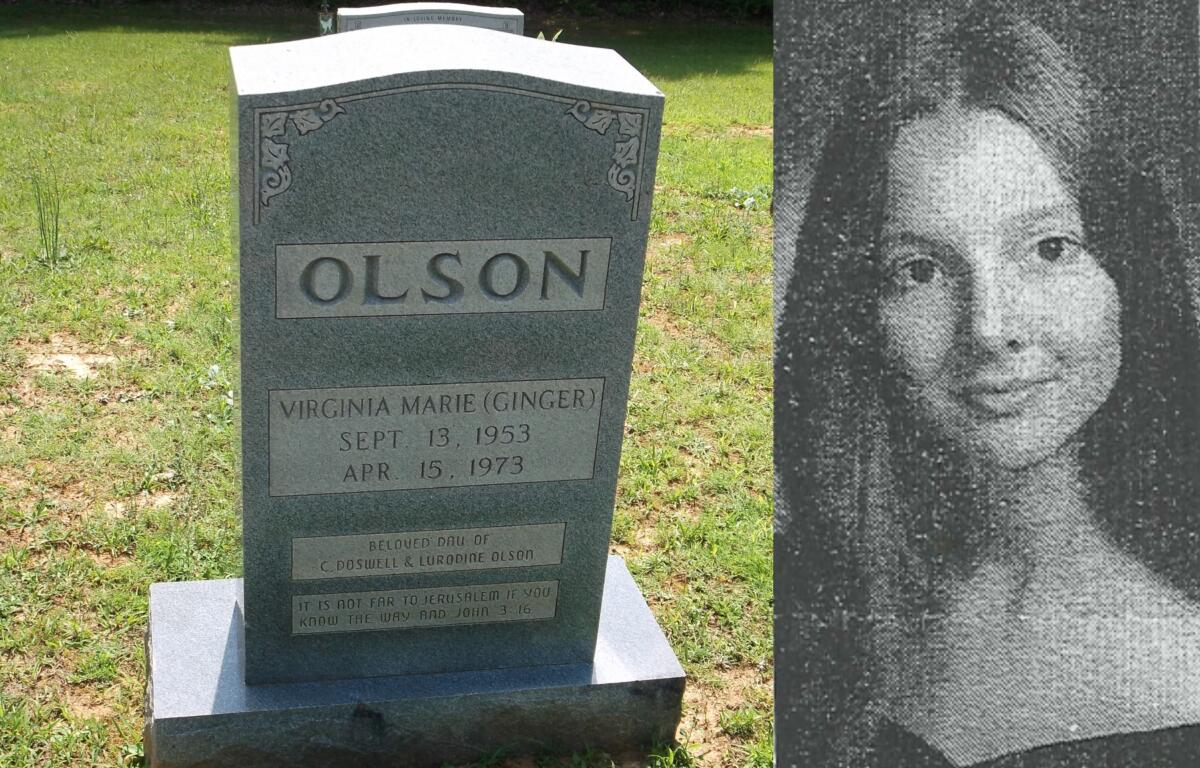

Editor’s Note: This story is part of Beneath the Blue Ridge: The Virginia Olson Case, a special series from 828newsNOW revisiting the unsolved killing of Virginia Olson in Asheville. Through records, reporting and interviews, the series examines what happened and why the case remains unresolved. Read the full series here.
ASHEVILLE, N.C. (828newsNOW) — On a spring afternoon in 1973, the body of 19-year-old UNC Asheville student Virginia “Ginger” Olson was found near the Asheville-Biltmore Botanical Gardens. Her killing shocked the city. More than five decades later, it remains one of Asheville’s most haunting unsolved homicides. Now, a new review of autopsy records and investigative files suggests evidence collected at the time may still hold answers.
Content Advisory: This story includes details from a homicide investigation and autopsy report that may be upsetting to some readers.
What happened to Virginia Olson in Asheville
Olson’s body was discovered around 3:30 p.m. on April 15, 1973, along a trail near the UNC Asheville campus.
Investigators documented signs of a violent struggle. Olson’s clothing was disturbed. Personal belongings, clothing items and books were found scattered up to 30 feet from her body. Her death was quickly ruled a homicide.
No one has ever been charged.
What the autopsy report found
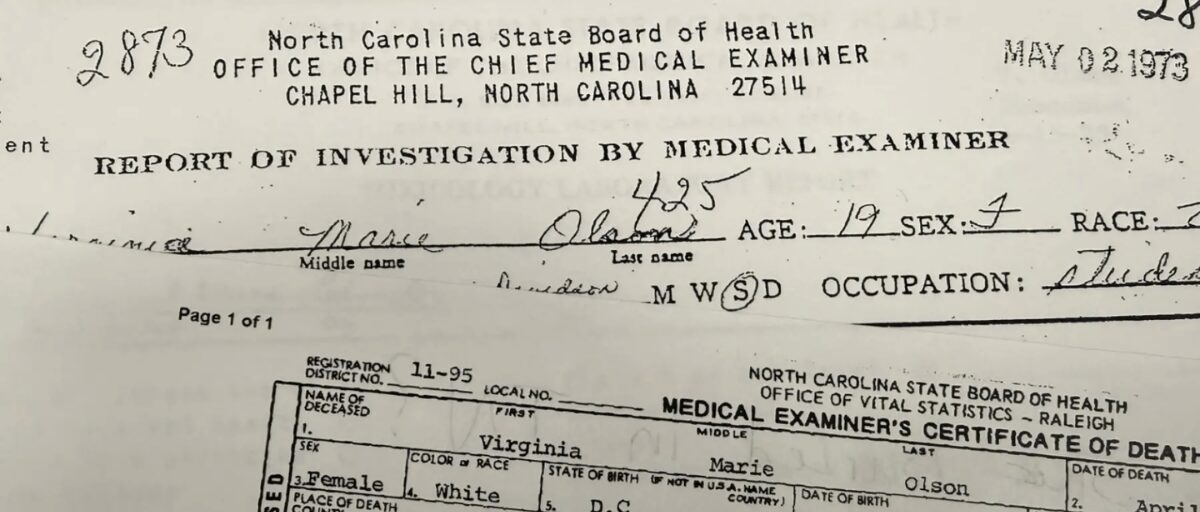
A retired pathologist reviewed the autopsy report and related case documents for 828newsNOW. The review found that Olson died from massive blood loss caused by a stab wound to the chest. The report also documented a serious wound to her neck, which the pathologist said would also have been life-threatening.
Olson’s wounds indicate a deliberate, brutal attack that required physical strength with the intention to kill. Official case records indicate her final moments were likely terrifying.
The crime scene records show investigators collected biological evidence, including blood and semen. More than 50 years later, the question is whether any of that evidence still exists, and whether it was preserved well enough to be tested using modern forensic methods.
The pathologist noted that DNA from clothing or biological samples, if still available and properly preserved, could potentially be used to develop a profile using modern testing methods. Even partial results might help narrow a suspect pool or identify possible familial links.
Some personal items and clothing tied to potential suspects were collected for comparison, but no definitive match has been made.
Why the 1973 investigation faced limits
Crime scene technology in 1973 looked very different from modern standards.
Leigh Thomas, Buncombe County Crime Scene Unit supervisor, said investigators at the time often had limited photography, fewer preservation tools and no DNA testing.
Detectives frequently handled both investigative work and evidence collection. Biological evidence could be collected, but testing methods were far more limited than today.
“Things were different in ’73″, said Thomas. “Officers would have approached the scene looking for evidence, but the mindset might have been different in what they saw as evidence.”
Investigators often wore no protective gear or gloves, handling evidence directly with their hands, unaware of the risk of contamination. Detectives frequently performed double duty: solving the crime while also documenting the scene.
Photography was limited and precarious. Investigators relied on 35mm film, which often yielded only a handful of photos per scene.
“You might open a homicide file, and there are literally six pictures of the scene of the body,” Thomas said. “Some of those could have been unusable — a finger over the lens, too dark, too light. It was completely dependent on the skill of the photographer.”
Evidence collection was similarly basic. Investigators would gather everything around the victim, usually storing items in paper bags. DNA testing did not exist, so blood could only be typed, and there was no way to trace microscopic evidence.
“The only thing they could tell back then was your blood type and if you were a secretor or non-secretor,” Thomas said. “DNA wasn’t used until the mid-1980s. So, much of what was collected, they didn’t even know could be used in the future.”
Despite these limitations, some investigators were surprisingly forward-thinking.
“They were either just collecting everything to keep it all, or they were hopeful of what we could do someday,” Thomas said.
Items preserved in paper bags — clothing, tissues, even small personal effects — can yield DNA decades later.
“If it was handled properly, DNA can last forever,” Thomas said.
Chaos at the scene was another challenge.
“EMS, fire and police would come in and trample all over stuff,” Thomas recalled. “But back then, it just couldn’t be helped.”
Today, careful protocols ensure that evidence is protected and preserved for microscopic analysis, something Thomas describes as “astronomically” more advanced than in the 1970s.
Yet, even in those early years, investigators laid the groundwork for modern breakthroughs.
“Some of the detectives did a really, really good job considering they didn’t know what they were collecting,” Thomas said.
With modern tools like touch DNA analysis and genetic genealogy, cold cases — sometimes decades old — can now yield new leads.
“Virtually anytime there is a meeting between two individuals, there is always evidence left behind,” she said.
Could DNA still solve the Virginia Olson cold case?
Thomas’ recollections underscore a simple truth: even when technology was limited, careful observation, thorough collection and a forward-thinking mindset created opportunities for justice far into the future.
“Back then, we looked more for the suspect — what does he look like, what was his car,” she said. “Now, we also have DNA and latent processing to put together to solve it, which they didn’t have in 1973.”
For many cold cases, time closes doors. But advances in forensic science have reopened others once thought unsolvable.
More than 50 years later, Olson’s killing remains part of Asheville’s unfinished history.
Investigators and forensic experts say the case may still hold clues that could bring long-awaited answers, offering hope that modern science may one day illuminate the truth behind a spring day that ended in tragedy.
Whether evidence still exists — and whether it can still speak — may determine if this case ever reaches resolution.
This story is part of Beneath the Blue Ridge, an ongoing series revisiting the Virginia Olson case. Six parts, released over three weeks. Follow along as the story unfolds with new installments each Monday and Wednesday.
Do you have information about the Virginia Olson case?
We are actively reporting this story. If you have information we want to hear from you.
Tips on the 1973 killing of Virginia Olson can be submitted to the Asheville Police Department at 828-252-1110, by texting “TIP2APD” to 847411, or through Asheville-Buncombe Crime Stoppers at 828-255-5050. The N.C. State Bureau of Investigation Cold Case Team can be reached at 919-662-4500 or contactus@ncsbi.gov.
828newsNOW is an independent news organization and is not affiliated with law enforcement.