


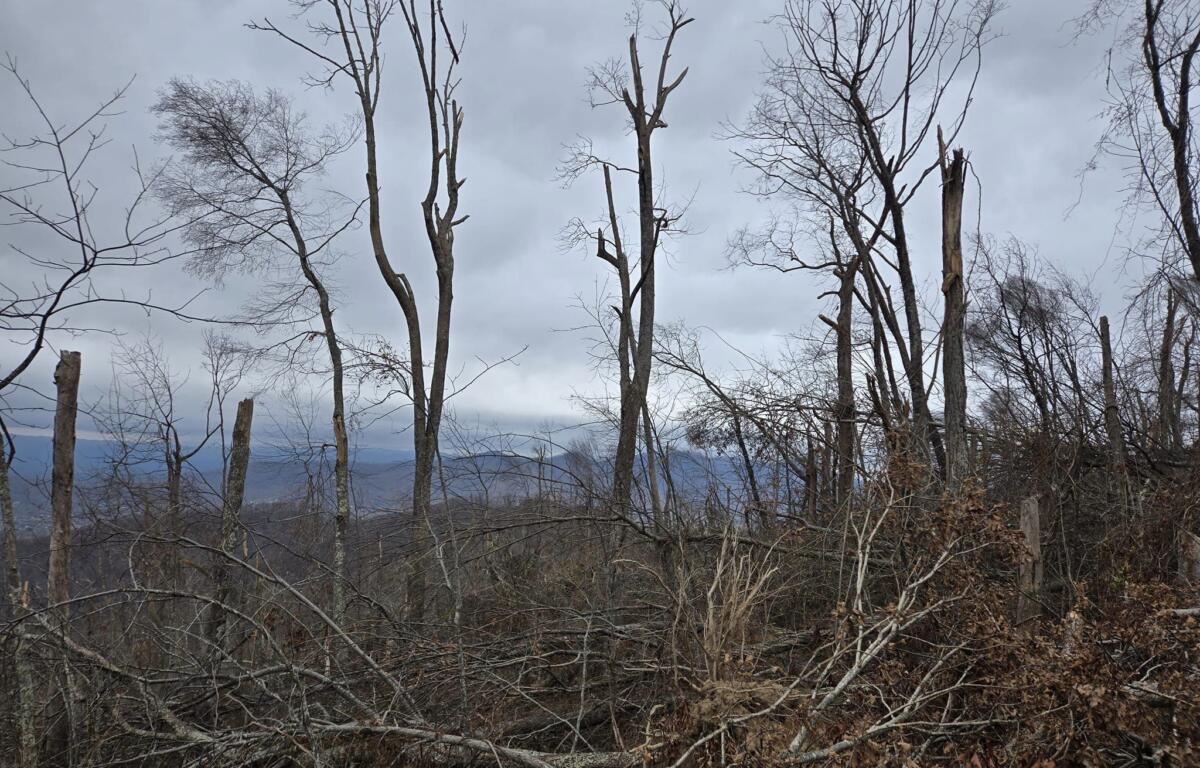

ASHEVILLE, N.C. (828newsNOW) — Nearly two years after Tropical Storm Helene ripped through Western North Carolina, its damage is still visible across the region’s forests.
Trees remain down. Streams and forest roads were damaged. Fallen timber has added to wildfire concerns. And some private landowners are still seeking compensation for timber lost in the storm.
A N.C. Forest Service assessment conducted after Helene estimated the storm damaged about 822,000 acres of timberland across North Carolina and caused nearly $214 million in timber losses.
Most of that damage was on private property.
The assessment estimated 78 percent of the affected timberland was privately owned, while about 21 percent was publicly owned and about 1 percent was reserved land, such as parks.
Western North Carolina bore the brunt of the damage.
The Forest Service identified Avery, Buncombe, Henderson, McDowell, Mitchell and Yancey among the hardest-hit counties based on its aerial survey.
McDowell County had an estimated 130,805 acres of damaged timberland. Buncombe had an estimated 89,440 acres, followed by Avery with 74,437, Yancey with 62,912, Mitchell with 59,244 and Henderson with 57,043.
Other mountain counties also sustained significant damage. The assessment estimated 39,764 damaged acres in Madison County, 21,376 in Transylvania and 16,737 in Haywood.
The financial losses didn’t necessarily follow the acreage.
Mitchell County’s estimated timber loss exceeded $41 million, while Yancey’s was about $27.5 million. Buncombe’s was about $19.3 million and McDowell’s was nearly $16.9 million.
A patchwork of damage
Those acreage figures don’t mean every tree within those areas was damaged or destroyed.
The N.C. Forest Service conducted an aerial survey after the storm, examining 333 survey points and using geographic modeling to estimate damage between observation areas. The agency said its acreage and dollar calculations should be considered estimates of maximum values.
What surveyors found was a patchwork.
Severely damaged areas sometimes sat beside forests that escaped with relatively little damage. Southerly, windward slopes generally suffered more damage, and hardwood stands were hit harder than conifers.
Most of the timber damage came from trees being blown over rather than snapped, according to the assessment. Surveyors also observed damage that appeared consistent with microbursts or downbursts.
The agency said Helene may have been North Carolina’s most damaging forest wind event since Hurricane Fran in 1996 and Hurricane Hugo in 1989.
But the damage didn’t end with the trees.
Streams, roads and watersheds
U.S. Forest Service teams returned to parts of the mountains in 2025 to get a closer look at what Helene had done to streams and watersheds.
Teams inventoried about 150 miles of streams in the Appalachian, Grandfather and Pisgah ranger districts and documented more than 10,000 individual features.
Those included landslides, erosion, flooding, downed trees, debris piles, log jams, sediment deposits and damaged infrastructure.
The inventory was intended to help the Forest Service identify and prioritize restoration work rather than provide a complete count of everything Helene damaged.
Access was another problem.
On the Grandfather Ranger District alone, Helene affected about 300 miles of forest roads. The U.S. Forest Service reported that crews had reopened 236 miles by December 2024.
The fallen trees and debris also created another lingering concern: wildfire.
Large amounts of downed timber remain across parts of the national forests, adding potential fuel for fires and making some areas harder for firefighters to reach.
One example is unfolding in Madison County, where officials are preparing for the fall fire season in an area hit particularly hard by Helene.
The Mars Hill Volunteer Fire Department said the southern Paint Fork area experienced some of the worst timber blowdown in Madison County during the storm. The N.C. Forest Service is seeking landowners willing to participate in the creation of a fuel break through the blowdown along the South Mountain ridgeline between Hamburg Road and Metcalf Creek Loop.
The proposed fuel break would follow existing logging roads and would be built at no cost to participating landowners, according to the fire department. Besides reducing wildfire fuels, the project is intended to give first responders better access to the forest interior if a fire breaks out.
Private landowners still seeking help
The effects are also being felt outside public forests.
With the state estimating nearly four out of every five damaged timberland acres were privately owned, North Carolina is still accepting applications from some landowners seeking compensation for their losses.
The N.C. Forest Service’s Timber Loss Relief Program provides federal disaster money to partially compensate eligible woodland owners for timber damaged or destroyed by Helene.
To qualify, applicants must own at least 10 contiguous acres of Helene-affected timber that sustained moderate or greater storm damage in one of the 39 federally declared disaster counties.
The current application period ends at 5 p.m. Oct. 12. Applicants in this round have until 5 p.m. Oct. 26 to submit the required timber damage assessment report used to document losses and help determine payments.
The N.C. Forest Service has been asked how many Western North Carolina landowners have applied, how many damaged acres those applications represent and how much money has been requested, approved or distributed.
Looking at another decade of recovery
Even as landowners seek help for losses dating to 2024, state and federal forestry officials are preparing for years of additional work.
The N.C. Forest Service announced Sept. 10 that it had entered into a nearly $65 million agreement with the U.S. Forest Service to help restore national forests and surrounding private lands affected by Helene.
The agreement runs for 10 years.
The money is expected to be used for work including reducing hazardous fuels, controlling invasive species and restoring forests. Work also may extend to qualifying private property near national forest land when it advances shared forest-management goals.
Officials say the enormous amount of fallen timber left by Helene continues to present wildfire, access and public safety concerns.
The U.S. Forest Service has also been asked for updated information on the condition of the Pisgah and Nantahala national forests, including how much storm-damaged land has been treated and what work remains.
The numbers collected after Helene offer a snapshot of what the storm did in 2024. The work underway now shows how much longer the consequences could last.
Helene crossed Western North Carolina in hours. For the region’s forests, recovery is being measured in years.