


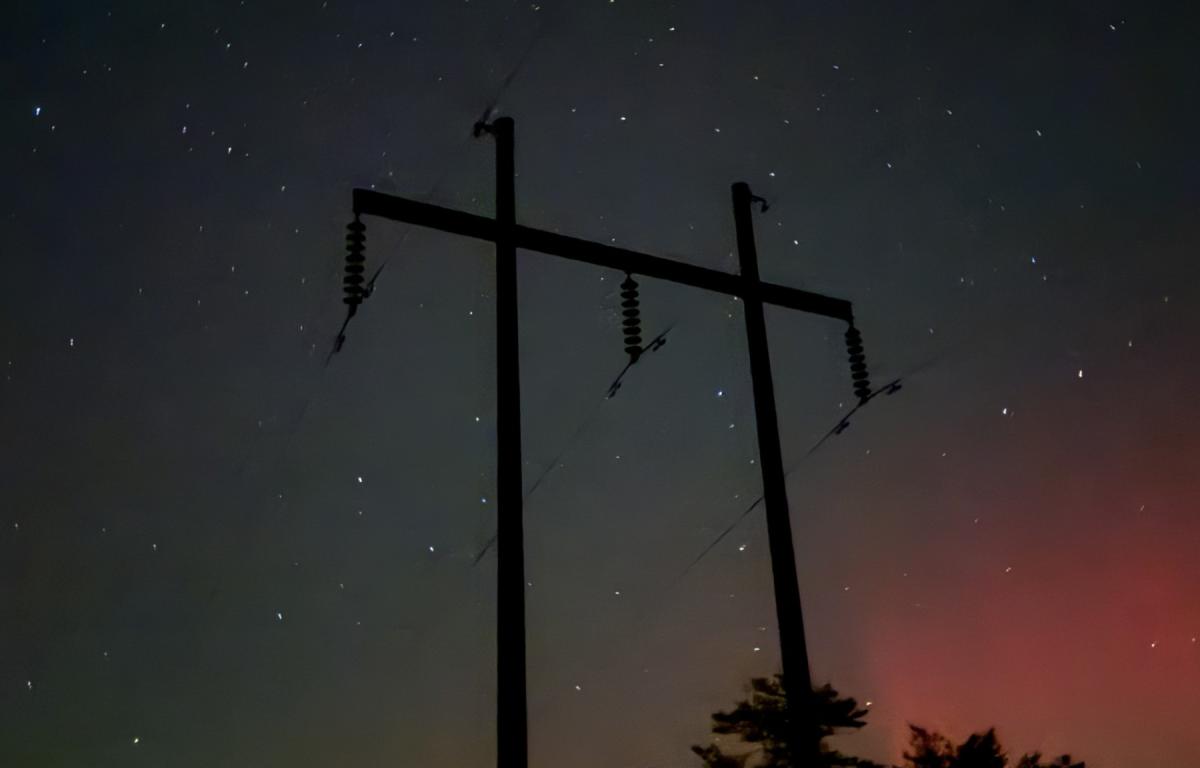

ASHEVILLE, N.C. (828newsNOW) — Skywatchers across parts of the United States could get a rare opportunity to see the Northern Lights Thursday night into Friday morning as space weather forecasters monitor a series of solar events expected to trigger strong geomagnetic storms.
The National Oceanic and Atmospheric Administration has issued a geomagnetic storm watch for Thursday and Friday, with conditions potentially reaching G3 (strong) or even G4 (severe) levels. If forecasts hold, the aurora borealis could become visible much farther south than usual, including parts of the mid-Atlantic and possibly North Carolina.
The colorful displays are generated when charged particles from the sun interact with Earth’s magnetic field. While the best viewing chances remain in northern states and Canada, stronger storms can push aurora visibility into lower latitudes.
Forecasters say several solar weather systems may arrive at Earth in close succession, increasing the likelihood of geomagnetic disturbances. Those include a coronal mass ejection, or CME, launched from the sun, a co-rotating interaction region where fast-moving solar wind overtakes slower-moving material, and a high-speed solar wind stream flowing from a hole in the sun’s outer atmosphere.
According to Spaceweather.com, a series of powerful X-class solar flares erupted June 3, producing multiple CMEs that are expected to reach Earth on Friday.
NOAA predicts isolated periods of G1 geomagnetic storm activity Thursday night, with stronger G3 to G4 conditions possible Friday. A G4 storm is considered severe and can occasionally produce aurora displays visible hundreds of miles farther south than normal.
For North Carolina observers, visibility remains uncertain. Experts note that aurora forecasts can change quickly depending on how incoming solar material interacts with Earth’s magnetic field. Even if the lights are not visible to the naked eye, smartphone cameras using night mode can sometimes capture faint colors in the sky.
Those hoping to catch a glimpse should seek out dark locations away from city lights, face north and allow their eyes time to adjust to the darkness. However, viewing conditions may be hampered by a bright waning gibbous moon that will rise after midnight and illuminate the pre-dawn sky.
Space weather enthusiasts can track real-time conditions through aurora forecast websites, webcams and mobile apps that monitor solar activity and geomagnetic conditions.
The potential light show comes as astronomers look ahead to a busy summer skywatching season that will include close planetary alignments, the Perseid meteor shower in August and both solar and lunar eclipses visible in parts of North America.
Whether North Carolina joins the viewing area will depend on the strength of the incoming solar storms, something forecasters say won’t be known until the charged particles arrive and begin interacting with Earth’s magnetic field.
Other celestial events to watch this summer
While skywatchers keep an eye out for the Northern Lights this week, several other notable astronomy events are on the calendar this summer:
- Planetary aAlignment (June 6-10): Venus and Jupiter will appear close together above the western horizon shortly after sunset. Mercury will also join the display, creating a rare grouping of bright planets visible to the naked eye.
- Crescent moon joins the show (June 17): A thin crescent moon will appear near Venus as part of the ongoing planetary alignment.
- Perseid meteor shower (Aug. 12-13): One of the year’s most popular meteor showers is expected to peak under favorable moonlight conditions. Observers in dark-sky locations could see dozens of meteors per hour, including bright fireballs.
- Total solar eclipse (Aug. 12): The path of totality will cross parts of Iceland, Greenland, Portugal and Spain. In North America, portions of the northeastern United States and much of Canada will experience a partial eclipse.
- Partial lunar eclipse (Aug. 27-28): Nearly 96 percent of the moon is expected to pass through Earth’s shadow, creating a dramatic reddish appearance visible throughout the United States and Canada.
- Milky Way core viewing season (all summer): Summer offers some of the year’s best opportunities to view the bright central region of the Milky Way from dark-sky locations away from city lights.
- International Space Station flyovers (throughout summer): The International Space Station will be visible on many summer nights, appearing as a bright, fast-moving object crossing the sky. Viewing times vary by location.
- Summer sonstellations (all summer): The Summer Triangle, the Big Dipper, Ursa Major and other familiar constellations will dominate evening skies, making summer one of the best seasons for beginner stargazers.