


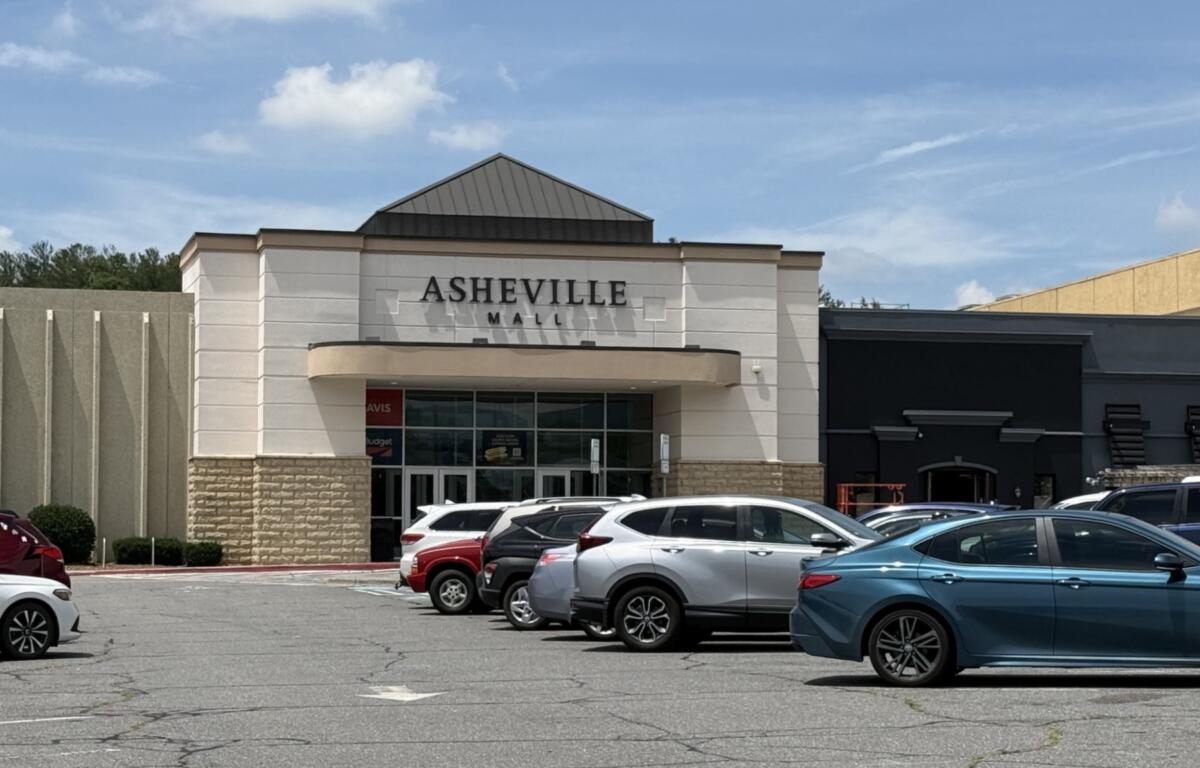

ASHEVILLE, N.C. (828newsNOW) — A debate over the future of the Asheville Mall property is expected to take center stage when the Asheville City Council meets Tuesday evening, as elected leaders consider whether to rezone part of the aging shopping center and potentially open the door to new development along the Tunnel Road corridor.
During Thursday’s agenda briefing, council members spent more time discussing the Asheville Mall proposal than any other zoning item on next week’s agenda, signaling it could be one of the meeting’s most closely watched decisions.
The request would rezone part of the mall property from the city’s Urban Place zoning district to Regional Business zoning. Unlike a conditional rezoning tied to a specific development plan, this request comes with no proposed project attached. If approved, the property could be developed under the broader list of uses allowed in the Regional Business district.
Planning staff is recommending the council deny the request, saying it does not align with Asheville’s Comprehensive Plan. The Planning and Zoning Commission also voted 4-3 to recommend denial after an extensive discussion.
Asheville Principal Planner Will Palmquist told council members the Urban Place zoning was created to encourage walkable, mixed-use redevelopment with housing, retail and other uses that create vibrant, 24-hour neighborhoods. Regional Business zoning, he said, is intended more for suburban-style commercial development, including larger retail uses.
Several council members questioned whether changing the zoning would undermine years of planning for the Tunnel Road corridor.
Council Member Sage Turner said she was weighing the need to spur investment in an area that has struggled to attract redevelopment against the city’s long-term vision for the corridor.
“I think Tunnel Road needs some kind of activation,” Turner said. “I’m weighing that against what I believe is a problem occurring along Tunnel Road and needing some innovation, some change.”
Turner also questioned whether the city should revisit the broader Urban Place zoning rules if they are discouraging redevelopment rather than approving individual rezoning requests one property at a time.
Council Member Kim Roney said she worries the request represents a step backward from the city’s original vision for the site.
“We made such a tremendous effort to envision people living in a neighborhood,” Roney said. “It just seems strange that after all of our work that we would downzone.”
She pointed to national trends where aging malls are being transformed into mixed-use developments that combine housing, offices, medical services and retail.
Council members also noted that very little development has occurred under the Urban Place zoning since it was adopted about five years ago. Palmquist said staff has reviewed only one significant development proposal in an Urban Place district, and that project stalled after Tropical Storm Helene.
That prompted additional questions about whether the zoning itself needs to be reexamined if it has not produced the type of redevelopment the city envisioned.
City staff said they will provide council members with additional background before Tuesday’s meeting, including information about previous development activity under the Urban Place zoning district.
Other issues on council’s radar
While the Asheville Mall discussion dominated the briefing, council members also previewed several other issues that could shape upcoming meetings.
Council is expected to continue work on an anti-displacement strategy aimed at protecting vulnerable neighborhoods while expanding affordable housing. One council member described the effort as “innovative” after years of discussion.
“It’s even, I would say, innovative in some ways,” the council member said. “I know that we have kind of been back and forth about it for, I mean, really a couple of years … I’m just glad we’re making some progress.”
The Public Policy, Finance and Infrastructure Committee will also receive an update Tuesday afternoon on concerns related to Asheville’s unhoused population and the city’s collaborative response.
Assistant City Manager Jay Dundas said the presentation will focus on community concerns, including areas along the Tunnel Road corridor, and highlight ongoing efforts such as the city’s new co-responder program, which pairs first responders with behavioral health professionals.
Vice Mayor Antanette Mosley asked whether the city should consider a focused 30-day public safety initiative along Tunnel Road similar to one previously used downtown.
Dundas said the idea could be discussed further by the Public Safety Committee, noting that changes in Asheville Police Department operations and the new co-responder program are already intended to improve conditions in affected areas.
The Public Safety Committee is also expected to receive updates July 29 on the co-responder program, community resource officers, recent community violence, Asheville Fire Department wellness initiatives and the region’s updated hazard mitigation plan.
Looking ahead, city staff said several major items are expected to come before council in August, including a contract to update Asheville’s Comprehensive Plan and Unified Development Ordinance, a planning contract for the city’s ArtPlace redevelopment initiative that includes affordable housing and transit improvements, and final approval of Asheville’s redesigned transit network.
Council members also indicated they want to continue discussions about potential zoning changes to encourage more housing in low-density neighborhoods and explore tougher penalties for speeding on roads frequently used by bicyclists.
The Asheville Mall rezoning is one of three public hearings scheduled for Tuesday’s meeting. Council will also consider a proposal for a 130-unit affordable apartment community on Sweeten Creek Road and amendments to the conditional zoning for the historic Princess Anne Hotel.