



ASHEVILLE, N.C. (828newsNOW) — Asheville’s Planning and Zoning Commission is recommending a series of changes that could make it easier to build more housing across the city, including duplexes and accessory dwelling units, while eliminating minimum parking requirements to comply with new state law.
The recommendations come as Asheville continues to grapple with a housing shortage, rising costs and concerns that new development could accelerate displacement in some of the city’s historically lower-income neighborhoods.
The commission voted 6-1 to recommend changes allowing duplexes and townhomes more broadly across the city. The panel also voted 6-1 on changes to accessory dwelling unit rules, while its recommendation to eliminate minimum parking requirements passed unanimously.
The recommendations now move to Asheville City Council for consideration.
The votes followed a lengthy discussion about how to encourage more housing without leaving vulnerable neighborhoods behind.
Commissioners generally agreed Asheville needs more housing. But some questioned whether the city should move ahead with zoning changes before additional anti-displacement protections are in place.
One commissioner said the city needs to be mindful of an anti-displacement resolution recently adopted by City Council, which calls for additional protections for identified communities and neighborhoods.
Others argued the housing changes shouldn’t be delayed while the city works out every other piece of its housing policy.
One commissioner described the zoning changes as a correction to some of the consequences of Asheville’s 1997 Unified Development Ordinance, which significantly reduced the amount of residential density allowed in parts of the city.
The commissioner also pointed to Asheville’s early planning history, noting that the city’s first plan in 1925 allowed two-unit dwellings throughout residential areas.
The goal, the commissioner said, should be to allow more people to enjoy Asheville’s neighborhoods while also ensuring vulnerable communities are protected from unintended consequences.
Duplexes and townhomes
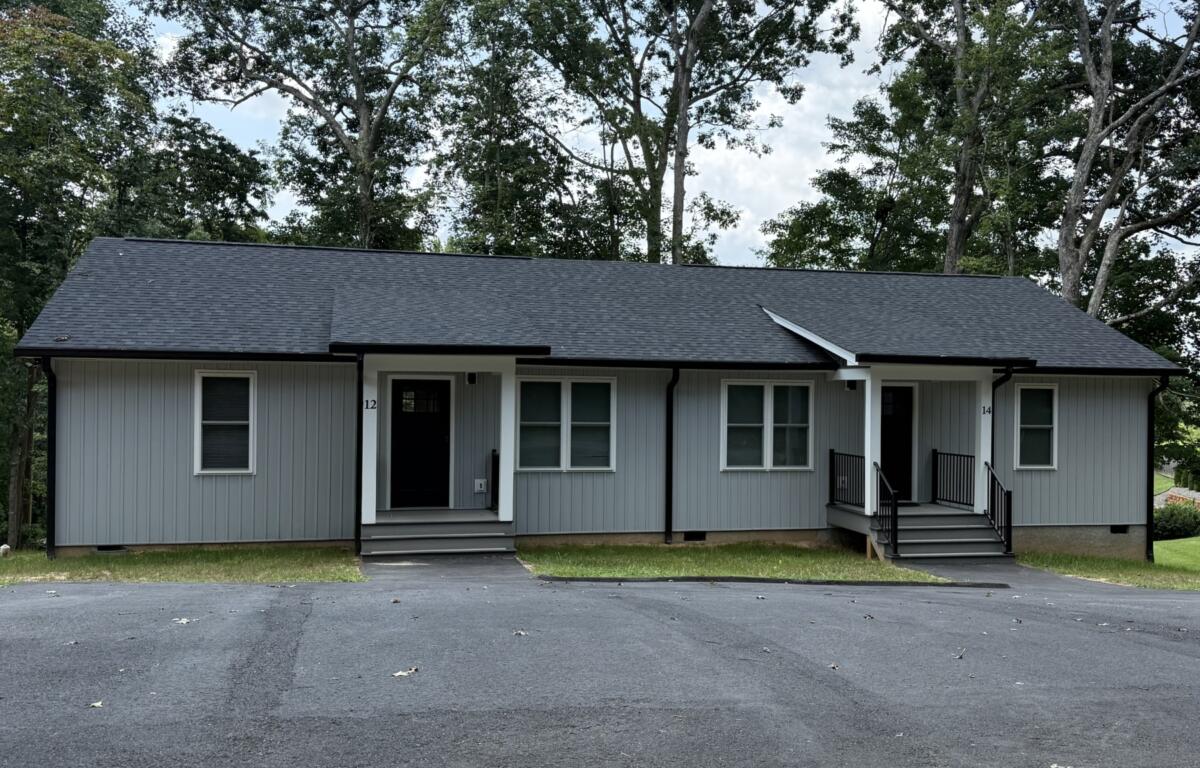
The commission’s recommendation would make duplexes and townhomes more widely available in residential areas.
Commissioners also recommended removing a provision dictating where parking associated with those units must be located and eliminating a limit on the number of attached townhome units in one residential zoning district.
The panel also wants city staff to further study minimum lot size, lot width and setbacks.
That discussion reflected a broader concern: Simply allowing more units doesn’t necessarily mean developers will be able to build them if lots remain too large or other dimensional requirements make projects impractical.
Commissioners also said the city should continue working on anti-displacement strategies as the zoning changes move forward.
The commission’s vote was 6-1.
ADUs
The commission also spent considerable time discussing how large an accessory dwelling unit should be allowed to be.
The proposed rules would have capped an ADU at 1,200 square feet or 90 percent of the primary home’s size, whichever was less.
Several commissioners questioned why the city should limit an ADU to 90 percent of the size of the primary residence, particularly because the rule has a bigger impact on owners of smaller homes.
The commission ultimately recommended that the maximum ADU size be 1,200 square feet or no larger than the primary structure, whichever is less.
The discussion also exposed some confusion in the city’s current terminology and regulations surrounding ADUs, accessory structures, garages, duplexes and townhomes.
Commissioners debated whether garage space should count toward the maximum size of an accessory structure containing an ADU.
Some argued that excluding garage space would provide more room for actual housing. Others worried that doing so could allow a very large accessory structure when a garage and ADU are combined.
The commission ultimately left the garage provision unchanged but said the issue deserves a closer look as part of the city’s larger UDO rewrite.
Commissioners also raised concerns about ADUs being used as short-term rentals.
City staff said ADUs cannot legally be used as short-term rentals under the current rules and said the city investigates complaints and enforces those restrictions.
Parking requirements
The parking change is somewhat different from the others because Asheville is required to make the change under new state law.
Staff told commissioners that North Carolina no longer allows local governments to require a minimum number of off-street parking spaces for development, with limited exceptions that do not apply to Asheville.
The commission therefore voted unanimously to recommend removing the city’s minimum parking requirements.
That doesn’t mean new developments will have no parking.
Staff presented data from Asheville projects that had been built without parking mandates and found that developers continued to provide parking on their own.
An analysis of 13 projects totaling 689 housing units found every project included some parking. Collectively, the projects provided about 93 percent of the parking that would have been required under the previous rules.
Staff also reviewed nine more recent projects. Those projects would have been required to provide 170 parking spaces under the old rules. Under the city’s reduced requirements, only 47 spaces were required.
The projects nevertheless provided 228 spaces.
Commissioners said the data would be useful as the city evaluates the effects of eliminating parking mandates.
What’s next
The three recommendations — expanded duplex and townhome opportunities, revised ADU standards and elimination of minimum parking requirements — now head to City Council.
The commission’s discussion made clear that the zoning changes are unlikely to be the end of Asheville’s housing debate.
Commissioners want the city to continue examining lot sizes and other development standards, while also developing anti-displacement strategies and considering ways to make new housing opportunities accessible to lower-income residents.
The commission’s ADU recommendation passed 6-1, with Commissioner Cyclesky voting against it. The parking recommendation passed unanimously.
The commission is scheduled to meet again Sept. 2.