
EDITOR’S NOTE: Strangeville explores the curious and unexplained stories that have long defined Asheville and Western North Carolina. The region is full of unanswered questions, from old folklore and local legends to eerie encounters, unsolved moments in history, and the true-crime mysteries that still leave people wondering. Each week, we look back with an open mind and a sense of curiosity, trying to understand why some stories take hold and why some can never be explained.
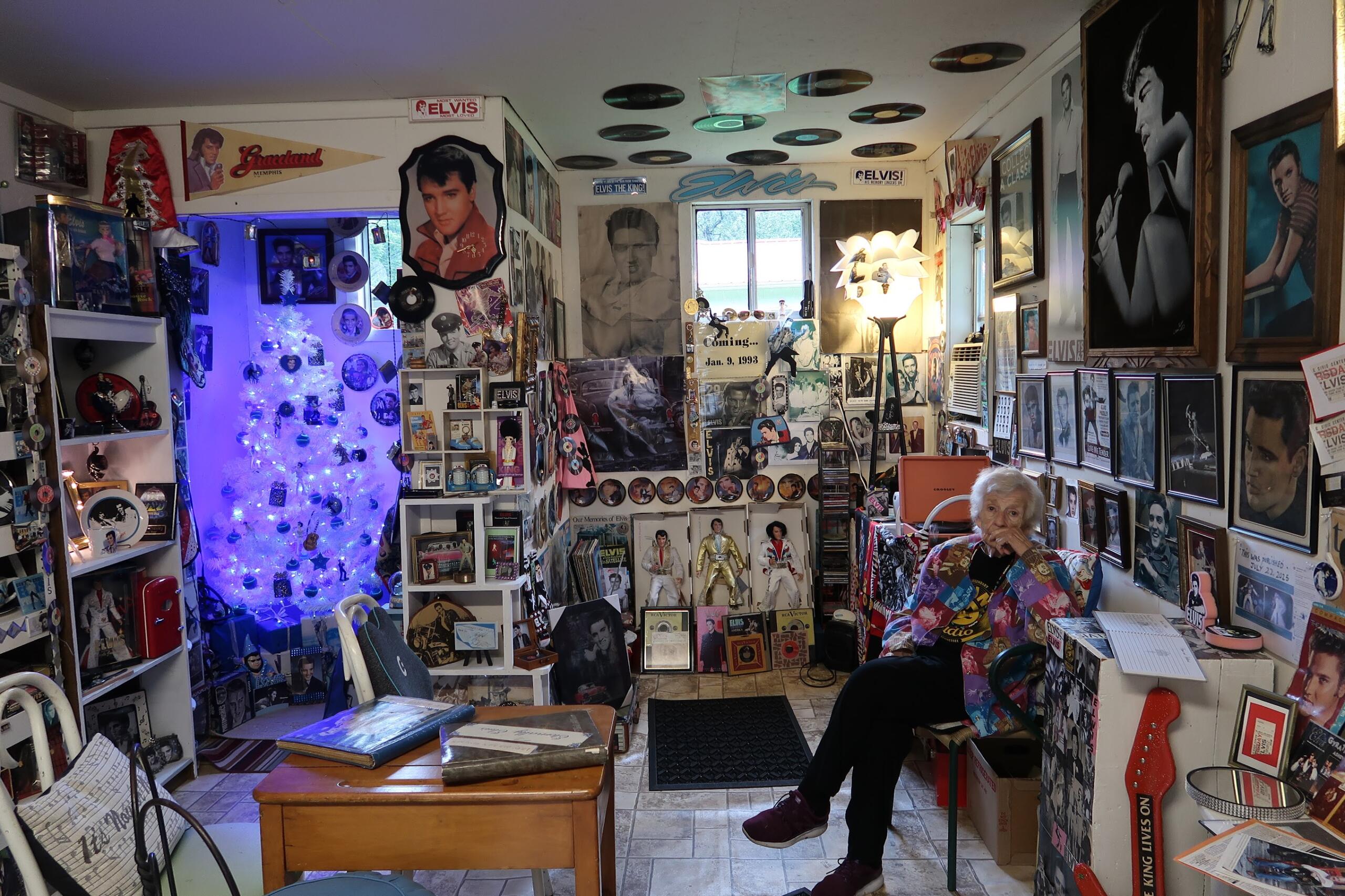
CHEROKEE, N.C. (828newsNOW) — Just off of Highway 19 on the way down to Cherokee, N.C., eagle-eyed drivers might spot the silhouette of Elvis Presley on the side of a small brown building. Inside, visitors will find one of the best museums in Western North Carolina.
The Elvis Museum, as the space is simply known, is owned and curated by Dorothy “Dee” Smith.
Smith has opened her museum to the public every summer since 2012. Typically, her season starts around the last week of June or first week of July and closes around Oct. 1. On the weeks it is open, guests are welcome between 11 a.m. and 4 p.m., Monday through Thursday. The museum is located next to Littlejohn Campground at 2289 Wolfetown Road. Admission is free.


“I’m just really not here to make money,” Smith said. “It’s good when I do, but that wasn’t the idea to do it.”
In fact, Smith said, the Elvis Museum started as her own private collection.
The origin of the Elvis Museum
Though a fan of Elvis since she was in college at Western Carolina University, Smith only bought her first piece of Elvis memorabilia in 1977, after the musician had died.
“There was a little shop in Cherokee that sold toys, and I heard they had Elvis dolls for sale,” Smith recalled.
Smith found one that cost $100 – around $545 today – and put it on layaway, paying a little at a time. It would become the first item in the Elvis Museum.
After purchasing her doll, Smith got the Elvis collecting bug. She would search for Elvis memorabilia at flea markets, clip articles from newspapers about him and purchase books, movies and music featuring The King. Her family contributed, too: one Christmas, Smith’s mother bought her first Elvis biography for her. One Mother’s Day, her son bought her a “Velvet Elvis,” a painting of the musician on velvet fabric.


However, the idea of presenting her collection to the public did not occur to Smith until her daughter, Kathi Littlejohn, suggested she display it all in a building she owned.
“I said, ‘No, Kathi, I’m not doing that.’ She said, ‘Yes, do it,’ and I said, ‘Nobody would come, and I just wouldn’t be comfortable doing that,'” Smith said. “She went on and on and on, and finally, I said okay. So, I fixed it up, painted it and everything.”
Smith opened the museum in 2012 with an event she estimated attracted around 100 people. The grand opening was emceed by her granddaughter, that year’s Miss Cherokee, and featured an Elvis impersonator from Bryson City. Since that day, there has been a steady stream of visitors every summer.
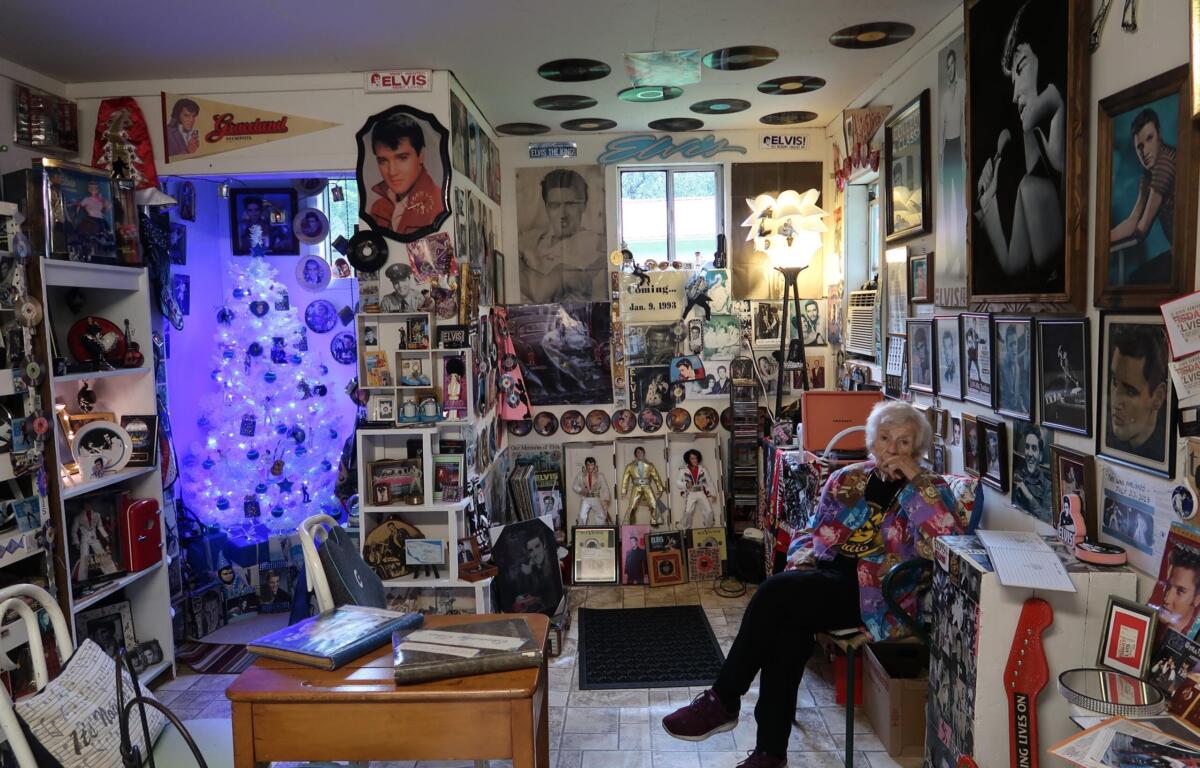
“They come in and they say, oh my goodness, look at this,” Smith said. “They think it’s gonna be just something little, I think, and it’s everywhere.”
Some visitors come back every year. Others travel from all over the world to visit. The collection is popular with kids, too.
“There was this little girl, and she said, when she came in, she said, ‘Oh, this is my favorite place,’ and she said, ‘I want to live here, just me and Elvis,'” Smith laughed.
Exploring the collection
The museum is arranged in two buildings on Smith’s family property. Both are covered wall-to-wall with Elvis: Photos, records, signs, magnets, magazines, dolls, pillows, pennants, books, candy, trading cards, newspaper clippings, clothing, cardboard standees, ornaments, and more, and more and more.
Any kind of object you can think of, odds are, Smith has one with Elvis on it, carefully labeled with a handwritten card.


While much of the museum has been accumulated by Smith herself, she said many people have contributed their own personal items to the collection.
“People give me things. Sometimes they leave them outside the door. Like those socks, last summer,” Smith said, gesturing to a pair emblazoned with Elvis. “They left the socks outside the door, and when I came to work, there they were.”
Elvis and Asheville
While there are many items in her museum that would be recognizable to Elvis fans worldwide, several of Smith’s artifacts are wholly unique to the Asheville area.
Elvis performed at the then-new Asheville Civic Center Complex – the venue known as Harrah’s Cherokee Center – Asheville today – at 8:30 p.m., July 24, 1975. Smith was in the audience, and she has kept her ticket stub ever since. Her memories of the night are crystal clear.
“He would start singing, and the girls would rush to the thing and they would stand there in line around the stage,” Smith remembered. “So, he would quit singing, and start kissing the girls. He did! And then he would go back to singing. It was really good. People my age that went still talk about it, ’cause we’d never seen anything like that.”


Smith has other regional curios on her walls. Elvis was supposed to return to Asheville on Aug. 26, 1977, but he died just 10 days before he was due to perform. In lieu of the show, fans around the community held a memorial service, printing custom T-shirts with Civic Center ticket stubs in the background and a proud “WE STILL LOVE YOU ELVIS” in the middle. Smith was gifted one of the shirts for the museum from a friend she went to school with.
One of the items she is most proud of is a newspaper printing plate from the Nashville Banner the day of the artist’s funeral. Smith has paired it in the museum with a framed front page.


Smith has a hard time deciding what she loves most about Elvis. Perhaps, just like her collection, it’s an accumulation of little things that built into something very special.
“The way he sang, the way he acted, the way he… I don’t know what it is. Even today, parents bring their little children in here, and the children know about Elvis, and they like him and they talk about him. That, to me, that’s amazing, him being dead for so long,” Smith mused. “I don’t know what it was. But he had it.”
-
Strangeville: Elvis, Asheville and a tiny Cherokee museum

Just off of Highway 19 on the way down to Cherokee, N.C., eagle-eyed drivers might spot the silhouette of Elvis Presley on the side of a small brown building. Inside, visitors will find the Elvis Museum, owned and curated by Dorothy “Dee” Smith.
-
Strangeville: Revolutionary War Ghosts of the Carolina Backcountry

Ahead of America 250, Revolutionary War folklore links Western North Carolina’s Overmountain Men to ghostly legends from the Battle of Kings Mountain.
-
Strangeville: Harry Gardiner, the ‘Human Fly’ Who Climbed Asheville’s Flat Iron Building
A century before viral stunts, Harry Gardiner drew crowds to downtown Asheville by scaling the Flat Iron Building without ropes — part spectacle, part fundraiser and part civic promotion.
-
Strangeville: Devil’s Den and the outlaw legends of Iron Mountain

On the North Carolina-Tennessee line, Devil’s Den became part of a darker mountain history shaped by moonshiners and outlaws.
-
Strangeville: Why Thomas Wolfe testified in a Yancey County murder trial
The Asheville author testified in a Yancey County murder trial after witnessing a Burnsville confrontation one week before a deadly shooting.