


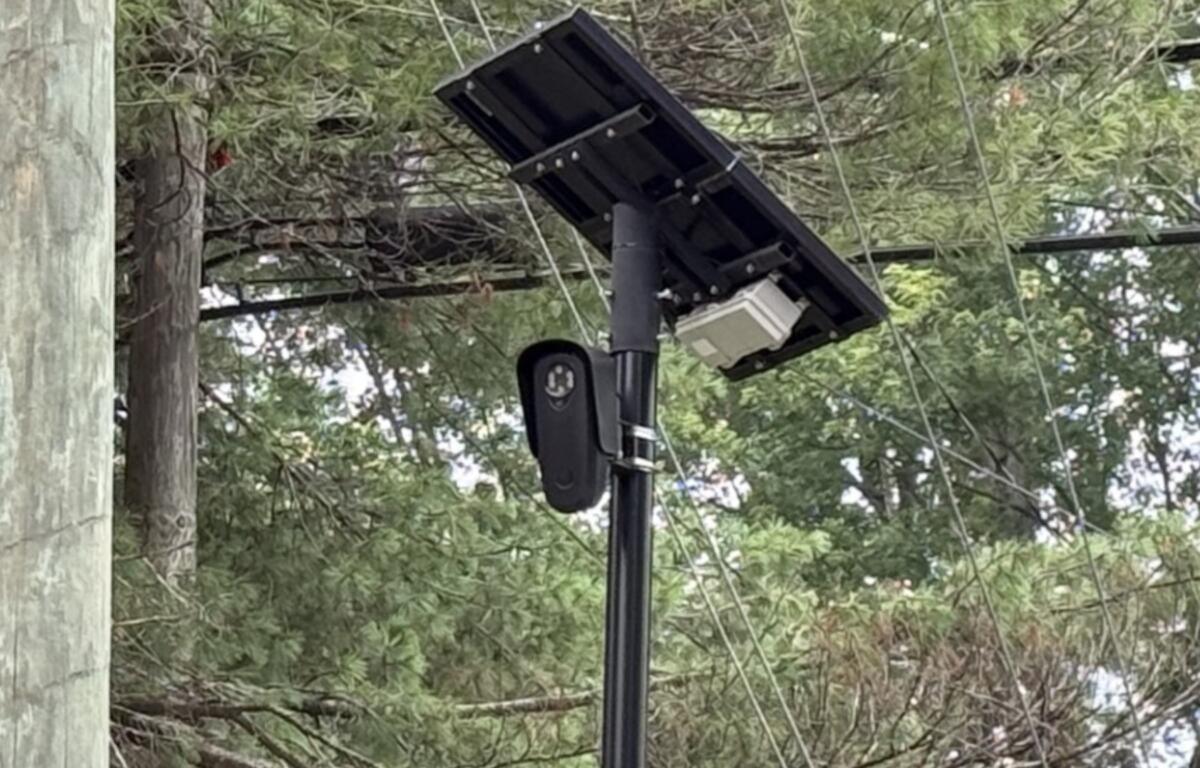

ASHEVILLE, N.C. (828newsNOW) — More than 2.7 million searches were recorded through the Asheville Police Department’s Flock license plate reader network during a three-month period earlier this year. But now that the city has ended its contract with the company, police say they can no longer provide detailed records showing which outside agencies conducted searches or why.
APD spokesman Rick Rice said Flock Safety deleted the associated data when the city terminated its contract. That included search activity, information about outside agencies and the reasons entered for searches.
“Because APD no longer has access to that data, we cannot produce a list of those agencies and their search reasons,” Rice said in an email to 828newsNOW.
The city has not said exactly when the data was deleted, whether copies were retained elsewhere or whether the information could be recovered.
Rice’s explanation comes nearly two months after Asheville City Council voted 5-2 on Aug. 25 to end its Flock contract amid concerns about privacy, government surveillance and outside access to license plate information.
What the audits show
An APD audit reported 2,756,648 searches of the Asheville PD Network during the second quarter of 2026, covering April through June.
That’s about 14 times the 196,605 searches reported during the first three months of the year.
The first-quarter audit identified searches attributed to 2,603 outside law enforcement agencies through the Asheville PD Network. Asheville officers conducted 173 Flock searches during that period.
The figures do not establish that each outside agency searched information collected by Asheville’s cameras.
Among the agencies with the highest search activity were the Jacksonville Sheriff’s Office in Florida, Louisville Metro Police Department in Kentucky, the Texas Department of Public Safety and law enforcement agencies in Houston and Atlanta.
The audits do not clearly explain whether the totals represent searches specifically involving information collected by Asheville’s 11 stationary Flock cameras or searches across a broader network. APD also has not explained the sharp increase between the first and second quarters.
Rice confirmed the second-quarter total and said auditors found that every search included a reason.
The audit also reported that APD searches were associated with a case number 90.17% of the time.
Having a reason entered for a search, however, does not necessarily establish that the search was justified. The publicly available audit does not provide enough information to independently evaluate the reasons given.
The second-quarter report is just one page long, compared with a more detailed first-quarter audit that identified outside agencies, search totals and examples of investigations involving license plate readers.
The department has posted five audit reports covering 2025 and the first three quarters of 2026 on the city’s public safety website.
Rice said APD no longer has access to the underlying Flock records needed to identify outside agencies and their reasons for conducting individual searches.
Privacy concerns and outside access
Flock cameras photograph passing vehicles and record license plate numbers, vehicle descriptions, locations and times. Police can search that information to identify vehicles connected to criminal investigations.
Law enforcement agencies say the technology helps them find stolen vehicles, locate suspects and investigate serious crimes.
But the ability to share that information across jurisdictions has raised concerns about privacy and whether agencies far from Asheville should be able to search records collected locally.
In Asheville, residents questioned whether license plate information could be accessed by agencies involved in immigration enforcement or used for purposes unrelated to local investigations.
Some agencies identified in APD’s first-quarter audit have participated in federal immigration enforcement partnerships. The audit, however, does not establish that any searches of Asheville’s network were conducted for immigration enforcement purposes.
The city says it does not share license plate data with U.S. Immigration and Customs Enforcement.
Before the Flock contract ended, APD had taken steps to restrict access to the system. An August memorandum from interim Police Chief Jackie Stepp described reducing the number of authorized users and limiting outside information sharing to North Carolina and four neighboring states, replacing an earlier 500-mile radius.
Rice said APD’s other license plate reader systems do not share information with outside agencies.
“There is no list to produce from Verkada or Axon because we don’t share information with outside agencies,” he said. “Both systems are only accessed by trained and approved APD staff.”
The city’s online public safety information also describes reciprocal sharing agreements with vetted outside law enforcement agencies, although it does not specify whether that language applies to the former Flock system or technology still in use.
Other police technology remains in use
Ending the Flock contract did not mean Asheville stopped using automated license plate readers.
Rice said APD has used three systems: Flock, Verkada and Axon.
Verkada was used briefly while the department compared its capabilities with Flock. The first-quarter audit identified two Verkada license plate reader cameras, seven APD members authorized to conduct searches and 237 searches during that period.
APD continues to use Axon license plate readers installed in patrol vehicles.
The department is also developing its Real-Time Intelligence Center, which uses Fusus software to bring together information from cameras, drones and other police technology.
City Council approved a multiyear Axon agreement in May. The contract took effect Aug. 1 and runs through December 2033.
The agreement totals approximately $7.42 million and includes body cameras, Tasers, drones, software, storage, warranties and other police equipment and services. The full amount is not solely for the intelligence center.
Council approved the agreement 6-1, with Councilwoman Kim Roney voting against it.
A new APD policy governing the Real-Time Intelligence Center took effect Oct. 1 following discussions with a community stakeholder workgroup. Rice said the policy was developed in response to concerns about privacy, data sharing and government surveillance.
Draft versions of the policy included restrictions on access to surveillance information and the use of facial recognition technology. Whether all those provisions were retained in the final policy has not been independently confirmed.
Rice said the city recognizes the benefits of police technology and residents’ concerns about how it is used.
“The city recognizes that technology can be an important tool for investigating serious crimes and protecting public safety, but also recognizes the legitimate concerns raised by residents regarding privacy, data retention, data sharing, and government surveillance,” he said.
Asheville has created an online resource explaining its public safety technology, policies and safeguards. Officials say the information will be updated as residents submit additional questions.
More public discussions about surveillance technology are expected in late 2026 or early 2027.
Meanwhile, removal of the city’s former Flock cameras remains a separate process.
City Council voted to terminate the contract Aug. 25, and the city sent a formal termination letter Aug. 27. APD says its Flock user accounts have been deactivated.
Four cameras located in city rights-of-way were covered as an interim measure.
Flock told the city that equipment removal was expected to begin Oct. 12 and could take up to 60 days. The city has not provided a current count of cameras physically removed.
Residents can review APD’s audits, policies and updates on the city’s Technology and Public Safety page.