


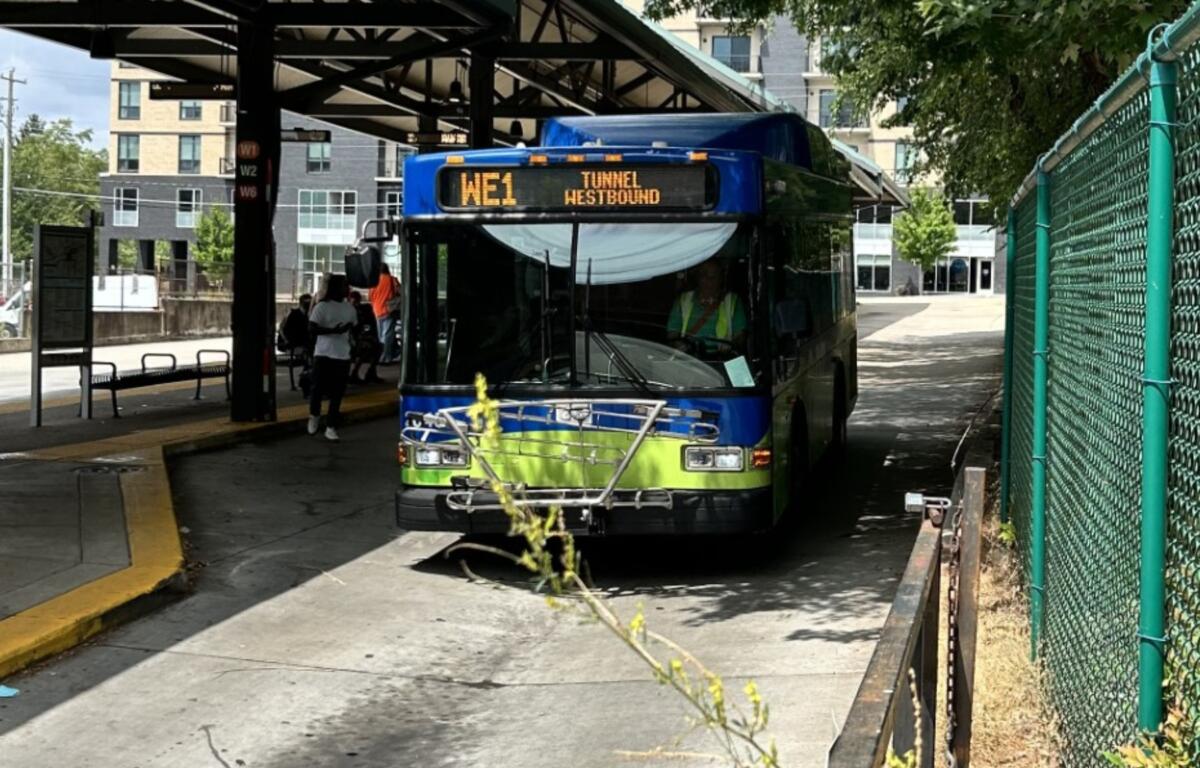

ASHEVILLE, N.C. (828newsNOW) — For Jonathan Cook, the Asheville bus system is more than a way to get around town.
It is how he gets to GED classes at Asheville-Buncombe Technical Community College, meets with his job coach, attends therapy and an autism support group, takes part in a diabetes prevention program, shops for groceries and spends time downtown.
Cook, 43, has been riding Asheville buses since his late teens.
Now, a proposed redesign of Asheville Rides Transit could eliminate the S2 service along part of Kenilworth Road, potentially making it much harder for Cook to get around town independently.
“I basically lose the only way I have to get anywhere,” Cook said.
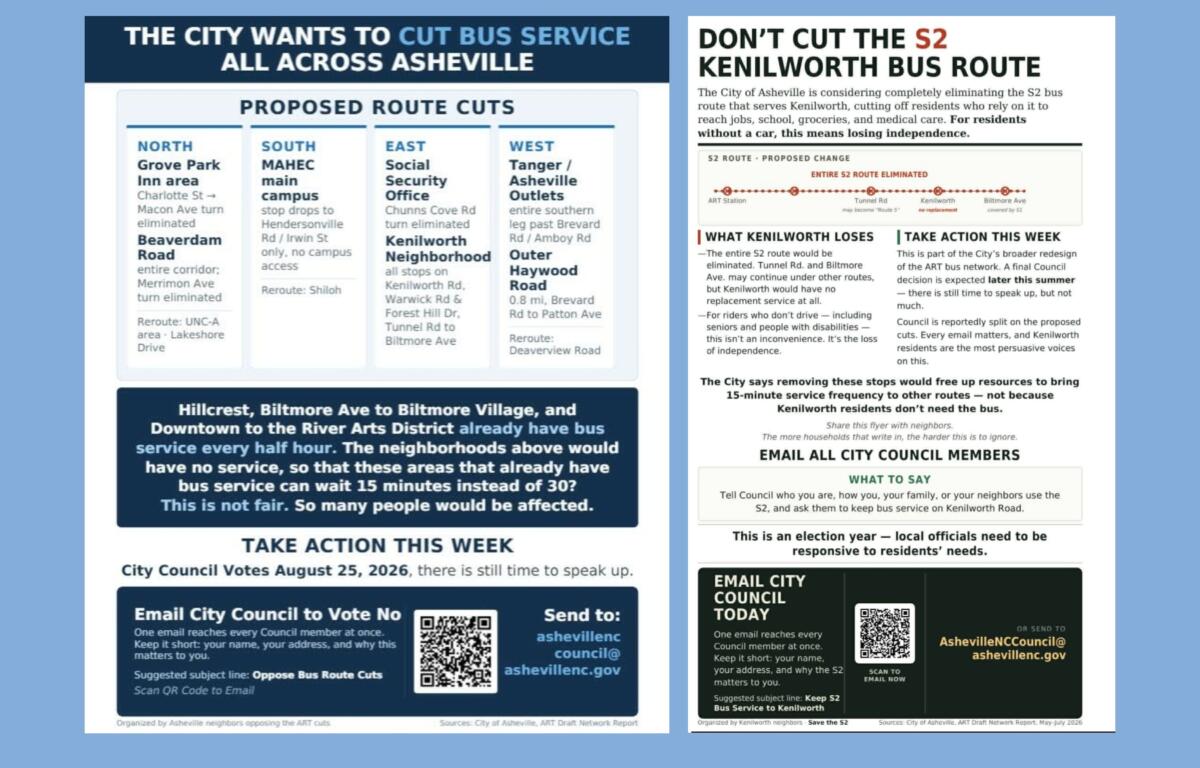
The proposed ART network would remove service along Kenilworth Road between Tunnel Road and Biltmore Avenue. The city says the area has relatively low ridership and that shifting resources from there would allow more frequent service along busier corridors.
For Cook and his housemate, Niki Foster, the proposal has turned a transit map into a deeply personal issue.
Foster said they didn’t realize the Kenilworth Road segment was among the areas where bus service could be removed until Vice Mayor Antanette Mosley, who lives nearby, stopped to talk with Cook at a bus stop about a week and a half ago.
Since then, the two have been trying to alert their neighbors.
“We didn’t know until Miss Mosley stopped,” Foster said.
They have printed flyers, shared information online and started talking with neighbors about the proposed changes.
The proposed network is not final. The city has been gathering public feedback and is expected to make changes before the plan goes to City Council for a final decision.
‘It’s a lifeline’
Cook’s typical week illustrates what can get lost when transit changes are measured primarily in ridership numbers.
On Mondays and Tuesdays, he takes the bus to A-B Tech for GED preparation classes. He rides to West Asheville to meet his job coach and to South Asheville for therapy and the YMCA’s diabetes prevention program.
He uses the bus to attend an autism support group at the Asheville Mall and to shop at Ingles on Tunnel Road.
And sometimes he simply takes the bus downtown.
He likes going to the library, looking around downtown and visiting stores.
“It’s a lifeline to everything,” Cook said.
Foster said that independence is particularly important to Cook, who relies on the bus to attend classes, appointments and his support group without depending on someone else for a ride.
If the Kenilworth Road service disappears, Foster said, their household could face a difficult choice.
“We have actually talked about maybe having to move out of the neighborhood if the bus is eliminated,” she said.
The Cook family has lived in the neighborhood since the 1970s, Foster said.
Foster said she and Cook are not wealthy and she worries the proposed changes could affect residents who don’t have another reliable transportation option.
“There’s a lot of people in Kenilworth that are not super wealthy,” she said. “We certainly are not.”
Cook said he regularly sees other people using the bus along Kenilworth Road, including people traveling to work and to Ingles.
He estimates he sees four or five regular riders, sometimes more when people are connecting to downtown.
Foster said that is why she believes ridership figures alone don’t tell the entire story.
“The numbers don’t tell the whole story,” she said. “It means so much more for people that have no real other way to have transportation.”
A difficult trade-off
The proposed ART redesign is a trade-off, according to the city: Less coverage in some areas would allow ART to provide more frequent service along busier corridors.
The city released the draft network in May after a months-long review of ART operations and a public survey. The plan would mean fewer overall routes but more frequent service in some parts of Asheville.
Under the draft, some routes would operate every 15 minutes, including service between downtown and the River Arts District.
The city says the changes would increase the percentage of residents with access to buses arriving every 30 minutes or less from 27 percent to 37 percent. But the percentage of residents living near transit service would fall from 61 percent to 58 percent.
More than 1,300 people submitted feedback during the city’s latest public engagement period, which closed June 28. The city shared a summary of that feedback in July.
The city says the proposed changes are intended to shift resources toward areas with higher ridership while maintaining service in public housing and other vulnerable areas.
But that also means some people would lose nearby service.
Kenilworth is one of those areas.
The city identifies the Kenilworth Road segment between Tunnel Road and Biltmore Avenue as a low-ridership area where residents are less dependent on transit than people in some other parts of Asheville.
Foster questions whether that description captures what the loss of service would mean for people who do ride the bus.
She also worries about other destinations that could lose direct service, including the Grove Park Inn, the Social Security office and MAHEC.
And she questions whether the redesign puts too much emphasis on increasing service in areas expected to attract more riders while reducing coverage in established neighborhoods.
“I just don’t think that now is the time to try to make these changes,” Foster said.
She said the city should reconsider the proposal and return to the drawing board.
The city’s transit planning effort is based on a comprehensive analysis conducted with consultant Jarrett Walker and Associates. The city has held multiple rounds of public engagement and has said the process was shaped by City Council’s direction to move “slightly in the direction of more ridership” while maintaining coverage for public housing and vulnerable neighborhoods.
Fighting to stay connected
Foster said she hopes the City Council ultimately rejects the proposed changes.
In the meantime, she and Cook are focusing on something more immediate: making sure Kenilworth residents know what’s being considered.
They have been distributing flyers in the neighborhood and elsewhere, including at the Asheville Mall, where Cook attends his autism support group. Foster said neighbors have also begun sharing information and speaking out.
For Cook, the stakes are straightforward.
He wants to keep the ability to get on a bus and go somewhere without depending on someone else to drive him.
“I just kind of want to get out,” he said.
Without the Kenilworth Road service, he said, he would be “trapped at home.”
“And nobody needs that,” he said.