


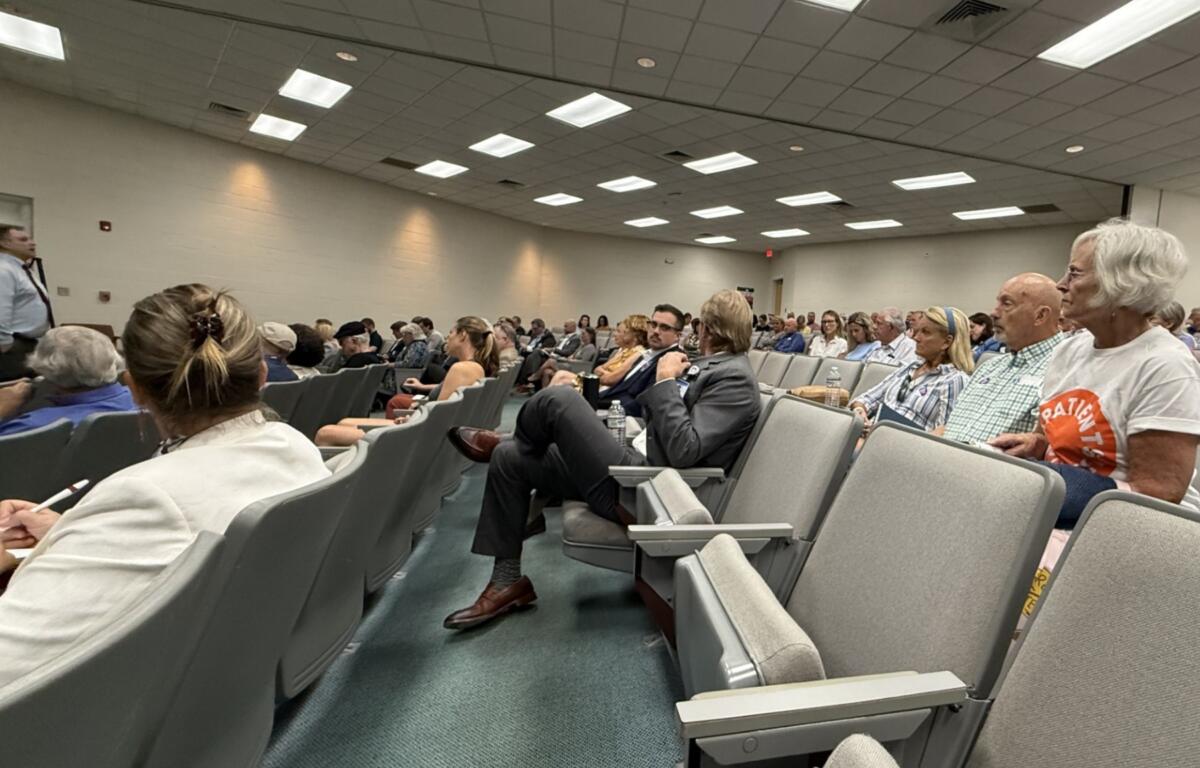

ASHEVILLE, N.C. (828newsNOW) — The message from rural Western North Carolina was blunt Wednesday: Getting to a hospital can take too long, ambulances can be tied up for hours and patients need more choices.
As state health officials listened to competing proposals for 92 additional hospital beds, speakers from Madison, Yancey, Clay and other mountain counties repeatedly reminded them that the debate isn’t just about Asheville.
For rural residents, they said, geography can be a health care issue of its own.
The testimony offered a different perspective from the technical details of the four Certificate of Need applications: what happens when someone who lives in the mountains needs emergency or specialty care.
‘Distance matters when you’re sick’
Madison County Commissioner Alan Wyatt described an experience involving his aunt, who became seriously ill and initially did not want to go to Mission Hospital.
Wyatt said she eventually was taken to Mission, where she was initially expected to go home before being diagnosed with an infection in her spinal cord and sepsis.
He said the experience was particularly difficult for his 75-year-old uncle, who has Parkinson’s disease and drove from Madison County to Asheville every day to be with his wife.
Wyatt argued that a hospital in Weaverville would have made a significant difference for his family.
“Distance matters when you’re sick,” Wyatt said.
That theme was repeated by Madison County Health Director Tammy Cody.
Cody said residents of Madison County frequently face an hour or more of travel for specialty care.
For elderly residents, people with limited transportation and families trying to balance work and medical appointments, she said, the trip to Asheville can become a barrier to care.
“Geographic proximity is not a convenience,” Cody said. “It is a life and reality.”
Cody supported AdventHealth’s proposal to add 92 additional beds to its hospital under construction in Weaverville.
The first phase of AdventHealth Weaverville is expected to open in late 2028. The additional 92 beds are tied to a planned 2030 expansion.
EMS worries about losing ambulances
Emergency medical services officials offered some of the most detailed testimony about the practical consequences of long-distance hospital trips.
Kristy Bryant, director of Yancey County EMS, said Yancey County has no hospital, meaning ambulances can spend hours transporting patients to Asheville or elsewhere.
She said local ambulances also sometimes become tied up after arriving at Mission while waiting for hospital staff or resources to take over a patient’s care.
Bryant described one recent case in which a Yancey County EMS crew remained at Mission for about two hours while waiting for pharmacy support so the hospital could take over medication being administered through an IV pump.
For a rural county with limited ambulances, she said, that delay has consequences beyond the patient already at the hospital.
“That’s an ambulance and trained EMS professionals sitting outside their community instead of being available for the next call,” Bryant said.
Bryant also described efforts to establish a prehospital whole-blood program in Yancey County.
She said Mission previously told the county the program could not be implemented at the time because of the number of laboratory processes involved. AdventHealth agreed to work with the county, she said, even though patients receiving the blood might ultimately be transported to a hospital other than AdventHealth.
The program went into service July 6, Bryant said, and four days later crews administered whole blood to a trauma patient during a lengthy rural transport.
Bryant also said AdventHealth staff provided neonatal resuscitation training to Yancey County paramedics.
She argued that the examples show why the state should consider not only the number of beds but the relationships between hospitals and rural emergency services.
Mission draws sharp criticism
Several speakers used the hearing to criticize HCA Healthcare’s ownership and operation of Mission Hospital.
Dr. Allen Nichol, a clinical pharmacist, said Mission has increasingly outsourced referrals and other services, creating delays for patients who need specialty care.
He described taking a patient to Mission who had been waiting for a cardiac-related referral. Nichol said he was able to get the patient seen much sooner after intervening personally.
He also described taking his wife out of Mission’s emergency department and taking her to AdventHealth, where he said she was evaluated by a physician.
“We need to hold them accountable for the shoddy services,” Nichol said.
Amy Loy gave one of the day’s most emotional accounts.
Loy said her husband, Harmon “Lee” Loy, spent 11 days at Mission after being hospitalized with severe cellulitis. She said he had pulmonary fibrosis and required continuous oxygen.
Loy said she repeatedly had to remind hospital staff that he needed oxygen and said other medical needs were not adequately addressed.
She said he later deteriorated while in a discharge unit and required a rapid response.
Loy said her husband died April 21.
“My husband did not deserve this kind of treatment,” she told state officials. “Western Carolina patients do not deserve this kind of treatment.”
Loy said she supports additional competition and specifically cited UNC Health and AdventHealth as alternatives she would like to see grow in the region.
Her account was one of several personal stories presented during the hearing about experiences with Mission. The accounts were testimony to state officials and were not independently verified by 828newsNOW.
Not everyone criticized Mission
The testimony was not uniformly negative.
Gail Webb said she was invited to the hearing by Mission but had no expectation of what she would say until she arrived.
She described getting a heart CT scan at Mission after an insurance authorization process that took months.
Webb said she became stressed after having difficulty finding the appropriate entrance and worrying that she had missed her appointment.
Instead, she said employees walked her through the hospital, helped her find her way and made the experience easier.
“The hospital not only provided the test, but they handled it with kindness,” Webb said.
Her testimony offered a counterpoint to speakers who described negative experiences with Mission.
UNC supporters focus on another kind of competition
Supporters of UNC Health emphasized that competition doesn’t necessarily have to mean another large tertiary-care hospital.
Asheville Mayor Esther Manheimer said the region needs another hospital provider and supported UNC’s proposal for a 92-bed hospital near Westgate.
She said she has heard concerns from residents, physicians and families about Mission and believes another provider could improve accountability.
Western Carolina University Chancellor Kelli Brown said UNC’s proposal could also help address a health care workforce shortage.
WCU has programs in nursing, physical therapy, social work, emergency medical care and other health-related fields, Brown said.
The problem, she said, isn’t necessarily a lack of students who want to enter health care. It’s the shortage of clinical sites where they can train.
A new hospital could provide internships, clinical training and employment opportunities that encourage graduates to stay in Western North Carolina, she said.
‘We are one mountain region’
Leaders from several counties stressed that the five-county service area used by the state doesn’t fully capture the communities that rely on its hospitals.
Yancey County Commissioner Jeff Whitson said some communities in his county are more than an hour from hospital care.
Yancey County Manager Lynn Austin said ambulances can spend hours traveling to Asheville and back, particularly when weather or traffic prevents medical helicopters from flying.
Madison County manager Rod Honeycutt compared the region’s health care market to an area that has plenty of choices for other goods and services but only one major hospital option.
“This is not about that,” Honeycutt said of Mission. “Today’s about options.”
Clay County officials also supported AdventHealth, saying residents in the far western part of the state often travel to Tennessee or Georgia for care.
Clay County Community Paramedic Ben English said about 30 percent of women of childbearing age in his community are on Medicaid and argued that more services in Western North Carolina could help keep patients closer to home.
“Competition definitely brings quality,” English said.
The testimony from rural officials also highlighted the role of existing relationships between AdventHealth and local governments and emergency services. Several said AdventHealth representatives had visited their communities, met with local officials and participated in community or EMS initiatives.
What happens next
The 92 beds are part of the state’s 2026 need determination for the Buncombe, Clay, Graham, Madison and Yancey service area.
Novant is seeking 20 of the beds to expand its previously approved 34-bed Arden hospital to 54 beds. UNC Health, AdventHealth and Mission each are seeking all 92 beds.
The state will evaluate the applications under North Carolina’s Certificate of Need law before deciding which proposal, if any, should receive approval.
For the people who filled the A-B Tech auditorium Wednesday, however, the issue was less about regulatory formulas and more about what happens when someone in the mountains needs a hospital.
As Bryant put it: “Western North Carolina deserves health care redundancy and not health care dependence.”