


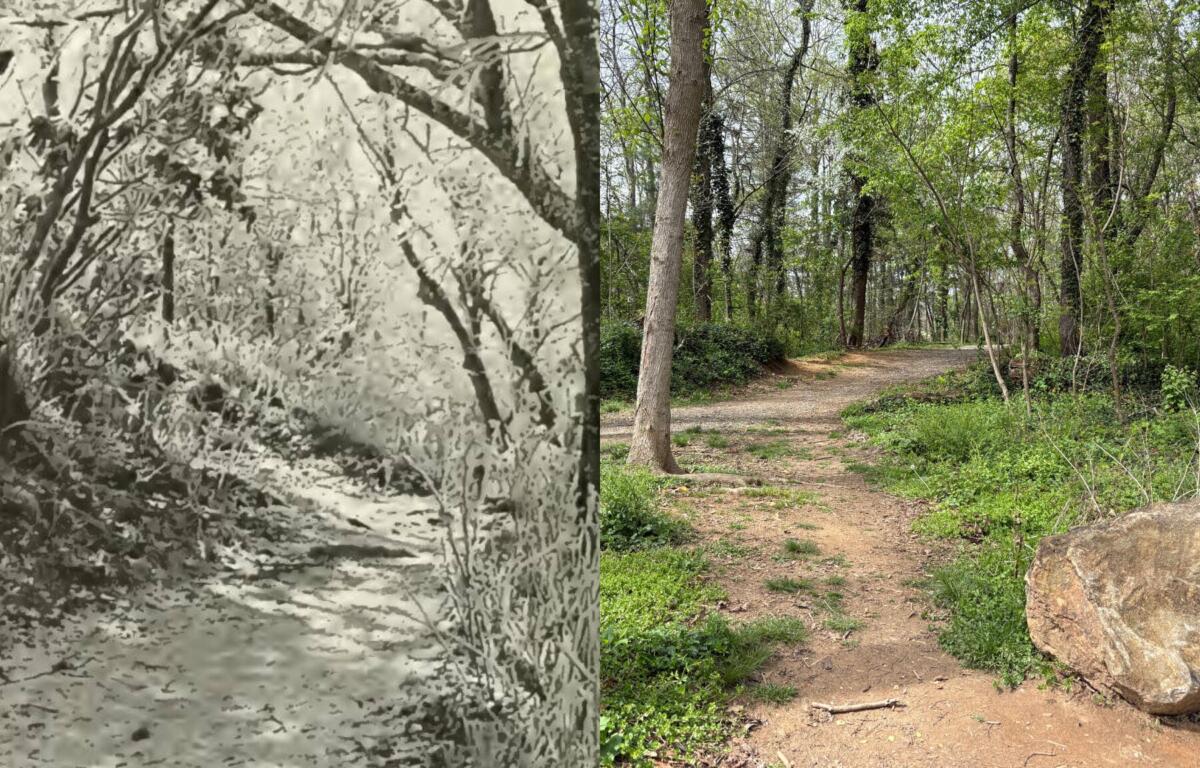

Editor’s Note: This story is part of Beneath the Blue Ridge: The Virginia Olson Case, a special series from 828newsNOW revisiting the unsolved killing of Virginia Olson in Asheville. Through records, reporting and interviews, the series examines what happened and why the case remains unresolved. Read the full series here.
ASHEVILLE, N.C. (828newsNOW) — A man who, as a teenager, was questioned by police as a witness in the 1973 killing of a University of North Carolina at Asheville student says he still thinks about what he saw that day — and what he did not.
Early encounter near campus
Robert Demetris was about 14 when he and his younger brothers were riding bicycles through what was then the Asheville-Biltmore Botanical Gardens on an April afternoon. There, they encountered 19-year-old Virginia Olson, known to friends as Ginger.
Investigators later identified Olson as a homicide victim. Two teenagers discovered her body among the trees near what is now part of the campus area.
Demetris said the encounter with Olson lasted only a few minutes.
“We ran over some mulch and went through some flowers. We didn’t run the flowers over, but she kind of got on us a little bit,” he said. “We were riding around, and we came back around the loop, and she said, ‘Hey, you guys, people are putting this stuff out and making it look nice and pretty, and you’re riding your bikes through it. Please come back here and help me straighten all this out.’”
The boys returned and helped Olson tidy the disturbed flower beds.
“It was a good conversation. It’s not like she was mad at us and we were being brats,” he said. “We were all hand-in-hand moving mulch and putting flowers back underneath.”
He said nothing about the interaction raised concern at the time.
“Nothing like, ‘Hey, there’s a really weird guy,’ nothing like that,” he said. “It was just us.”
Questioned by police
Demetris said investigators later came to his family’s home after receiving a tip that placed the brothers with Olson shortly before her death. Officers asked about their movements and whether they had seen anyone else in the area.
“We went down there (the gardens), and we looked and we walked around and they told us that she had been murdered,” he said. “They were just trying to put all the pieces together.”
He said officers specifically asked about trails and paths near the wooded area where Olson had been studying. The brothers said they had not seen anyone else.
“I have very limited information,” Demetris said. “I couldn’t tell you what she was wearing. But I can tell you she didn’t say anything about somebody’s following me or I fear for my life or somebody’s bothering me, nothing like that.”
Decades later, one thought still lingers.
“We didn’t see anyone. But obviously, somebody else was out there.”
A crowded trail area, but no witnesses
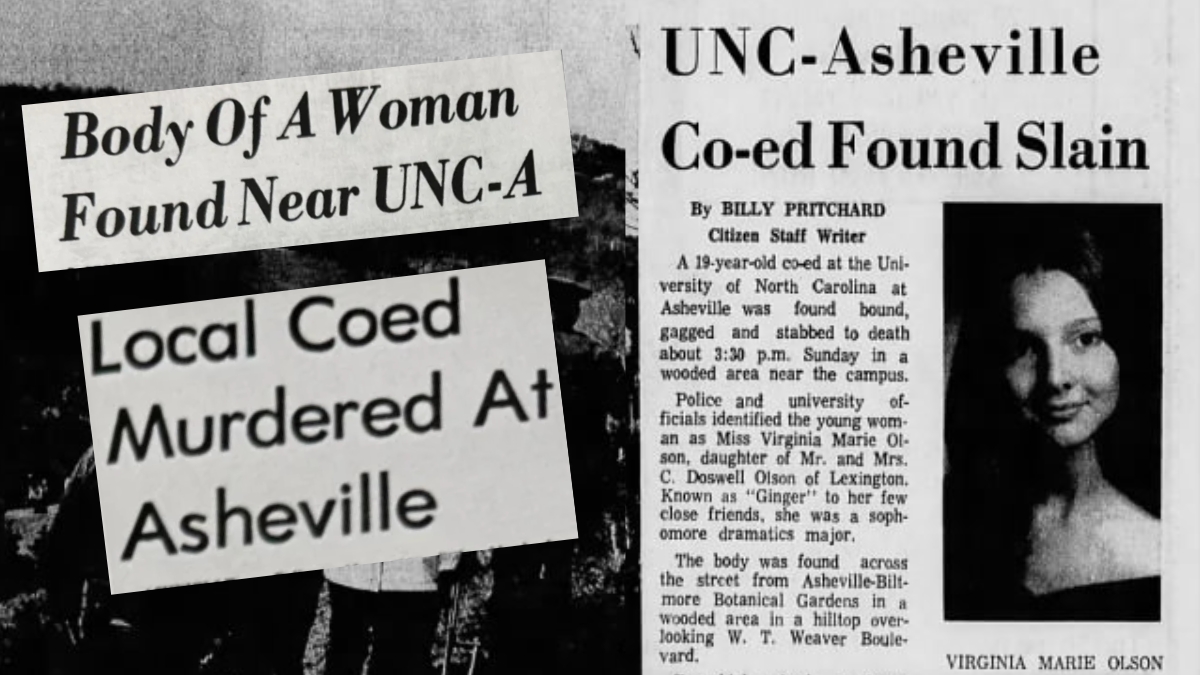
Olson was a student at UNCA when she was killed on an April afternoon in 1973. Investigators placed her at a secluded study spot near a large rock across W.T. Weaver Boulevard around 1 p.m. Her body was discovered roughly two hours later.
The wooded trail network was heavily used at the time and remains traveled today. The site where Olson was found is now associated with the chancellor’s residence, Pisgah House, and surrounding grounds.
Former Asheville Police Detective Kevin Taylor, who later worked cold cases, described the area as a common gathering place.
“It was just a large wooded tract of land with a lot of trails,” he said. “It was a common area for students and locals to go and hang out.”
Police said at the time they were puzzled that, despite the number of people in the area, no one reported hearing or seeing anything connected to the attack.
Police pursued leads in Asheville and beyond
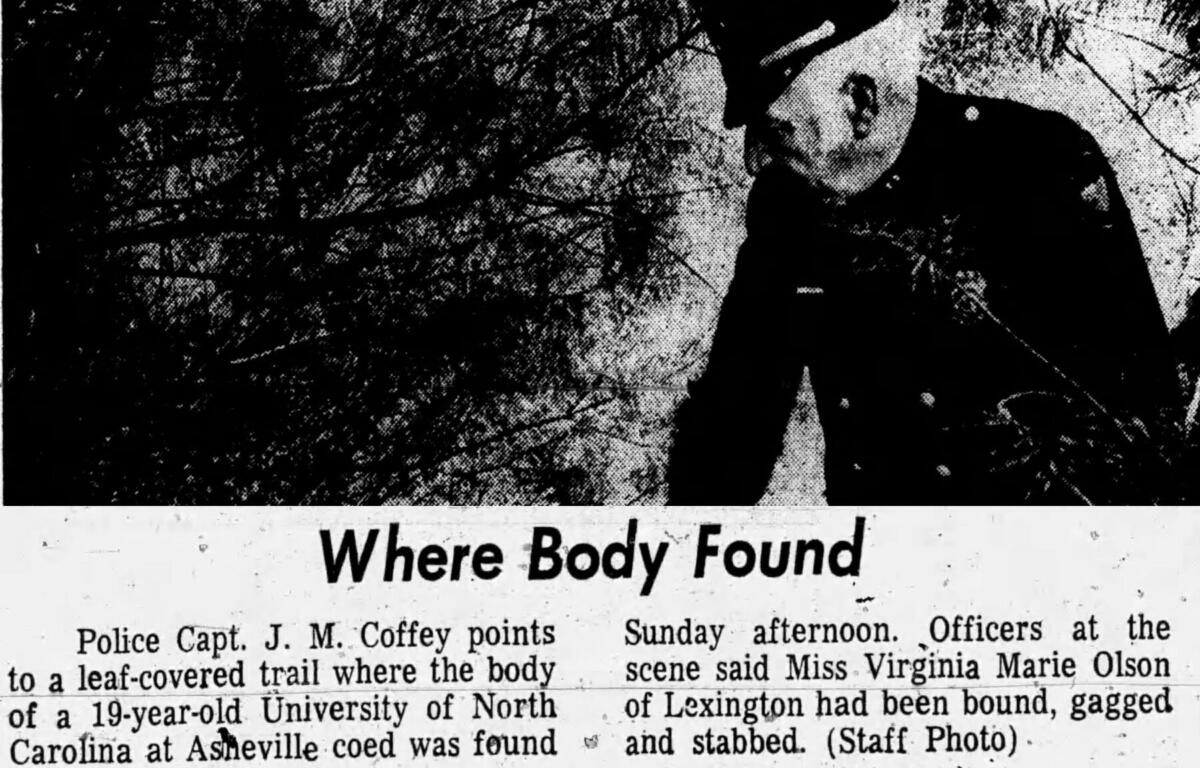
Asheville police interviewed students, visitors and local residents in the days after Olson’s death. Officers worked the case day and night, but no arrests were made.
One of the earliest leads centered on a 19-year-old visitor from Richmond, Virginia. He was given a polygraph test the day after the killing, and physical evidence collected from him and from the scene was sent to the State Bureau of Investigation crime lab in Raleigh. Asheville Police Chief J.C. Hall told The Asheville Times that investigators still had “a long way to go,” unless something turned up in lab testing. Nothing did, and the man was later cleared.
Just days after the killing, investigators also searched the apartment of a man who lived near the crime scene. Officers seized boots and a knife, but laboratory testing produced no conclusive results. Authors Brian Santana and Cameron Santana later identified the nearby resident as John Reavis Jr. in their book A Murder on Campus.
A UNCA employee was also questioned and later cleared after passing a polygraph examination. At the same time, other rumors circulated, including unsubstantiated claims involving a patient from Highland Hospital.
Investigators pursued leads beyond Asheville. In 1974, authorities followed a lead to Florida, where they questioned a man who had once attended UNCA. He was then being held in connection with a series of sexual assaults. Even with that broader reach, no charges were filed.
Evidence that never solved the case
Physical evidence collected early in the investigation was extensive but inconclusive. Olson’s body was found roughly 35 feet from the rock where she had been studying. Her clothing was heavily bloodied, and investigators initially described blood as a key piece of evidence. Multiple searches of the wooded area, including the use of metal detectors, failed to turn up a murder weapon.
Investigators also recovered a man’s handkerchief and what was initially believed to be fatty tissue on a broken weed stem, later determined to be fatback.
A State Bureau of Investigation spokesman said in May 1973 that evidence tested at the state crime lab had come back “negative,” according to The Asheville Citizen.
Olson’s autopsy found she had been stabbed in the heart, causing rapid blood loss. Her throat was slashed after death. She had been bound and gagged with pieces of her own clothing and sexually assaulted. A semen sample described in the report as “abundant” was collected along with blood evidence from her clothing.
Author Brian Santana has said the semen sample referenced in the autopsy report is reportedly missing, raising concerns about a possible lost forensic link. Law enforcement sources have said DNA evidence from the case still exists and remains part of the investigation, though they have declined to provide details.
Case remains open five decades later
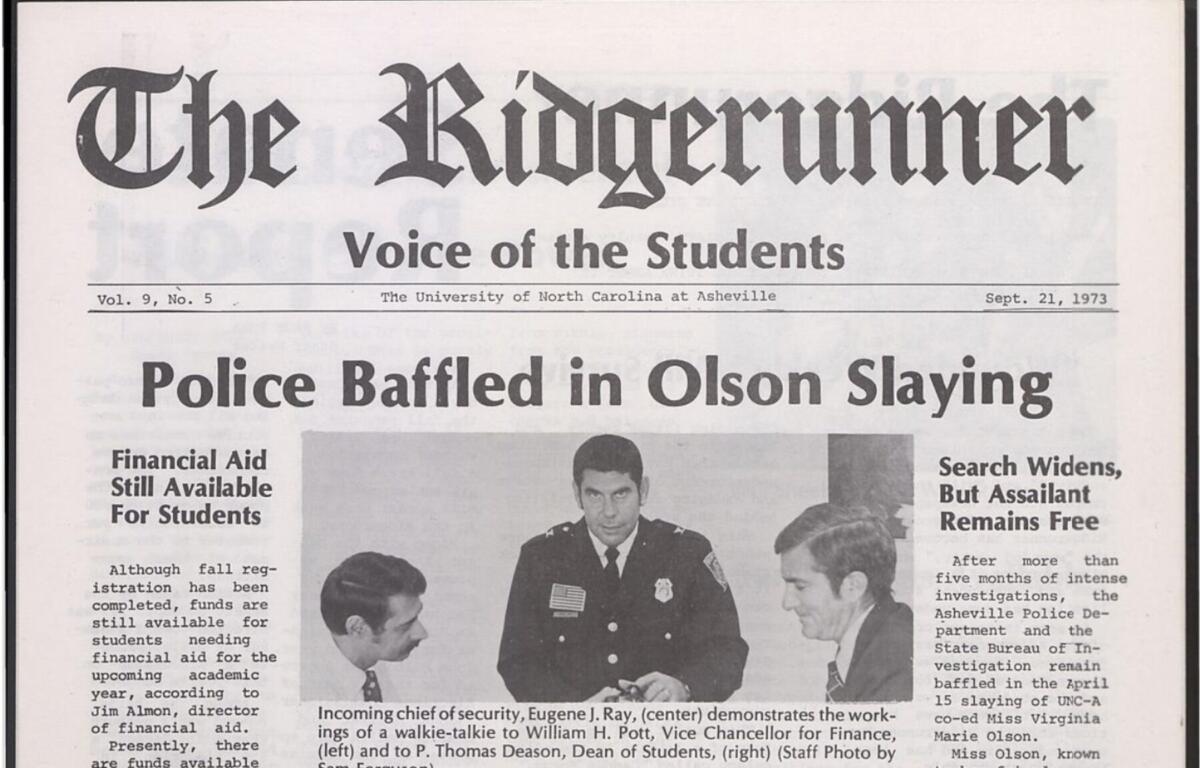
Michael Gouge, a longtime UNCA professor who first came to campus as a student in the late 1980s, said he learned of the case as a student journalist when information was scarce and has since kept it in view for new generations of students.
“You couldn’t just Google the name and find out everything,” he said. “You had to hear about it second- or third-hand or dig through old newspaper clips.”
He has used the case as a recurring teaching example in journalism classes, encouraging students to revisit cold cases when possible.
“Over the years, I’ll remind new generations of students that this case is still unsolved,” Gouge said. “You can see their eyes widen — they want to know more.”
He said student interest has occasionally led to renewed reporting, though efforts are often limited by time, access to records and the lack of new information.
“I keep holding out a sliver of hope,” he said.
Despite extensive interviews, searches and laboratory analysis, no suspect has ever been charged in Olson’s death, and the case remains unsolved.
Gouge stressed the importance of journalistic rigor in unsolved cases. “You need to listen to every rumor and every theory. But you need to establish facts — and print facts”.
He believes continued attention — whether through student reporting, podcasts or other coverage — could be critical.
“Somebody knows something. And maybe one day, they’ll decide to talk,” Gouge said.
This story is part of Beneath the Blue Ridge, an ongoing series revisiting the Virginia Olson case. Six parts, released over three weeks. Follow along as the story unfolds with new installments each Monday and Wednesday.
Do you have information about the Virginia Olson case?
We are actively reporting this story. If you have information we want to hear from you.
Tips on the 1973 killing of Virginia Olson can be submitted to the Asheville Police Department at 828-252-1110, by texting “TIP2APD” to 847411, or through Asheville-Buncombe Crime Stoppers at 828-255-5050. The N.C. State Bureau of Investigation Cold Case Team can be reached at 919-662-4500 or contactus@ncsbi.gov.
828newsNOW is an independent news organization and is not affiliated with law enforcement.