


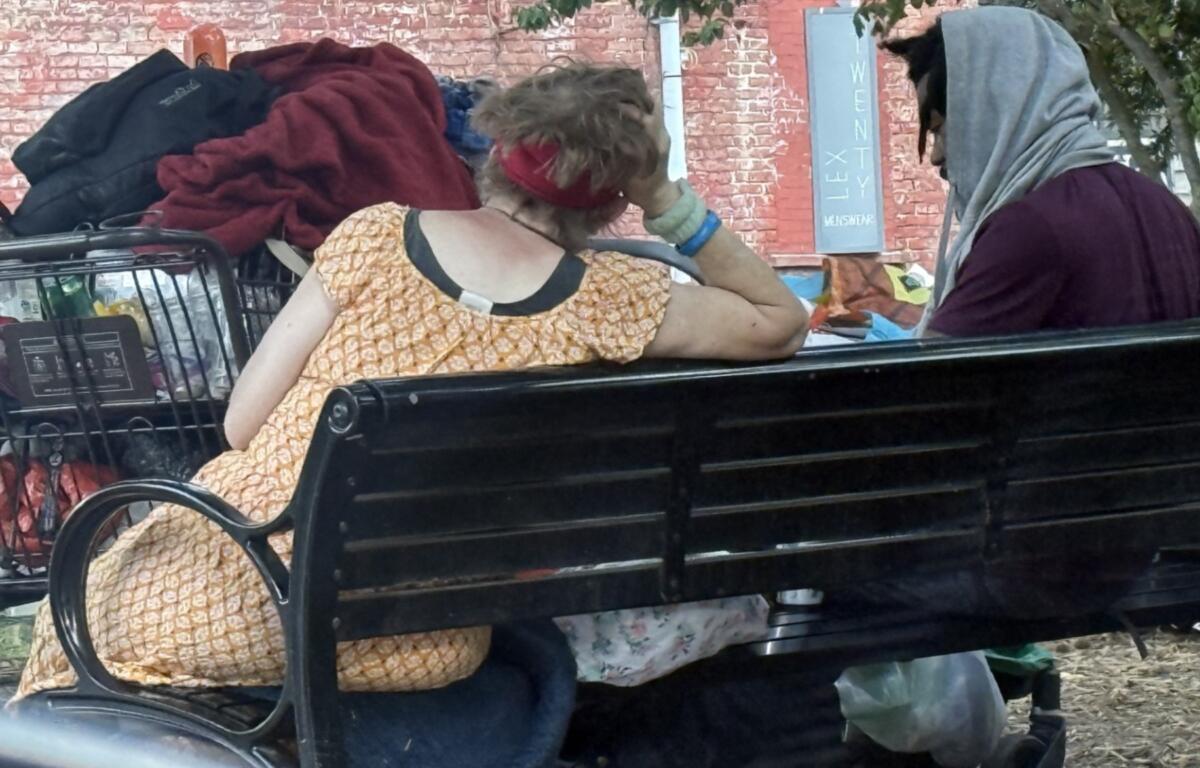

ASHEVILLE, N.C. (828newsNOW) — A West Asheville resident told City Council that encounters with unhoused people along the Haywood Road corridor have increased sharply, describing open drug use, aggressive behavior and an incident that prompted her to call 911.
The concerns raised at the Sept. 8 City Council meeting helped push homelessness in West Asheville onto the agenda of the council’s Public Safety Committee, where the issue was discussed Sept. 24.
The resident told council she has lived in West Asheville for more than 20 years and spends a lot of time walking in the neighborhood.
“This summer my interactions with unhoused folks has increased exponentially,” she said, adding that many of those encounters had been negative.
She said she is repeatedly asked for money while walking and has seen what she described as open drug use. She also recounted several more troubling encounters.
“Someone took a swing at my husband when they were simply passing each other,” she said. “I was called a cheapskate for not handing over my groceries.”
The woman said she called 911 after seeing a man she regularly encounters attacking another man outside The Hop in the middle of the afternoon.
She was also careful to distinguish between homelessness and someone who may present a danger.
She said she and her husband talk with their two teenagers about how not every unhoused person is unsafe, but that someone experiencing a mental health crisis or drug addiction may be unsafe at that moment.
The situation has changed how the family thinks about their children’s independence in a walkable neighborhood, she said.
“We worry about them standing at the bus stop on Burton and walking,” she told council members.
She said she has spoken with neighbors who share her concerns and described conditions in West Asheville as reaching a “boiling point.”
“The situation right now isn’t safe for the homeless folks or the residents,” she said.
Resident calls for different response
The West Asheville resident did not ask council simply for more police enforcement.
Her primary request was for the city to work with Buncombe County to expand the community paramedic program so trained responders could intervene when someone is experiencing a mental health, substance-use or medical crisis.
“Having trained people responding to unhoused people in crisis” could help connect people with psychiatric medication or medical care or provide de-escalation, she said.
She argued that could be more effective than relying on traditional emergency responses when someone calls 911 when they encounter a person in crisis.
Council members responded with several requests of their own.
Council member Bo Hess asked for homelessness in West Asheville to be placed on the Public Safety Committee’s agenda and for representatives from Safe Shelter to participate.
Hess said he wanted the issue to remain before the committee while the city looks for solutions.
Council member Sage Turner, who said she also lives off Haywood Road, echoed concerns about conditions there.
“I’ve lived there for 25 years, and I know it’s not just West Asheville, but Haywood Road is really undergoing some serious challenges right now,” Turner said.
She noted that Tunnel Road also is experiencing challenges and asked for an update on the city’s work along those corridors.
Turner also asked that a previously discussed walk through West Asheville with the city manager be rescheduled.
Issue moves to Public Safety Committee
The issue reached the Public Safety Committee on Sept. 24.
Participants included Emily Ball, Asheville’s Homeless Strategy Division manager, and Christian Chambers, executive director of Safe Shelter, a nonprofit located just off Haywood Road in West Asheville.
The concerns voiced at City Council also came as Safe Shelter says it has noticed an increase in homelessness in the area.
Chambers told 828newsNOW in an August interview that the situation in West Asheville was urgent.
Ezra Parashar, Safe Shelter’s development specialist, described homelessness in the area as “pretty serious” and said Asheville’s shortage of affordable housing is a major part of the problem.
“We’re seeing an uptick there,” Chambers said of West Asheville.
Safe Shelter operates an overnight shelter 365 days a year and works with families and individuals experiencing homelessness. Parashar said 77% of the shelter’s guests last year exited into permanent or transitional housing.
The organization also operates WASE, or West Asheville Street Engagement, a street outreach program. Its outreach coordinator works directly with people living outside, building relationships and trying to connect them with housing, detox and other services.
Safe Shelter also conducts a community cleanup every Tuesday. Chambers said residents who encounter trash, discarded needles or similar problems can contact the organization.
Chambers said Safe Shelter has seen people move into housing and remain there, while others have entered detox and continued their recovery.
Parashar said addressing homelessness on a larger scale requires more than the work of individual organizations. He said reaching what is sometimes called “net zero homelessness” — when the number of people leaving homelessness keeps pace with or exceeds the number becoming homeless — requires a broader, systemwide response.
For West Asheville, the Sept. 8 council meeting put residents’ concerns squarely before city leaders. Two weeks later, those concerns had moved to the Public Safety Committee, along with a larger question of how Asheville responds when homelessness intersects with mental health, substance use and neighborhood safety.