


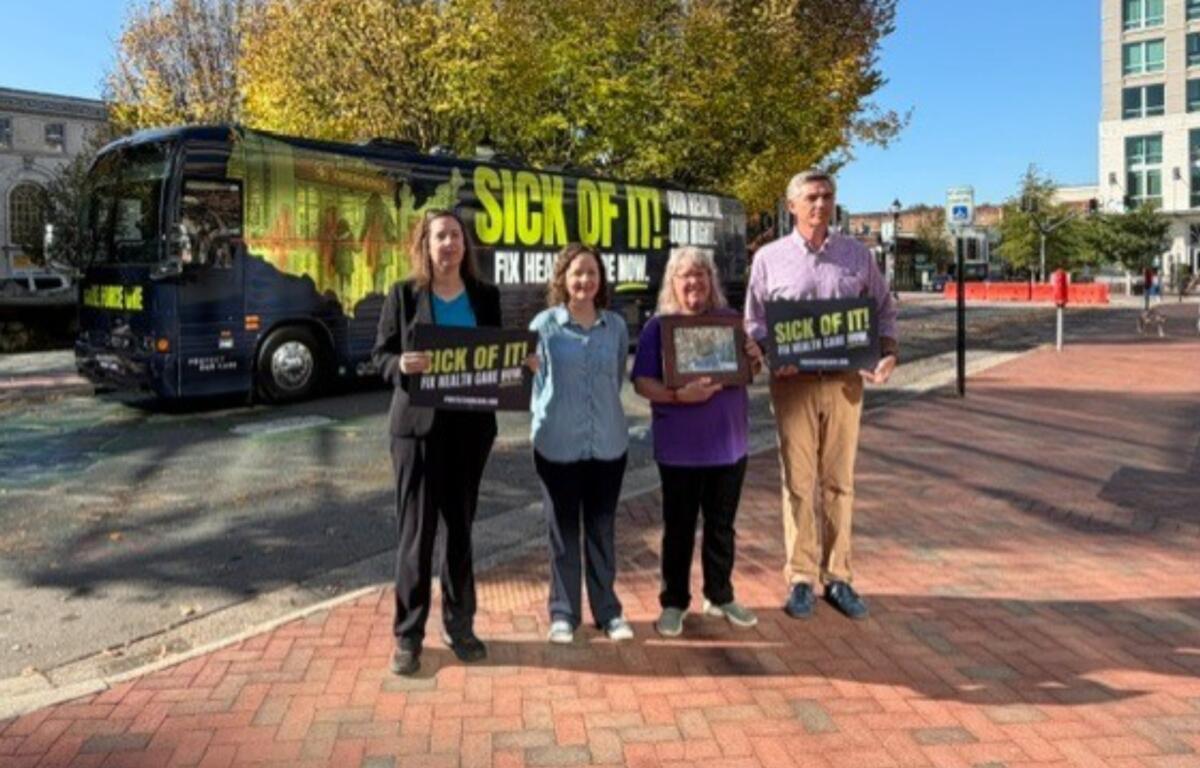

ASHEVILLE, N.C. (828newsNOW) — With changes to Medicaid approaching and health insurance premiums rising, state lawmakers and health care advocates gathered in downtown Asheville on Thursday, Oct. 15, to warn that more North Carolinians could struggle to afford medical care.
State Reps. Lindsey Prather and Brian Turner, both Buncombe County Democrats, joined patients and advocates at Pack Square Park for a stop on Protect Our Care’s “Sick of It! Fix Health Care Now” bus tour.
The national advocacy group is making nearly 40 stops over four weeks, calling on Congress to reverse federal Medicaid funding cuts, restore enhanced Affordable Care Act tax credits and take additional steps to lower prescription drug costs.
Speakers criticized President Donald Trump and congressional Republicans, including U.S. Rep. Chuck Edwards, whose district includes Asheville, over policies they say will leave families paying more for insurance while making medical care harder to obtain.
Prather pointed to the financial strain facing families, citing figures showing that annual health insurance premiums for a North Carolina family of four earning $130,000 could increase by $13,428, bringing the total to $24,478.
“Literally, what are people supposed to do?” Prather asked.
Turner warned that reductions in Medicaid funding, combined with rising insurance premiums, could create problems throughout the health care system.
He said people who lose coverage or cannot afford treatment may put off seeing a doctor until their conditions become more serious. That could mean more emergency room visits, higher medical costs and additional financial pressure on hospitals and clinics.
“It equals a loss of access,” Turner said. “It means more people sick and dying of preventable and treatable diseases and conditions.”
He also raised concerns about maternity care, long-term care for older adults and services for people with disabilities.
What the federal changes mean for North Carolina
North Carolina is preparing for significant Medicaid changes under a federal budget law signed by Trump in July 2025.
Beginning Jan. 1, 2027, many adults covered through Medicaid expansion will have to meet new work, education or other qualifying activity requirements to maintain coverage. Most affected recipients also will have to renew their coverage every six months instead of annually.
The requirements generally call for 80 hours of qualifying activity per month or meeting an income threshold. Affected recipients generally must meet the requirements during three of the six months before their eligibility review. Exemptions apply to certain groups, including pregnant women, people with qualifying medical conditions and some caregivers.
Gov. Josh Stein’s administration has estimated that more than 250,000 North Carolinians could lose health coverage because of the federal changes. Those are projected losses, not people who have already lost insurance. The state also faces the prospect of losing billions of dollars in federal health care funding over the next decade.
Supporters of the federal legislation say the changes are intended to control government spending, strengthen eligibility requirements and preserve Medicaid resources for those who qualify. Critics argue that additional paperwork and reporting requirements could cause people to lose coverage even if they remain eligible.
Separately, enhanced federal tax credits that helped people purchase insurance through the Affordable Care Act marketplace expired at the end of 2025 after Congress did not extend them.
The expiration has meant higher premiums for many households, particularly those that previously received substantial financial assistance.
Edwards defended vote on federal health care changes
Edwards voted in favor of the sweeping federal tax and spending bill signed into law in July 2025. The legislation includes reductions in projected Medicaid spending, new eligibility requirements and a $50 billion fund intended to support rural health care providers.
In a July 4, 2025, statement following his vote, Edwards defended the legislation, saying it would strengthen Medicaid and provide funding to help rural health care providers adjust to changes in federal reimbursements.
“This bill strengthens Medicaid to its original intent,” Edwards said in the statement, pointing to protections for children, pregnant women, older adults and people with disabilities.
Edwards also highlighted the $50 billion rural health fund as a way to help hospitals and medical providers in communities such as those in Western North Carolina.
Health care organizations have questioned whether that funding will be enough to offset the effects of Medicaid reductions, which are projected to exceed $900 billion nationally over the next decade.
Asheville mother shares son’s story
For longtime Asheville health care advocate Leslie Boyd, the debate is personal.
Her son, Michael Danforth, died of colon cancer in 2008 at age 32.
Boyd has said her son was born with a rare medical condition that increased his risk of developing colon cancer. Because of his pre-existing condition, he struggled to obtain affordable private health insurance and access the regular screenings that might have detected the disease earlier.
According to Boyd, Danforth had some insurance coverage at one point, but it did not pay for the colonoscopies he needed.
After developing Stage 3 colon cancer, he also struggled to qualify for Medicaid. Boyd said he was initially denied because of household assets, including a car and modest education savings.
Boyd has also said her son applied for federal disability benefits, but the approval process took 37 months. He died nine days before his first disability payment arrived.
Boyd, a former Asheville Citizen-Times journalist who later helped establish the health care advocacy organization Life O’ Mike, has spent years sharing her son’s story and pushing for changes to the health care system.
“He was an extraordinary human being, and none of that mattered,” Boyd said Thursday.
She argued that providing preventive screenings would have cost far less than the medical treatment her son eventually received.
“It would have been cheaper for us to take care of him,” she said.
Cancer survivor calls for action
Laura Packard, a cancer survivor and health care advocate, also spoke about the importance of affordable insurance.
“Nine years ago I walked into the doctor’s office with a nagging cough and walked out with a stage four cancer diagnosis,” Packard said.
She said her health insurance covered the chemotherapy and radiation treatments she needed to survive.
Packard called on Congress to restore enhanced ACA tax credits and reverse Medicaid cuts, saying people facing serious illnesses cannot afford to wait for lawmakers to act.
“Cancer doesn’t wait, and neither should Congress,” she said.
Vanessa Watson, Protect Our Care’s North Carolina state director, said the tour is intended to draw attention to federal health care policies and hold lawmakers accountable for their decisions.
“Families across this country are sick of it, and they’re making their voices heard loud and clear,” Watson said.
Along with restoring insurance subsidies and reversing Medicaid cuts, the organization wants Congress to expand Medicare’s ability to negotiate prescription drug prices and extend certain Medicare drug cost protections to people with private insurance.
Those protections include a $2,000 annual out-of-pocket prescription drug spending cap and a $35 monthly insulin cost limit for eligible Medicare beneficiaries.
The Asheville event came on the first day of early voting in North Carolina, ahead of the Nov. 3 general election. Protect Our Care has said the tour is intended in part to hold Republican lawmakers accountable at the ballot box.
The bus tour was scheduled to continue Friday in Ohio, with appearances by Democratic U.S. Reps. Greg Landsman and Marcy Kaptur.