


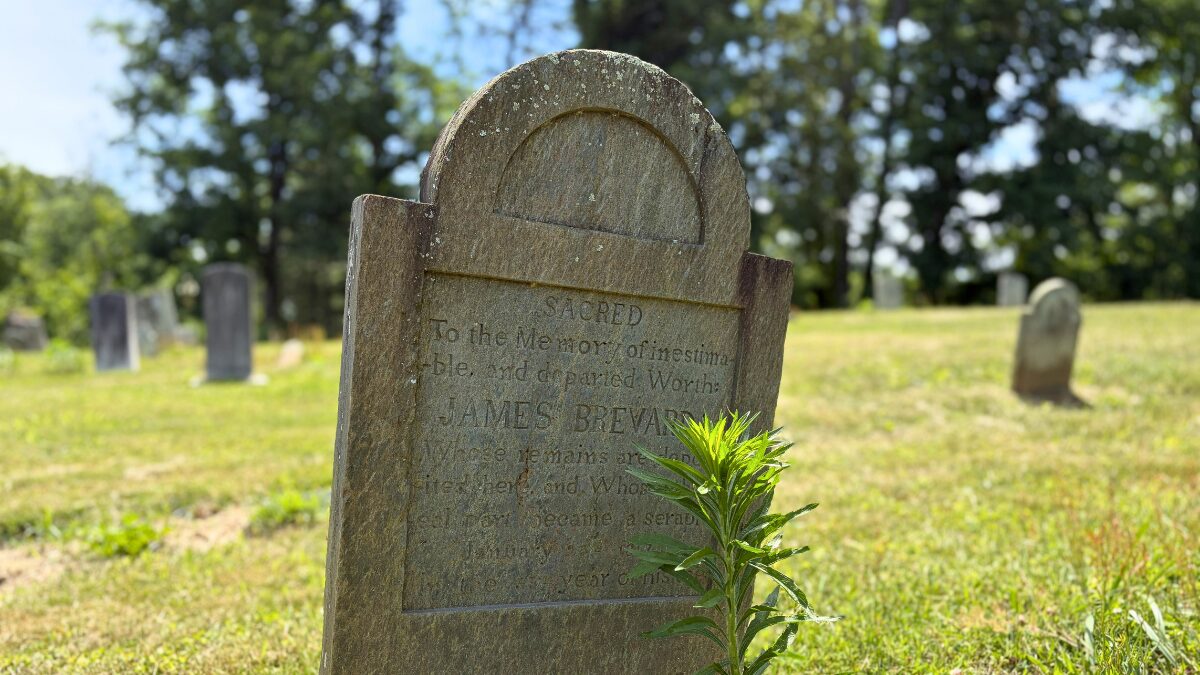

FAIRVIEW, N.C. (828newsNOW) — Time has taken some of the sharpness from the letters carved into James Brevard’s gravestone at Cane Creek Cemetery.
But it has not erased the remarkable way he was remembered.
“Sacred to the Memory of inestimable, And departed Worth,” the inscription begins.
Below Brevard’s name, the stone offers something more unusual. It says his remains were deposited there while his spirit “has become a seraph.”
Nearly 180 years later, those words pose a question.
Who was James Brevard?
The answer leads into the early history of Fairview, to a time when the roads, mail routes and institutions that connected Cane Creek to the rest of North Carolina were still taking shape.
Brevard was born about 1794 and was the son of Zebulon Brevard Jr., according to Fairview historian Bruce Whitaker. The elder Brevard brought his family to the Fairview area about 1805 or 1806 before eventually leaving North Carolina for Ohio. James stayed behind.
Fairview became his home.
He married Ruth Ashworth in 1823, and the couple eventually raised 10 children. Brevard made his living as a farmer and became a man of some standing in the community.
In 1830, a post office named Brevardsville opened in Buncombe County, and James Brevard became its postmaster.
His public role soon expanded.
In 1831, voters sent him to Raleigh to represent Buncombe County in the North Carolina House of Commons, the forerunner of today’s state House.
For a farmer living in the mountains of Buncombe County, Raleigh was a long way from home. But the issues confronting Western North Carolina were often rooted in a basic problem Brevard would have understood firsthand: getting people and goods across the mountains.
Several years after his legislative service, Brevard’s name appeared in a state law involving just such an effort.
The General Assembly appointed Brevard, James W. Patton and Lambert Clayton as Buncombe County commissioners for a company authorized to build a turnpike from Rutherford County into Buncombe County. The proposed road would cross the Blue Ridge at Hickory Nut Gap.
For modern drivers traveling U.S. 74A between Fairview and the Hickory Nut Gorge, the geography is familiar. For Brevard’s generation, that mountain passage was part of the difficult work of connecting isolated communities to markets and neighboring counties.
Brevard died Jan. 14, 1847, and was buried at Cane Creek Cemetery in Fairview.
The unusual word carved into his epitaph, “seraph,” gives the inscription a distinctive meaning.
In biblical tradition, seraphim are heavenly beings described in the Book of Isaiah as surrounding the throne of God. In later Christian tradition, they came to be regarded among the highest orders of angels. The choice of that word gives the inscription a level of reverence that is striking even now.
Who selected the wording is unknown. What remains clear is the sentiment behind it. Brevard was not remembered simply as a farmer, postmaster or legislator, but as someone whose life had left a deep impression on those who mourned him.