


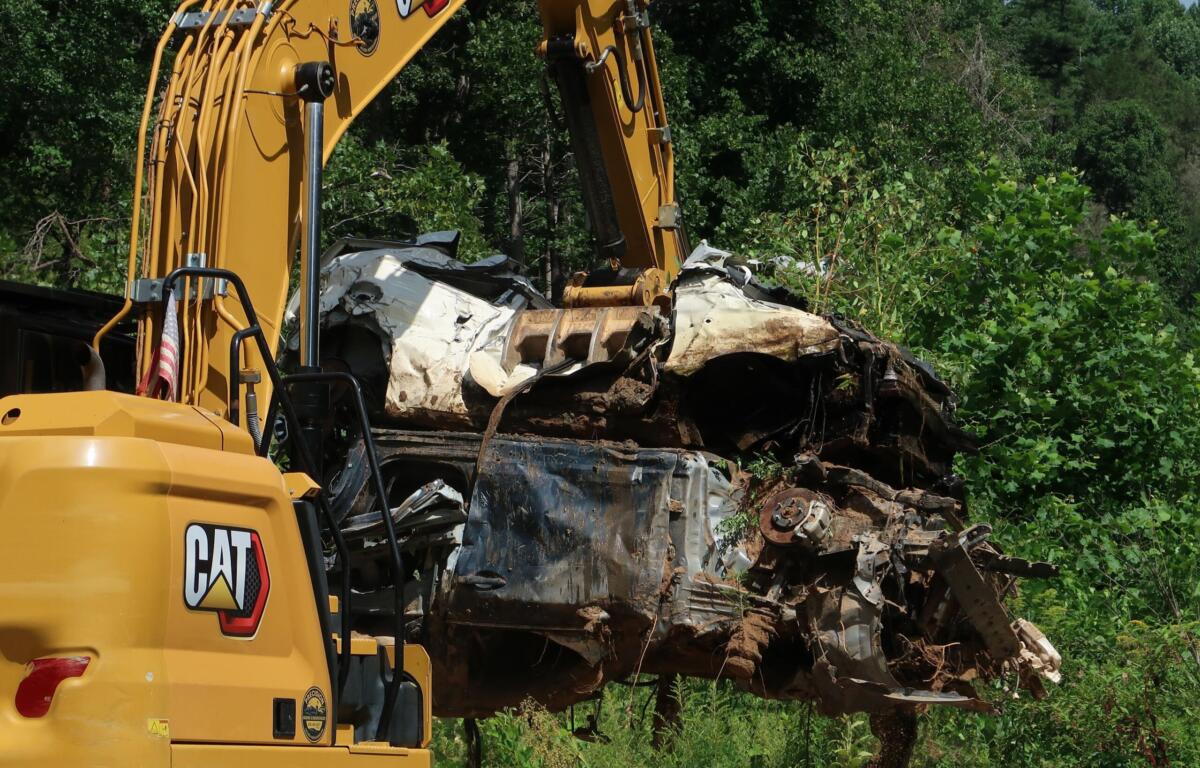

FLAT ROCK, N.C. (828newsNOW) — Nearly two years after Tropical Storm Helene, MountainTrue crews are still hard at work clearing debris from Western North Carolina rivers. Today, that meant excavating and extracting several battered vehicles from the Hungry River in Flat Rock, N.C.
Preparing for river removal
According to Erica Shanks, Green Riverkeeper and Watershed Outreach Coordinator at MountainTrue, the site of the vehicle removal was first scouted in February 2026 after a local resident contacted the North Carolina Wildlife Resources Commission.
“We had a neighbor up here on one of the hills that called one of their biologists and said, ‘Hey, down from my property, there’s a car in the river,'” Shanks recalled. “[The biologist] then called me and told me that there was a car in Big Hungry. We had access from [the neighbor’s] property to hike down, and we saw the one car, and then as we came down farther, we were like, oh no, wait, there’s three cars. Three more, and then there was a motorcycle also with the car up here that was buried.”


Shanks said that the entire process of extraction was an exercise in collaboration. Over the course of three separate scouting trips, MountainTrue worked with local landowners, the NCWRC, the United States Army Corps of Engineers and the protectors of the Green River Game Land to ensure that the right permits and environmental preservation protocols were in place before attempting removal.
Once the preparations had been made, MountainTrue called in Jake Jarvis, owner of Precision Grading & Disaster Relief, as the contractor for the job.
With the help of Mya, his 10-year-old daughter and co-pilot, Jarvis navigated a Caterpillar excavator down the steep dirt trail to the river. The contractor, his team and MountainTrue crew members began work the morning of Monday, Aug. 3, six months after the careful preparations for the job began. Jarvis snapped the vehicles up in the jaws of the excavator, often removing them from the sandy embankments of the Hungry River, and then delivered them back up the mountain to a waiting dump truck.


Protecting people and preserving the environment
One of the major reasons for removing the cars from the river was environmental, Shanks explained. The vehicles were still full of gas and other chemicals that could be hazardous for the aquatic ecosystem. Other deteriorating car components could prove toxic as well.
“Aside from the metal, all of the things that make your upholstery and other stuff, that breaking down over time and going back into our rivers and streams, and even into our wooded areas and forested areas, obviously, that’s going to have some toxic pollution and pollutants in it there that we don’t want in our rivers and streams,” Shanks said.


According to Mya, the cars smelled as toxic as their pollutants.
“Earlier when we got the first car, it felt like day one like crazy, and it smelt like day one,” Mya said, referring to the first day after Helene.
It was worth it, though.
“Cleaning up the river, I know that I’m helping people,” Mya said.
Protecting the river for people was front of mind for the MountainTrue team, too.
“By not removing these, that would also cause harm potentially in our rivers and streams for years to come,” Shanks explained. “In Big Hungry downstream, people recreate, and play, and swim and stuff, and so we want to get that out also for the community to enjoy as well.”


It was not lost on the MountainTrue team that what they had uncovered once belonged to someone. That is a factor of their work the debris team is “phenomenal” about honoring, Shanks said.
“They do such an amazing job at really giving respect and valuing what they’re pulling out was a part of somebody’s life,” Shanks said. “One of the things that we want to do also is, we’ll get the VIN numbers. If we can find the VIN numbers on the car, we’ll connect that back to the owner, and then let them know that we found their cars in the river. Even though they might not be able to drive the car away, I feel like that’s some type of closure or connection to a really traumatic event.”
For more about MountainTrue, visit www.mountaintrue.org.
Read more. . .
-
Juvenile arrested in connection with Atkinson Street shooting
A juvenile wanted in connection with an April 2026 shooting on Atkinson Street, located by the Hillcrest Apartments complex in Asheville, has turned themselves in.
-
Woodfin PVC pipe company invests $500,000 in French Broad River cleanup
Nearly two years after Tropical Storm Helene, IPEX Inc., a PVC pipe manufacturing company, has announced a $500,000 commitment to local conservation nonprofit MountainTrue to continue cleaning up debris in the French Broad River.
-
Man charged after South French Broad Avenue stabbing
Victim taken to Mission Hospital with non-life-threatening injuries
-
Recalled Laura Lynn soaps were sold at all Ingles stores
Ingles says 1,714 units were removed from shelves in July, and customers with affected products can get a full refund without a receipt
-
I-26 Connector update: Hill Street closure changes Asheville traffic
Long-term closure near Atkinson Street will remain in place through at least 2027; no additional traffic shifts are scheduled