



CHEROKEE, N.C. (828newsNOW) — The Fourth of July is a complex day for Cherokee. In 2026, the holiday marks 250 years of American independence, a celebratory milestone for a country simultaneously weighed down by a history of violence against Indigenous people.
As the annniversary approaches, the Museum of the Cherokee People has prepared several ways for the community to consider the Fourth of July from a nuanced angle.
A complicated history
Like many other communities across the United States, Cherokee will observe America 250, said Shana Bushyhead Condill, MotCP executive director. The community holds an annual Fourth of July Powwow, which will take place this year from July 3-5. Find more information here.
“We’re like other folks, right? We’re grilling hot dogs and watching fireworks. But, of course, it’s complicated. I think any commemoration is complicated,” Condill said. “The thing I keep pushing back on is the word ‘celebrate.'”
Condill explained that it was hard to “celebrate” the signing of the Declaration of Independence, for instance, when the same document referred to Indigenous Americans as “merciless Indian savages.”
“Written by Thomas Jefferson, with ‘Life, Liberty, and the Pursuit of Happiness,’ right? Like, all these good, amazing things,” Condill said. “‘All men are created equal.’ At the same time, enslaving folks. So, it’s complicated, is what I always say.”
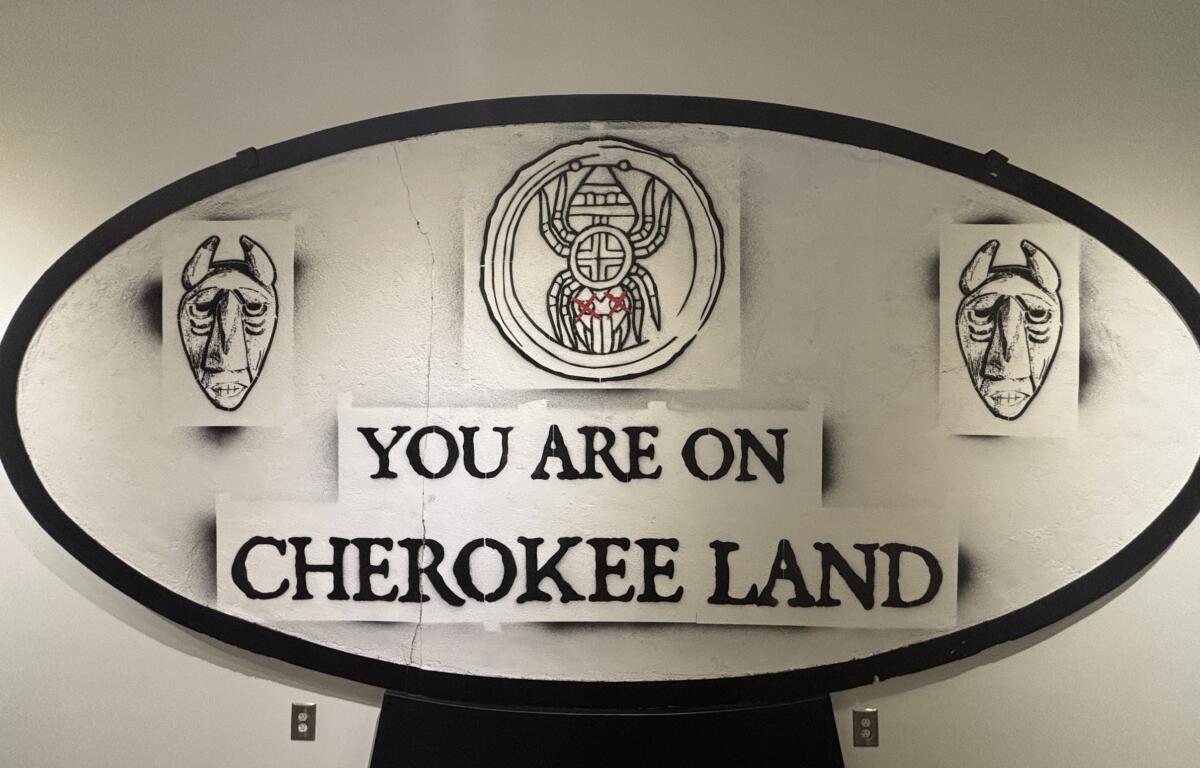
On March 17, 2026, MotCP opened “ᏧᏂᏲᏍᎩ ᏂᎨᏒᎾ: ᏣᎳᎩ ᎠᏂᏴᏫᏯᎯ ᏃᎴ ᎠᏂᏴᏫᏁᎦ ᏓᏂᎦᏘᎴᎬ ᎠᏰᎵ ᎤᏙᏒᎲᎢ,” or “Unrelenting: Cherokee People and the American Revolution,” an exhibit which examined the Cherokee relationship to the colonial United States through artwork, historical documents and contemporary reminiscences on the 250th anniversary of the nation’s founding.
“Unrelenting” will be open to the public from 9 a.m. to 5 p.m. on the Fourth of July. Read more about the exhibit in our story here.
One of the major takeaways from “Unrelenting” is just how intrinsically linked the birth of the United States and decades of bloodshed were for the Cherokee.
“We have an idea when you say Fourth of July, right, you just have fireworks and bald eagles and red, white and blue in your head. But, I think part of what we were trying to do was to complicate that narrative a little bit and have folks think about other perspectives,” Condill explained. “That long-standing state of warfare is one of those things that when we started realizing and doing the math on how long the Cherokee had been in armed conflict, it was like, oh my goodness, that’s crazy. That’s actually really insane.”
The museum has posted a series of informative Facebook posts in the weeks leading up to the Fourth of July. A post on Monday, June 29, outlined a timeline of conflicts the Cherokee were involved in between 1711 and 1776.
“What was life like for Cherokee people leading up to the American Revolution?” the post asked. “Imagine your community living in the midst of war for generations. The choices would be tough, and living a life in the middle of destruction would be exhausting. The 1700s brought conflict and change to Cherokee country. We fought in brief disputes and decades-long struggles for most of the century leading to the American Revolution.”
Ultimately, however, Condill said that the goal of “Unrelenting” – and other America 250 events at MotCP – is to take a hopeful look at American identity.
“The goal isn’t necessarily to remain in the darkness,” Condill said. “I think for me, the America 250 is a moment of reflection and a call to action. Let’s think about who we are as Americans, and who we hope to be and how we get there.”
Further conversation
There are several other Fourth of July events coming to MotCP. A panel discussion titled “Listen, Lunch, & Learn: Cherokees in the American Revolution” will feature podcaster Rebecca Nagle of the Cherokee Nation, whose series “First America” explores how the Founding Fathers’ treatment of Indigenous people has reverberated into the present political moment.
Nagle will be in conversation with Maggie Blackhawk of the Fond du Lac Band of Lake Superior Ojibwe, a New York University professor of law, Brandon Dillard, Cherokee Nation, Director of Historic Interpretation and Audience Engagement at Monticello, and C. Joseph Genetin-Pilawa, a George Mason University associate professor of history.
The discussion will be held for free over Zoom from noon to 5 p.m., Wednesday, July 8. Find more information here.
A full calendar of events can be found at www.motcp.org/events.