


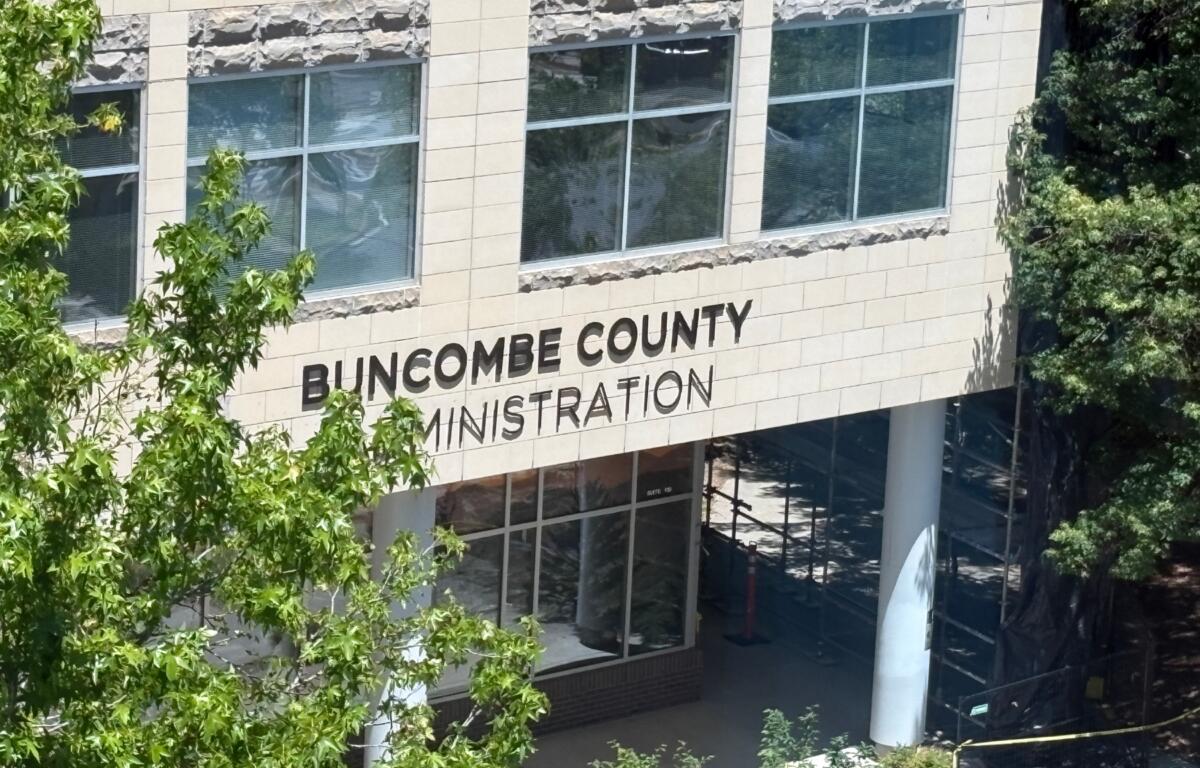

ASHEVILLE, N.C. (828newsNOW) — Buncombe County commissioners voted Tuesday to pursue nearly $19 million in disaster recovery grants aimed at helping rebuild Swannanoa and other storm-damaged commercial areas, while also accepting more than $800,000 for stream restoration projects and approving funding for schools and emergency medical services.
Nearly $19 million sought for Helene recovery projects
Commissioners unanimously approved submitting two applications for Community Development Block Grant-Disaster Recovery (CDBG-DR) funding before the state’s Aug. 4 deadline.
The first application seeks the program’s maximum $10 million award to build approximately 2 miles of sidewalks along U.S. 70 between Whitson Avenue and Warren Wilson Road in Swannanoa. County officials said the project would improve pedestrian safety, strengthen connections between businesses and support long-term economic recovery following Tropical Storm Helene.
The second application requests $8,966,557 to remediate storm-damaged commercial properties throughout unincorporated Buncombe County. The project would fund activities such as removing unsafe structures, cleaning up debris, remediating damaged commercial properties and taking enforcement actions needed to move properties toward recovery.
County staff said the goal is to restore commercial activity by improving the condition of business districts still affected by Helene while encouraging private reinvestment.
The applications received strong support during the public hearing.
Carol Groben, president of the Friends and Neighbors of Swannanoa, told commissioners the community still lacks safe places to walk along U.S. 70 despite serving as the area’s main commercial corridor.
“Nobody should have to risk their life to walk to the store,” Groben said.
She said sidewalks were identified as one of the community’s highest priorities during the Swannanoa Small Area Plan process and would improve both safety and economic revitalization.
Groben also said removing storm-damaged buildings and debris would help residents heal emotionally after months of living with constant reminders of Helene’s destruction.
“The psychological impact of that on the community as a whole can’t be underestimated,” she said. “Those visual images of the destruction that’s still there keep the wounds open. We really need to close the wounds.”
Friends and Neighbors of Swannanoa board member Megan McCrea said many residents without reliable transportation are forced to walk along U.S. 70, including people using wheelchairs and parents pushing strollers.
“It would be a huge step toward making Swannanoa a safer, more walkable place,” McCrea said.
Advocacy group chair Matt Barker said the grants would send an important message that Swannanoa remains worth investing in after the storm.
“The question that hung in the air was, ‘Is Swannanoa worth investing in?’ The answer, I believe, is emphatically yes,” Barker said.
Commissioner Terry Wells reflected on visiting Swannanoa immediately after Helene, saying she initially feared the community might not recover.
“I didn’t think Swannanoa would survive,” Wells said. “But after walking around and talking to the people … I knew that Swannanoa will be better off than they were going into Helene.”
Stream restoration grant approved
Commissioners accepted an $802,275 grant from the Streamflow Rehabilitation Assistance Program (StRAP), administered by the N.C. Division of Soil and Water Conservation.
The funding will stabilize approximately 3,500 feet of streambank damaged by Helene along Flat Creek in Fairview and Dillingham Creek in Barnardsville.
County staff said the projects will stabilize streambanks, remove debris, improve water quality and reduce future flooding. Officials also said they expect another round of StRAP funding to become available later this year.
Rural health grant expands community paramedicine
The board accepted a $282,104 Rural Health Transformation Program grant from the N.C. Department of Health and Human Services for Buncombe County Emergency Services.
The funding will add a contracted mental health clinician and a peer support specialist to the county’s Community Paramedicine Program while also covering continuing education costs for community paramedics and peer support specialists.
School funding approved
Commissioners approved an additional $12,036,686 for School Capital Needs Fund projects benefiting Buncombe County Schools and Asheville City Schools.
The funding represents the remaining portion of the School Capital Fund Commission’s fiscal year 2027 recommendations after commissioners approved approximately $30.1 million during adoption of the county budget.
The amendment also reallocates $1.65 million originally budgeted for security improvements at Asheville City Schools while preserving funding for those projects.
In a separate action, commissioners approved five state lottery-funded paving projects totaling $2.5 million at West Buncombe Elementary, Valley Springs Middle, North Buncombe Elementary, Clyde A. Erwin Middle and Charles D. Owen Middle schools.
Air quality governance transitions to county
Commissioners also adopted the new Buncombe County Air Quality Code, completing the transition of the former Asheville-Buncombe Air Quality Agency into a division of the county’s Permits and Inspections Department.
The action follows a June vote creating a locally governed air quality program after reductions in federal funding and fee revenue.
Address ordinance updated
The board approved updates to Buncombe County’s E-911 addressing ordinance, the first major revision since the 1990s.
County planners said the changes modernize street naming and addressing standards, clarify terminology and improve emergency response by making addresses easier for first responders to locate.
Parks and Recreation Month recognized
Commissioners proclaimed July as Parks and Recreation Month, recognizing the role parks play in improving health, protecting natural resources and serving as community gathering places.
County Parks and Recreation Director Allison Dains noted that county staff continue rebuilding parks damaged by Tropical Storm Helene, saying parks have become important community resilience hubs during the recovery process.