
EDITOR’S NOTE: Strangeville explores the curious and unexplained stories that have long defined Asheville and Western North Carolina. The region is full of unanswered questions, from old folklore and local legends to eerie encounters, unsolved moments in history, and the true-crime mysteries that still leave people wondering. Each week, we look back with an open mind and a sense of curiosity, trying to understand why some stories take hold and why some can never be explained.
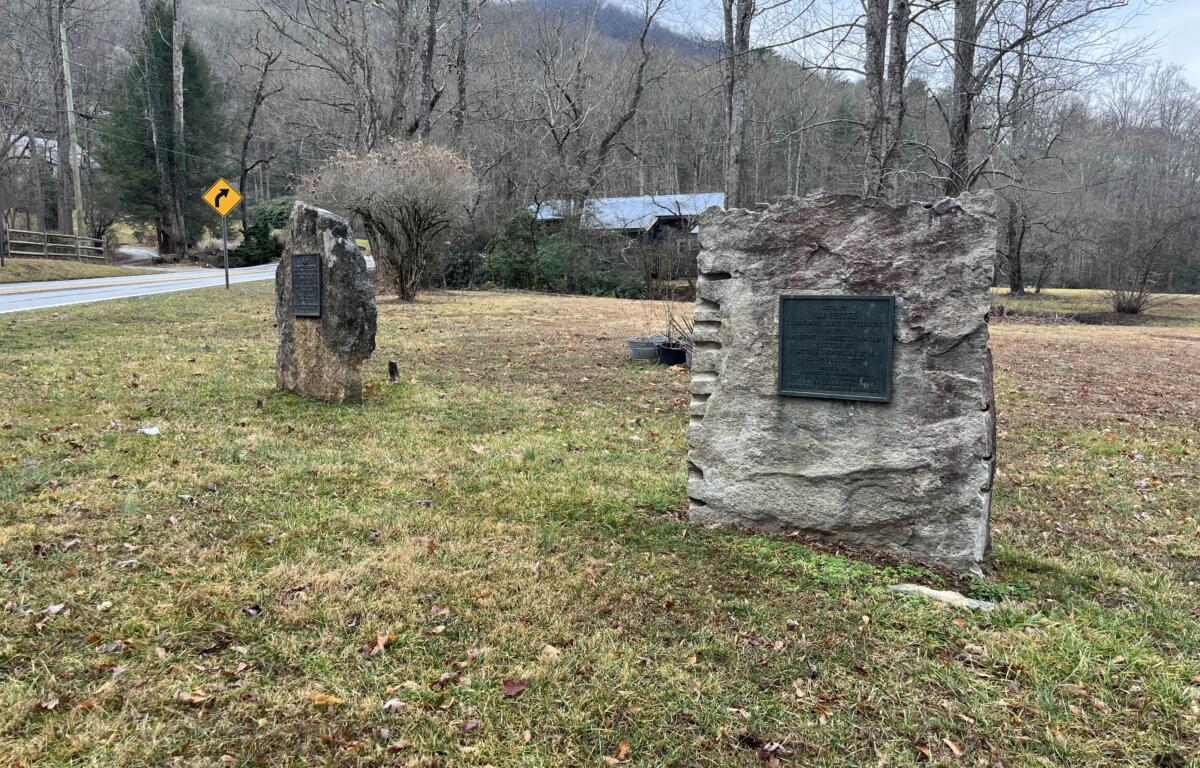
BREVARD, N.C. 828newsNOW — Along U.S. 276 south of Brevard, an aging historical marker makes a strange claim.
Bolted to a large boulder near the intersection of Greenville Highway and Walnut Hollow Road, the marker identifies the site of Conestee, a “legendary lost settlement” of the Cherokee. According to its inscription, British troops visited the settlement in 1725.
Then, in 1777, it disappeared.
There is history behind the settlement. What happened to the people who lived there is much harder to establish.
Cherokee tradition offers another explanation entirely.
They went into a mountain.
A village with many names
The settlement has been called Conestee, Kanasta and Kana’sta. It was located near present-day Connestee Falls, a few miles south of Brevard in Transylvania County.
Much of the legend that survives comes from ethnographer James Mooney, who spent years studying Cherokee culture and recording stories and traditions for the Smithsonian Institution’s Bureau of American Ethnology.
His 1900 work, “Myths of the Cherokee,” includes a story titled “Kana’sta, The Lost Settlement.”
And this is where the story of Kanasta gets strange.
The strangers who came to Kanasta
According to the story Mooney recorded, two strangers arrived in Kanasta and went to see the chief. They looked Cherokee, but claimed to live in a nearby town no one in Kanasta had ever seen. Their home, they said, was a place without the constant threat of war and enemies.
They brought a warning: A stronger enemy would eventually come and take the Cherokee country. Then they offered the people of Kanasta a way out.
The strangers pointed toward Tsuwa’telda, identified by Mooney as Pilot Knob, and invited the entire settlement to live with them.
There was one condition.
The people had to fast for seven days.
Kanasta’s leaders gathered the community and decided to go. On the seventh day, the strangers returned, and together they headed toward the mountain.
One visitor from another Cherokee town happened to be in Kanasta at the time, and agreed to go with them.
A town inside the mountain
When the group reached the mountain, their guides led them through what appeared to be a large cave opening.
Inside was an open country and a town with houses arranged in long rows. Homes had already been prepared for the people of Kanasta who moved in.
Their visitor, however, wanted to return home. The chief allowed him to leave so he could tell others what he had seen and escorted him back through the cave.
When the man turned around, the entrance was gone.
There was only solid rock.
Legend says the people of Kanasta were never seen again.
Mooney’s story detailed the legend which claimed they remained inside Tsuwa’telda. In another part of his work, Mooney described spirit people known as the Nunnehi, beings associated with mountains and hidden places who could appear human when they chose. Pilot Knob was among the places associated with them.
What does history tell us?
The historical marker near Brevard provides a timeline, saying British troops visited Conestee in 1725 and that the settlement disappeared in 1777.
What happened between those dates is less certain.
The residents could have joined another Cherokee community or moved elsewhere as warfare, disease and European settlement transformed the Southern Appalachians. A settlement disappearing from the historical record does not mean its people literally vanished.
But that isn’t the story that survived.
More than two centuries later, exactly what became of Kanasta remains uncertain.
The mountain isn’t telling.
-
Strangeville: Elvis, Asheville and a tiny Cherokee museum

Just off of Highway 19 on the way down to Cherokee, N.C., eagle-eyed drivers might spot the silhouette of Elvis Presley on the side of a small brown building. Inside, visitors will find the Elvis Museum, owned and curated by Dorothy “Dee” Smith.
-
Strangeville: Revolutionary War Ghosts of the Carolina Backcountry

Ahead of America 250, Revolutionary War folklore links Western North Carolina’s Overmountain Men to ghostly legends from the Battle of Kings Mountain.
-
Strangeville: Harry Gardiner, the ‘Human Fly’ Who Climbed Asheville’s Flat Iron Building
A century before viral stunts, Harry Gardiner drew crowds to downtown Asheville by scaling the Flat Iron Building without ropes — part spectacle, part fundraiser and part civic promotion.
-
Strangeville: Devil’s Den and the outlaw legends of Iron Mountain

On the North Carolina-Tennessee line, Devil’s Den became part of a darker mountain history shaped by moonshiners and outlaws.
-
Strangeville: Why Thomas Wolfe testified in a Yancey County murder trial
The Asheville author testified in a Yancey County murder trial after witnessing a Burnsville confrontation one week before a deadly shooting.