
Editor’s Note: Western North Carolina is rich with untold stories—many resting quietly in local cemeteries. In this Tombstone Tales series, we explore the lives of people from our region’s past whose legacies, whether widely known or nearly forgotten, helped shape the place we call home.
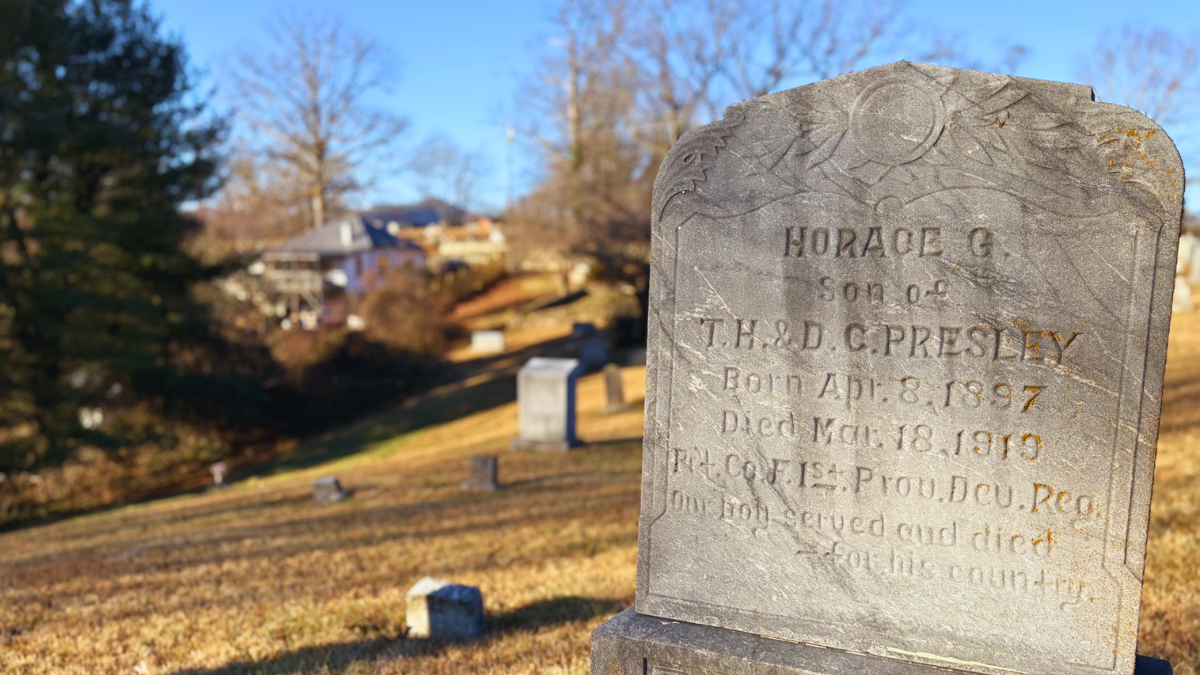
CANTON, N.C. 828newsNOW — On an old gravestone in Haywood County, a single sentence offers a clue to the short life and death of Horace Presley.
“Our boy served and died for his country.”
The inscription might suggest a young soldier killed on a European battlefield during World War I, but Presley never went overseas. He survived his brief time in the U.S. Army and returned home to Western North Carolina.
Less than four months after his discharge, he was dead.
Presley’s story unfolded far from the trenches, during a war in which disease posed its own deadly threat. His Army service coincided with the devastating fall wave of the 1918 influenza pandemic.
His family’s inscription speaks to a complicated question confronting the military and families during World War I: If a soldier became sick while serving and later died from that illness or its complications, had he died for his country?
A Haywood County man goes to war
Horace G. Presley was born April 8, 1897, the son of T.H. and D.C. Presley.
As a young man, he worked in Canton for Champion Fibre Company, the pulp and paper operation that employed generations of Western North Carolina residents.
Presley was inducted into the Army in Waynesville on Sept. 5, 1918. He and other selected men from Haywood County were sent that day to Camp Jackson, South Carolina.
Presley was assigned to the 156th Depot Brigade. His military career would last less than three months.
Influenza arrives at Camp Jackson
Presley arrived at Camp Jackson at a dangerous moment. The influenza pandemic was entering its most devastating period, and military installations were particularly vulnerable as large numbers of men lived and trained in close quarters.
Army medical histories date the beginning of Camp Jackson’s major influenza outbreak to Sept. 17, 1918. Presley had arrived just 12 days earlier.
The disease spread rapidly. By late November, officials had recorded 8,255 influenza cases and 412 deaths at Camp Jackson. The base hospital struggled with the influx of patients, and men from Presley’s 156th Depot Brigade were among those assigned to help during the emergency.
Presley remained at Camp Jackson until Nov. 30, 1918. He was honorably discharged and returned to Western North Carolina.
‘Following influenza’
Presley remained under the care of a physician until his death on March 18, 1919. He was 21 years old.
His death certificate reveals what happened after his return home. The physician described Presley’s tuberculosis as fatal, “following influenza.”
What did ‘line of duty’ mean?
Presley’s death came amid a broader debate within the U.S. military over what it meant for an illness, disability or death to occur “in line of duty.”
A soldier did not have to be struck by a bullet or shell to become a casualty of military service. Disease could disable or kill.
But determining whether an illness was connected to military service could be difficult. A soldier might enter the Army apparently healthy, become sick during service, recover enough to return to duty or be discharged, and later suffer serious complications.
The Army’s policies evolved during the war. By the summer of 1918, a soldier who passed his physical examination and was accepted as fit was generally presumed to have developed a subsequent disability in the line of duty unless evidence showed it existed before enlistment or resulted from misconduct.
Tuberculosis was among the diseases that complicated those determinations because it could exist without obvious symptoms and later become active.
The issue arose at Camp Jackson itself. Official Army medical history records detail the case of another private in the 1st Provisional Regiment, 156th Depot Brigade, Presley’s own brigade. The private developed pulmonary tuberculosis after entering the Army and later died.
Military officials disagreed over whether his death occurred in the line of duty. The case eventually reached the Judge Advocate General’s Office.
There is no known record showing that Presley’s death received such a formal review. But the question extended beyond military paperwork. Families across the country were confronting deaths from influenza, pneumonia, tuberculosis and other diseases during a war traditionally associated with battlefield casualties.
For those left behind, the question was more personal: Had he died because he went to war?
‘Our boy’
Presley was buried March 20 at Locust Field Cemetery in Haywood County.
His grave carries a government-issued military marker and a family monument.
On the family stone, his parents did more than record his military service. They connected it directly to his death:
“Our boy served and died for his country.”
The distinction is significant.
At a time when the Army itself was trying to define when disease and death were consequences of military service, Presley’s family carved its own answer into stone.
Their boy had served and died for his country.
-
Haunted Asheville and WNC: Ghost stories, eerie legends and mysterious places

From Asheville’s historic landmarks to mountain trails, old cemeteries and Appalachian folklore, explore the ghost stories and mysterious places that have become part of Western North Carolina’s history.
-
Tombstone Tales: Bascom Lamar Lunsford’s remarkable life

The Asheville lawyer, folklorist and festival organizer spent decades preserving Western North Carolina’s songs, dances and mountain traditions.
-
Tombstone Tales: A Fairview grave says James Brevard ‘became a seraph.’ Who was he?
Buried at Cane Creek Cemetery in 1847, the farmer, postmaster and state legislator left a public record that helps explain an extraordinary epitaph.
-
Tombstone Tales: The Reems Creek pitcher who played one game in the Major Leagues
Richard “Rome” Chambers became the first known Western North Carolina native to play Major League Baseball before returning home to Buncombe County, where he died just one day before his 27th birthday.
-
Tombstone Tales: A Revolutionary War veteran’s grave in Mitchell County tells a WNC story for July Fourth
At Kona Baptist Church Cemetery, a memorial to George Silver carries the story of American independence into the Toe River Valley and a family legacy deeply rooted in Western North Carolina.