


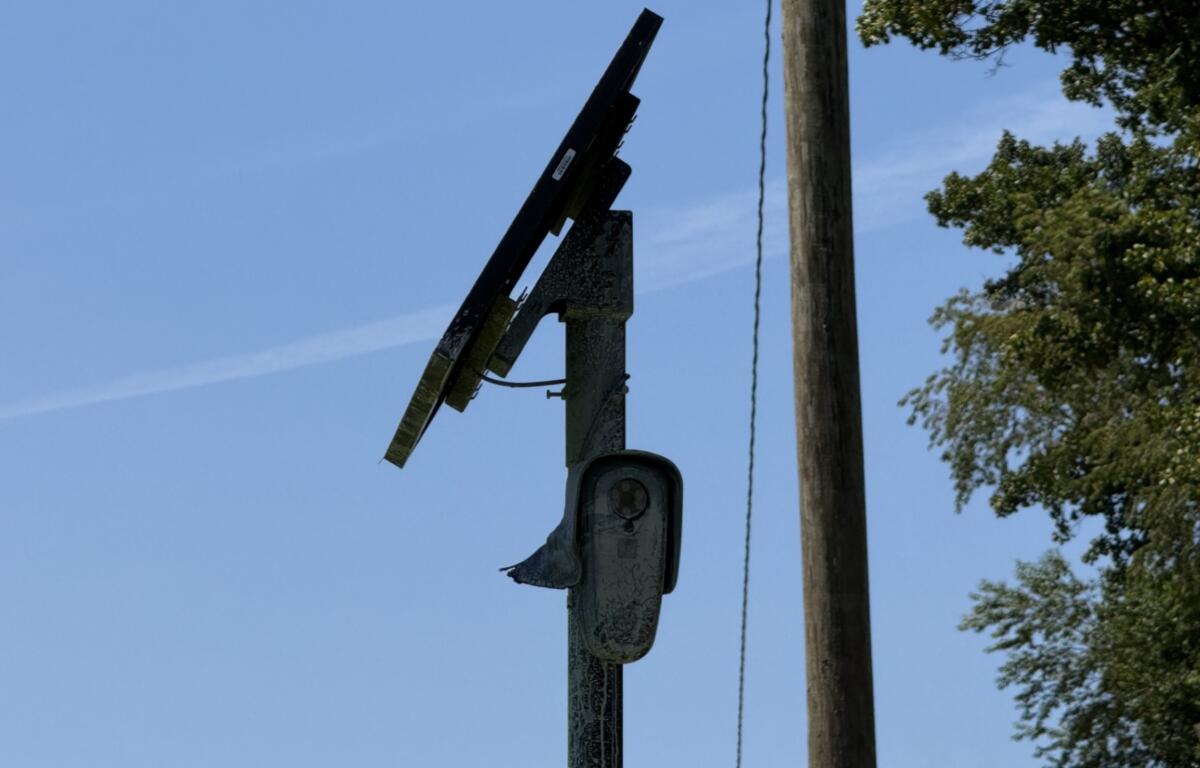

ASHEVILLE, N.C. (828newsNOW) — Asheville City Council voted 5-2 Wednesday to terminate the city’s contract with Flock Safety, ending the city’s use of 11 stationary automated license plate reader cameras.
The vote came during a marathon City Council meeting that lasted nearly five hours and followed extensive public comment from residents who urged council members to go beyond the Flock contract and reconsider Asheville’s broader use of automated license plate readers and surveillance technology.
The approved resolution calls for the immediate termination of the city’s contract with Flock Safety and requests removal of all associated hardware.
It also directs city employees to suspend access to, searching of and sharing of data collected through Flock technology, while ensuring existing data is handled according to legal and retention requirements.
The resolution further calls for a comprehensive review and the development of policy recommendations addressing the use, oversight and privacy safeguards of surveillance technology.
Residents say Flock is only part of the issue
While speakers generally supported ending the Flock contract, many said the vote does not go far enough.
The city’s 11 Flock cameras are stationary ALPRs. Residents repeatedly urged council to also reconsider the city’s separate Axon technology, including automated license plate readers and Fusus technology connected to the city’s Real-Time Intelligence Center.
“Canceling Flock while we quietly wave through a massive federally funded Axon surveillance dragnet” would be a bait and switch, said Jen Hampton, who identified herself as a member of Asheville Food and Beverage United and the Southern Workers Assembly.
“If Flock isn’t right for Asheville, then an identical mass surveillance web built by Axon isn’t right for us either,” Hampton said.
Rachel Cohen also urged council to reconsider Axon’s technology.
“The city should not use any nationally networked mass surveillance tools, including Axon ALPRs and Fusus-powered surveillance,” Cohen said.
Cohen said the city should require council approval before deploying ALPRs in the future.
Residents describe privacy and accuracy concerns
James Risner told council about an incident involving his husband and an ALPR system in the Atlanta area.
Risner said his husband was riding in an Uber or Lyft in mid-2025 when the vehicle was flagged by an automated license plate reader. He said police conducted a felony stop, pointed rifles at his husband and another passenger, a domestic violence victim, and detained them for about 30 minutes before releasing them.
Risner said the vehicle was associated with a domestic violence case and that outdated or incorrect title information contributed to the alert.
“I don’t really want to think about the alternative resolutions to that scenario,” Risner said.
Risner argued that ALPR systems can produce errors and said Asheville could explore alternatives that keep license plate information within a local network rather than sharing it with national databases.
He offered to help the city develop alternatives.
Other speakers also questioned the effectiveness of ALPR technology and whether it is appropriate to collect information on people who are not suspected of crimes.
Joel Shuman, who identified himself as a data scientist, said the expansion of surveillance technology is happening rapidly across the country.
“We are turning on mass surveillance around the nation and here in Asheville at unprecedented speed,” Shuman said.
Calls for more public oversight
Nina Tovish suggested the city revive the Citizens Police Advisory Commission, which she said has been inactive for years.
Tovish said an ongoing advisory group could give residents a place to discuss policing, surveillance and public safety before major technology decisions are made.
She said such a group could include residents with lived experience, professional expertise and community ties.
“It would have been an opportunity to consult and advise council on these matters,” Tovish said.
Tovish said the group also could provide accountability, oversight and transparency if the city continues using surveillance technologies.
Questions about Axon contract
Patrick Conan used the general public comment period to raise questions about the city’s Axon contract.
Conan said the city has released portions of the contract but not the company’s quote or price list showing the equipment included in the agreement.
He said releasing the document could help answer questions about whether the Axon agreement includes stationary ALPR equipment.
“I just want to encourage the city to consider making that quote available to the public,” Conan said.
Conan also praised the city for making more information about its surveillance programs available but said important information remains unavailable.
“The more information the city makes available to the public, the better conversations we can have,” he said.
Vote does not end Asheville’s ALPR debate
The Flock resolution specifically addresses Asheville’s contract with Flock Safety and the city’s 11 stationary cameras.
It does not, by itself, eliminate other ALPR technology available to Asheville police or prevent other entities from operating their own license plate readers.
That distinction became one of the central issues during public comment.
Several speakers said they viewed Wednesday’s vote as an important first step but urged council to address Axon’s technology and the city’s broader approach to surveillance.
Natasha Kittles said the concerns raised about Flock also apply to other companies that operate ALPR systems.
“The criticism of Flock applies to all for-profit ALPR systems including Flock’s competitor Axon,” Kittles said.
“We don’t want Axon ALPRs or mass surveillance either,” she said.
The approved resolution now directs the city to remove the Flock hardware, suspend access to the data and conduct a broader review before developing recommendations on the future use and oversight of surveillance technology.
The 5-2 vote ends Asheville’s Flock contract. The larger question of how the city uses ALPRs and other surveillance technology remains unresolved.